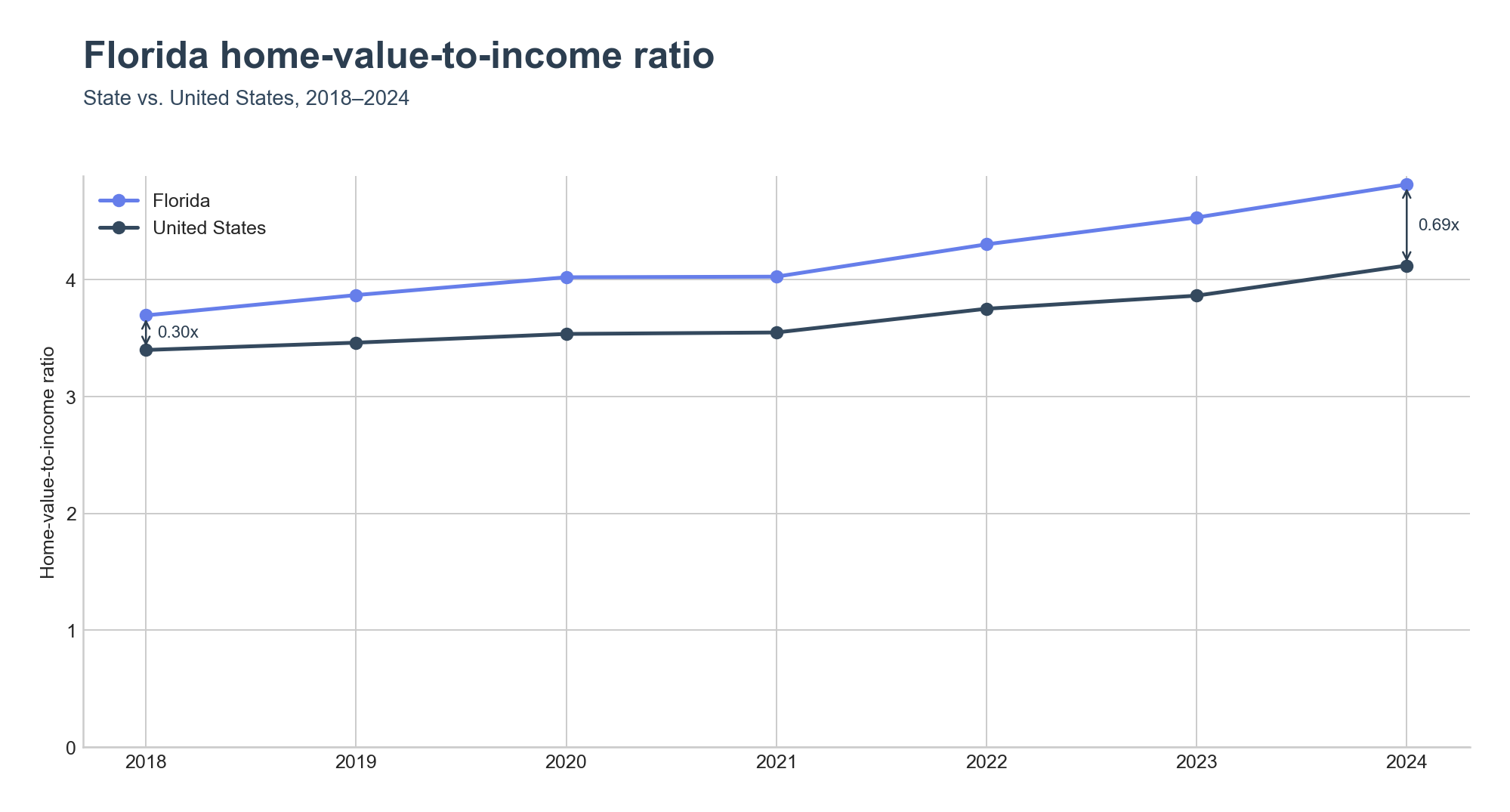
Florida ended 2024 with a home-value-to-income ratio of 4.81x, well above the United States figure of 4.12x. The gap was only 0.30x in 2018 and has more than doubled to 0.69x as Florida home values pulled away from incomes faster than the national pace.
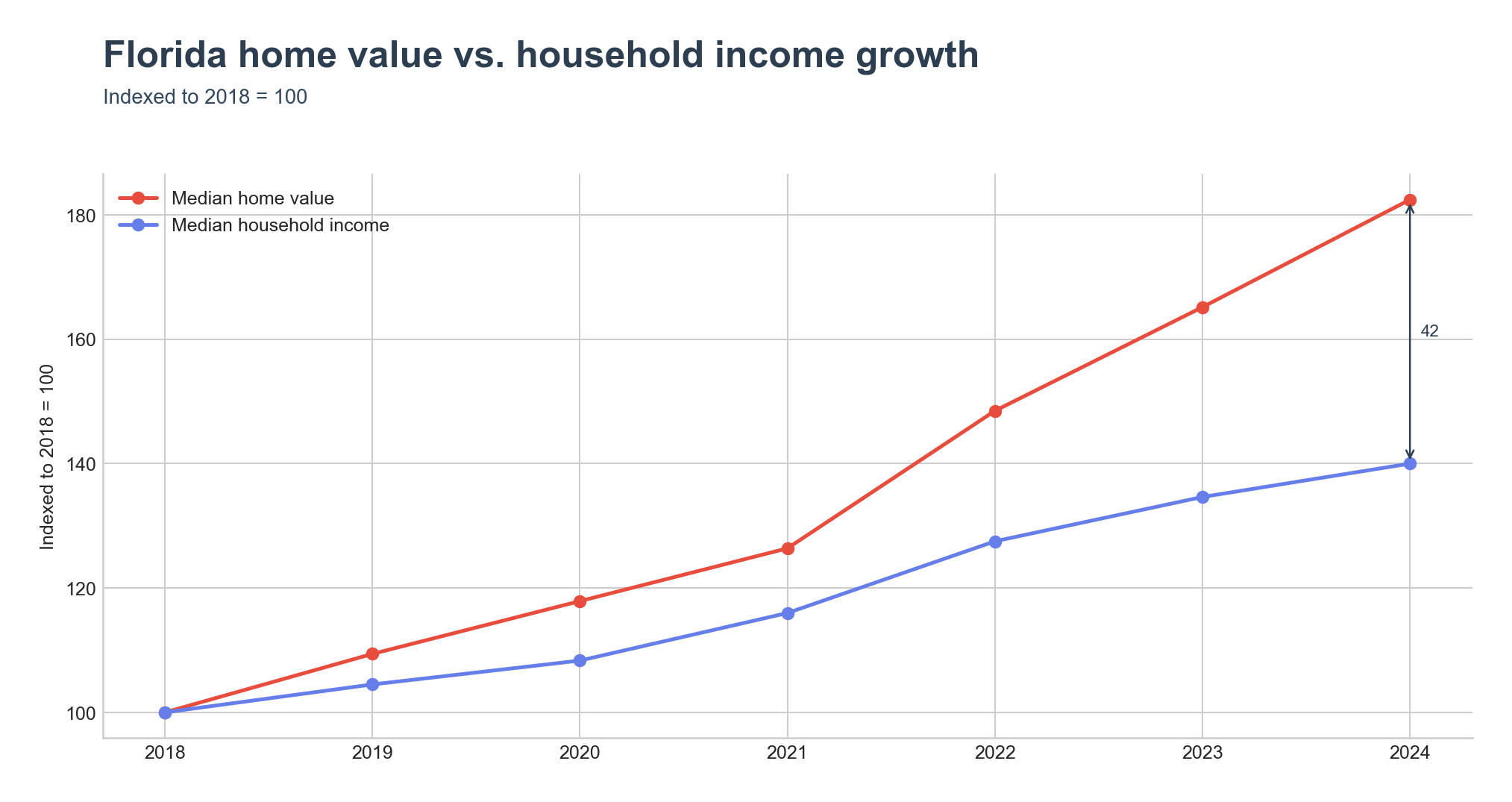
The component view shows the split. Indexed to 2018, the median Florida home value reached 182 by 2024 while median household income reached only 140 — a 42-point gap that opened almost entirely after 2020.
Where the ratio is highest
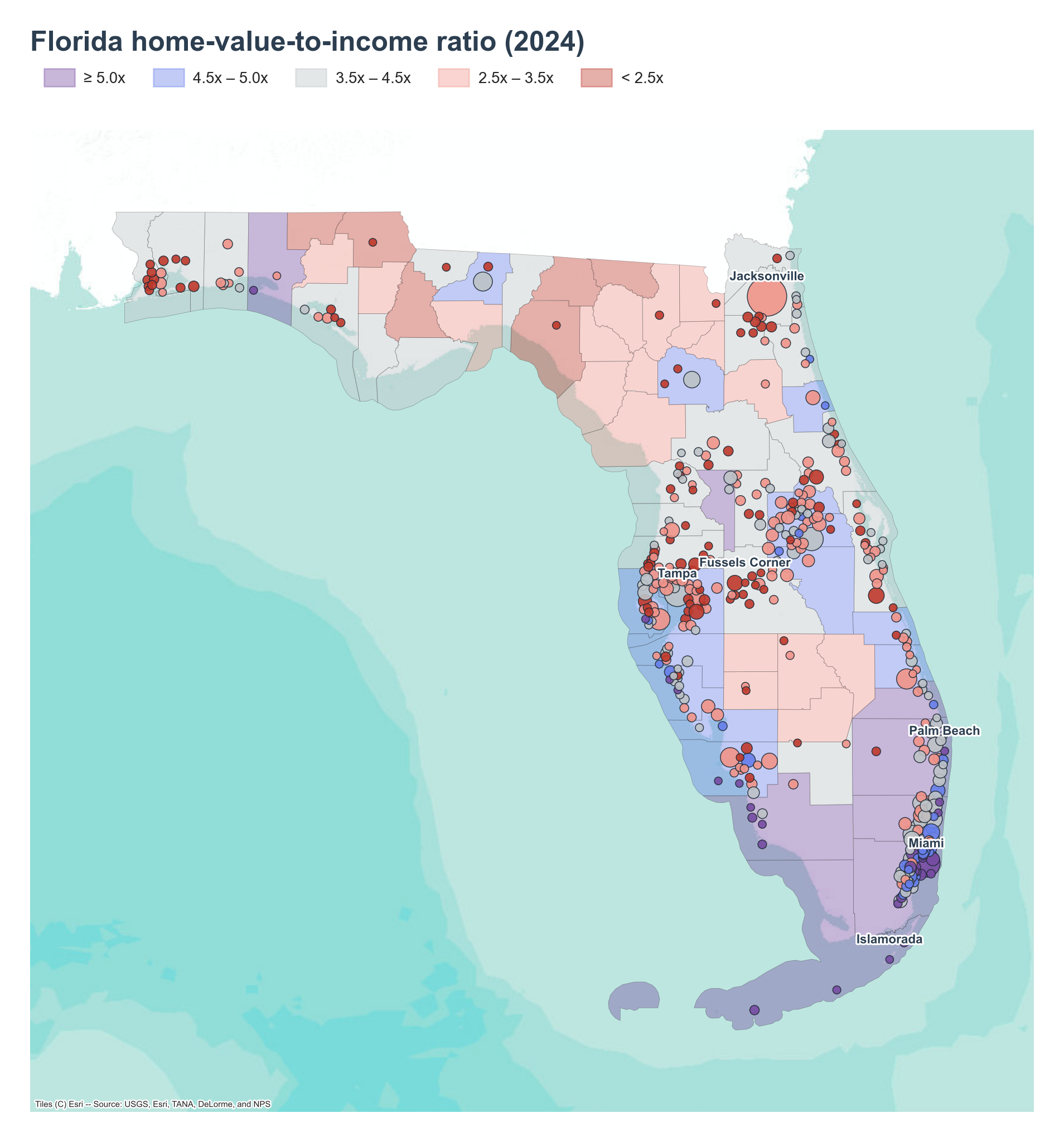
The top place is Palm Beach at 11.88x, the barrier-island resort town on the Atlantic coast in Palm Beach County, where a median home value of $2,000,001 sits against a median household income of $168,403. (The home value is at the ACS top-code, so the printed ratio is a floor.) Two of the next three places are in the Florida Keys : Islamorada at 10.54x and Key West at 9.79x, both island communities whose tourism-driven labor markets keep household incomes near the state average while waterfront constraints push home values past $850,000. Naples on the Gulf coast comes in at 9.96x, a longstanding retirement and second-home destination in Collier County.
The fifth top place — Leisure City at 8.94x — sits in south Miami-Dade near Homestead. The pattern is different: a $375,100 home value against a $41,977 income reflects Miami-area housing inflation reaching a lower-income community rather than a wealth enclave.
The county map confirms the same geography. Monroe (8.90x, the Keys), Miami-Dade (6.45x), Collier (6.00x), Palm Beach (5.35x), and Broward (5.34x) form a continuous South Florida block that the choropleth renders in the darkest shade across the southern third of the peninsula.
Where the ratio is lowest
The bottom of the place ranking lands in two distinct regions. Three of the five lowest are clustered around Zephyrhills in Pasco County north of Tampa — Zephyrhills South (1.17x), Zephyrhills West (1.75x), and the nearby Fussels Corner (1.64x) and Inwood (2.56x) in Polk County. These are central Florida communities with large manufactured-housing and retiree populations whose home values stayed under $150,000 even in 2024. The remaining bottom place, Marianna at 2.44x, sits in Jackson County in the Panhandle.
The county ranking is entirely a rural North Florida and Panhandle pattern: Liberty (2.17x), Hamilton (2.22x), Holmes (2.23x), Taylor (2.34x), and Madison (2.40x) all sit along the Georgia border or the Big Bend Gulf coast, with home values between $110,000 and $130,000.
How the distribution shifted
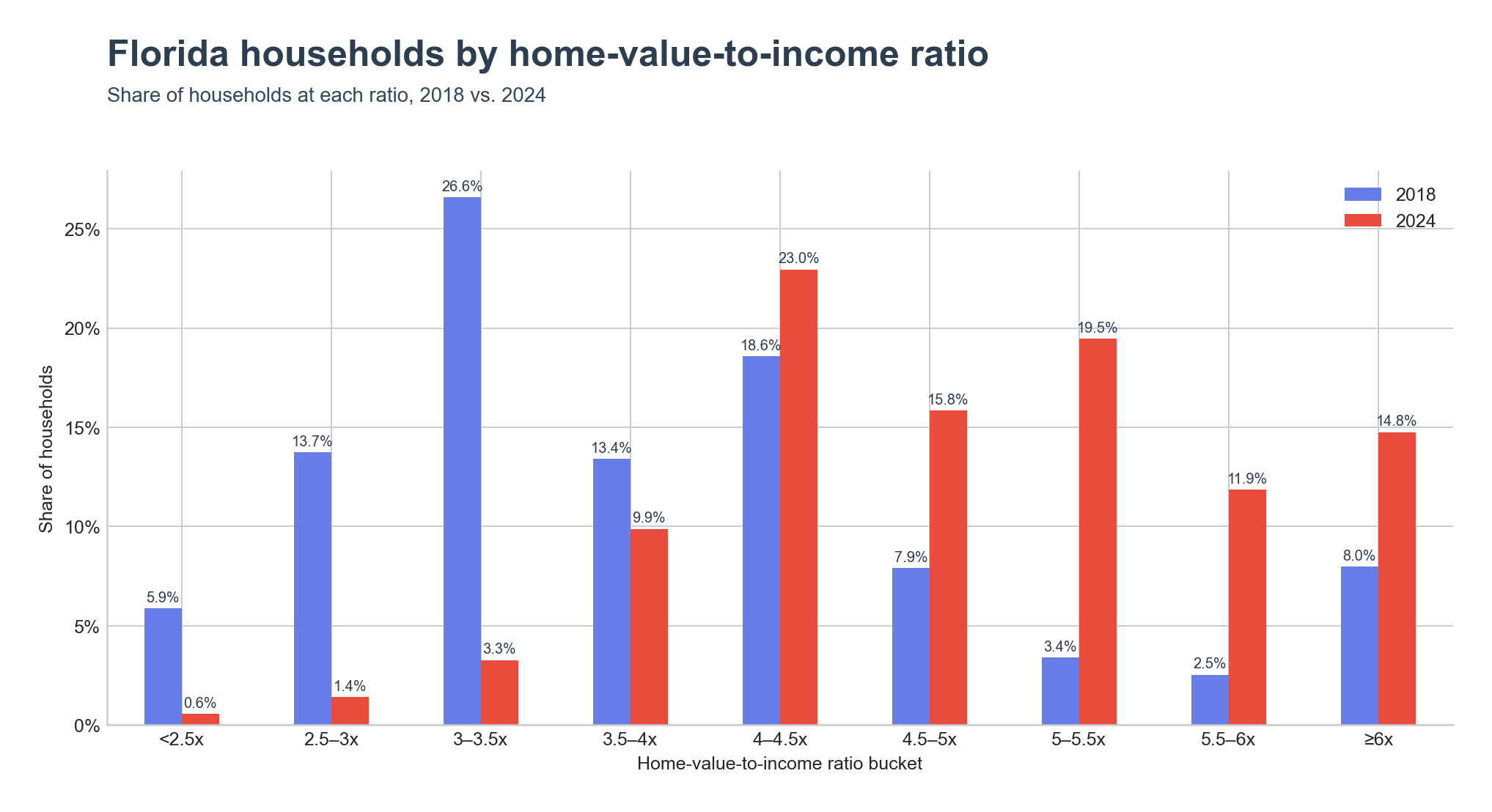
Florida's place-level distribution moved up by roughly two buckets between 2018 and 2024. Households living in places under 3.5x collapsed from 46.2% to 5.3%. The 4–4.5x bucket grew from 18.6% to 23.0% and the 4.5–5x bucket doubled from 7.9% to 15.8%. The shift above 5x is the sharpest: from 13.9% of households in 2018 to 46.2% in 2024, with the ≥6x bucket alone rising from 8.0% to 14.8%.
Key Takeaways
- Florida is now 0.69x above the United States on the home-value-to-income ratio, up from 0.30x in 2018.
- Median home values grew 82% since 2018 against 40% for median household income, a 42-point index gap.
- South Florida and the Keys — Monroe, Miami-Dade, Collier, Palm Beach, and Broward counties — concentrate the highest ratios in the state.
- The rural Panhandle and Big Bend counties remain the most affordable, with five counties under 2.4x.
- Florida households living in places at 5x or higher went from 13.9% in 2018 to 46.2% in 2024.