The San Francisco–Oakland–Fremont metro houses 4.6M people (per 2024 ACS 5-year Estimates ) with a median household income of $136K, a median home value of $1.1M, a median age of 40, and a bachelor's-degree share of 53% among adults 25+. The neighborhood-level view below covers 3.9M residents living inside the metro's urbanized areas — about 84% of the metro total. Wealth runs in a wishbone: one prong down the Peninsula from San Francisco through San Mateo, another north into Marin, and a third east into the Lamorinda–Tri-Valley hills. Lower values pool in the inner East Bay flatlands and out at the far eastern edge near Antioch and Pittsburg.
Median home value
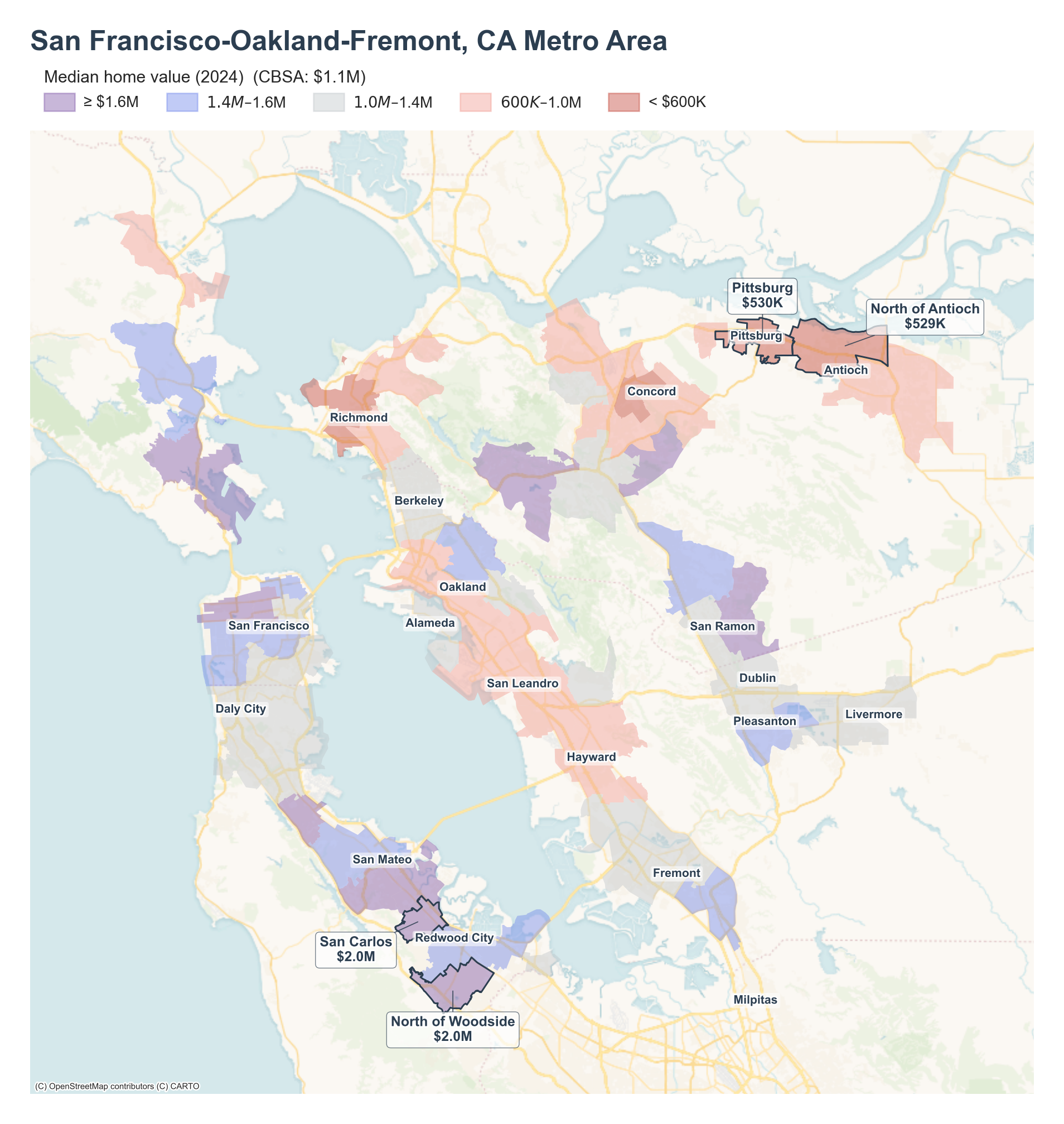
The cluster around North of Woodside tops the metro at $2.0M, matched almost exactly by the cluster around San Carlos at $2.0M — both sit on the mid-Peninsula spine of San Mateo County, where large-lot zoning and proximity to Sand Hill Road wealth keep prices at the top of the scale. The cluster around North of Antioch anchors the bottom at $529K, with the cluster around Pittsburg right behind at $530K, both at the metro's far-eastern Delta edge. Between those poles, the high band continues with the cluster around South of Millbrae ($1.9M), the cluster around North of Mill Valley ($1.8M), and the cluster around South of San Mateo ($1.8M) — a near-continuous chain from southern Marin through the Peninsula. The low band runs through inner East Bay neighborhoods — the cluster around South Richmond ($555K), the cluster around Concord ($578K), and the cluster around East of Richmond ($590K) — well under the $1.1M metro median.
Median household income
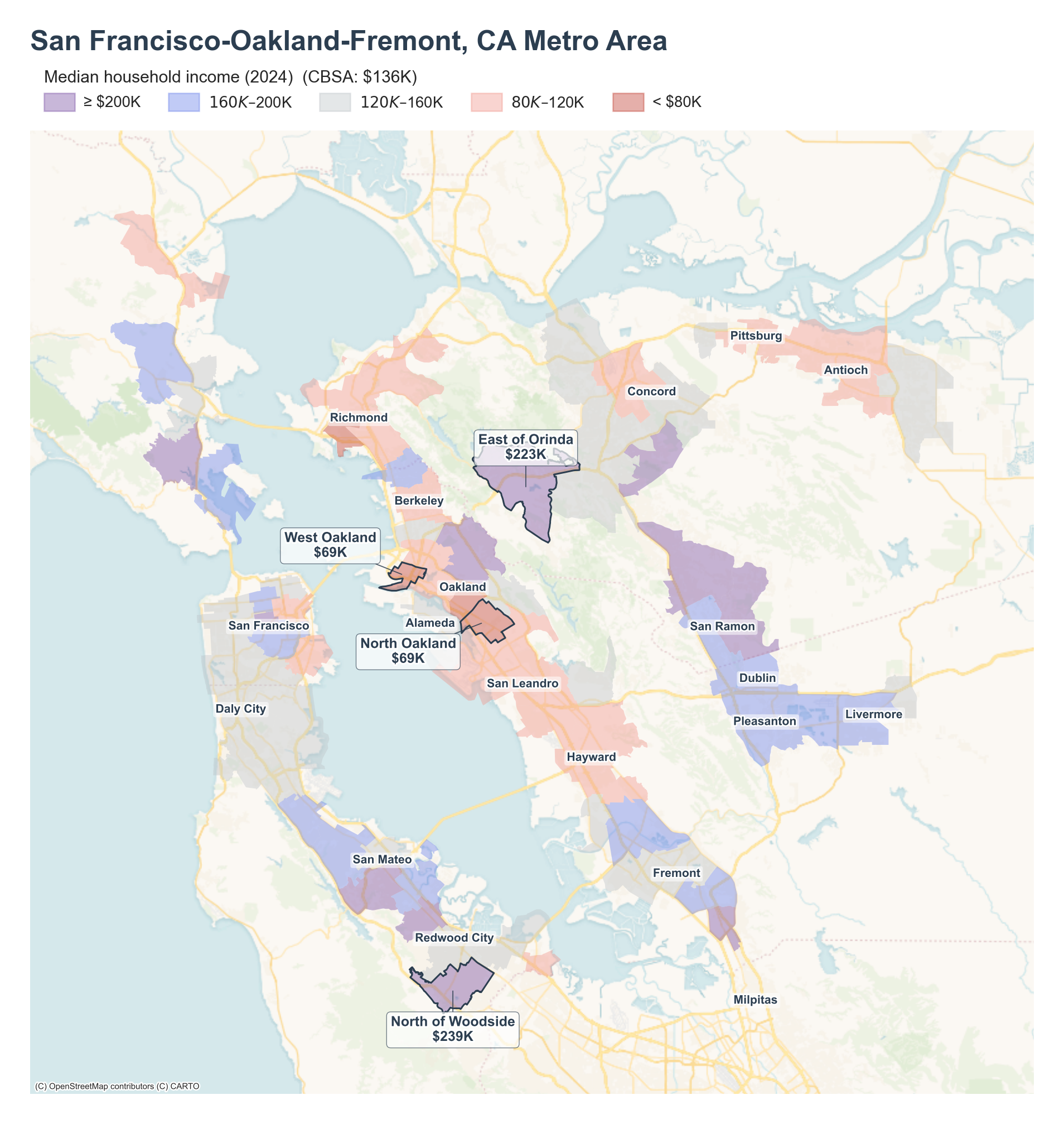
The cluster around North of Woodside leads at $239K, followed by the cluster around East of Orinda at $223K — Orinda sits in the Lamorinda group of East Bay hill towns long ranked among the wealthiest small cities in California. The cluster around West Oakland comes in lowest at $69K, just under the cluster around North Oakland at $69K. The high band extends through the cluster around San Carlos ($219K), the cluster around North of San Ramon ($218K), and the cluster around East of Danville ($216K), tracing the Peninsula and the I-680 Tri-Valley corridor. Low-income neighborhoods cluster tightly in the inner East Bay flatlands — the cluster around North Oakland appears twice ($69K and $74K), with the cluster around South Richmond at $72K and the cluster around North of Antioch at $80K rounding out the bottom group.
Median age
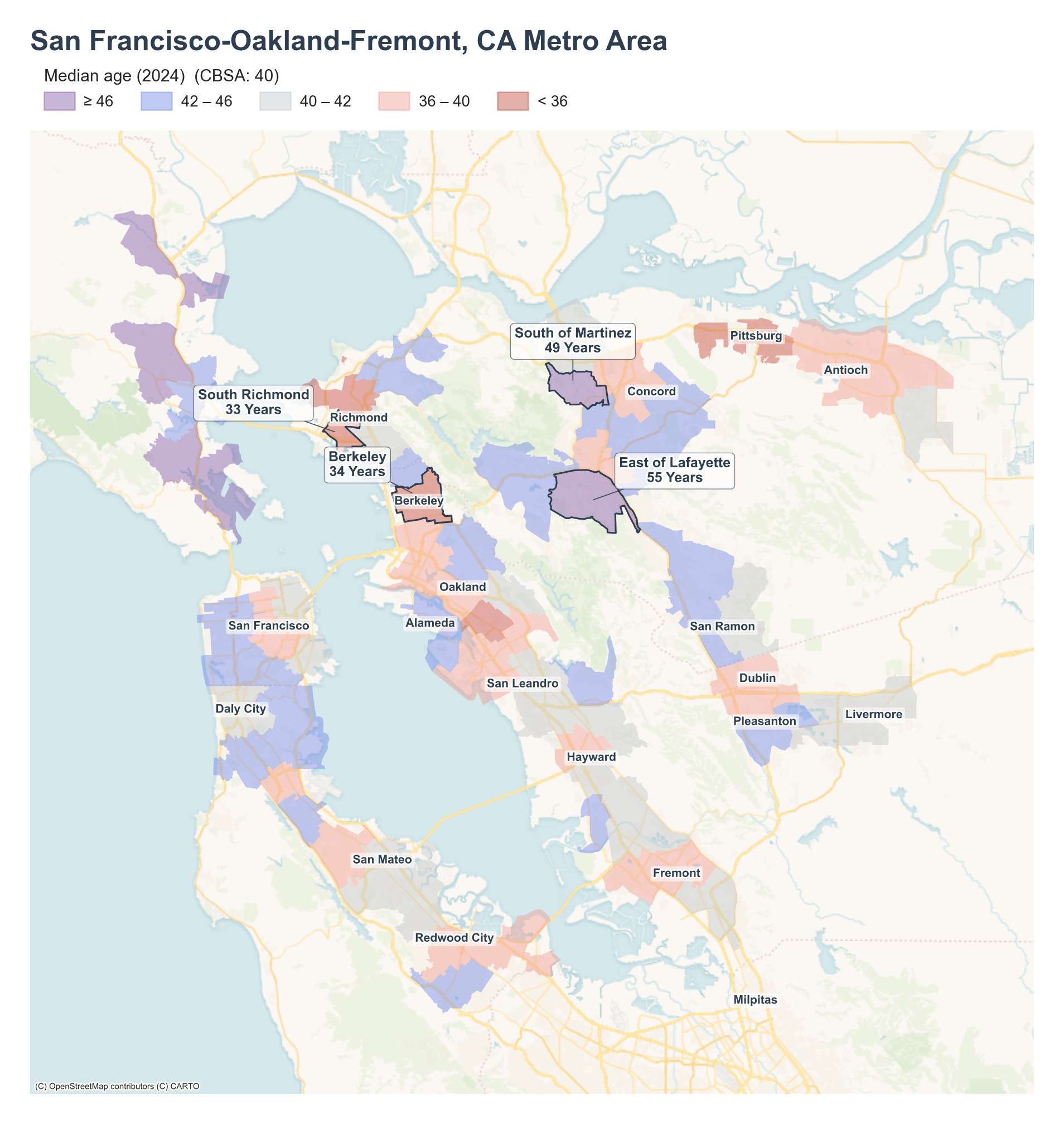
The cluster around East of Lafayette is the oldest at 55, with the cluster around South of Martinez at 49 and the clusters around North of Belvedere and West of San Rafael both near 48 — all aging, low-density East Bay and Marin enclaves where family turnover has slowed. The cluster around Berkeley is the youngest at 34, pulled down by the student population around UC Berkeley. The cluster around South Richmond (33), the cluster around West of Pittsburg (35), the cluster around North Oakland (35), and the cluster around Pittsburg (35) form the rest of the young end — a mix of inner East Bay neighborhoods and the eastern Delta edge. Most of the metro sits between 36 and 46, close to the metro median of 40.
Adults 25+ with a bachelor's degree
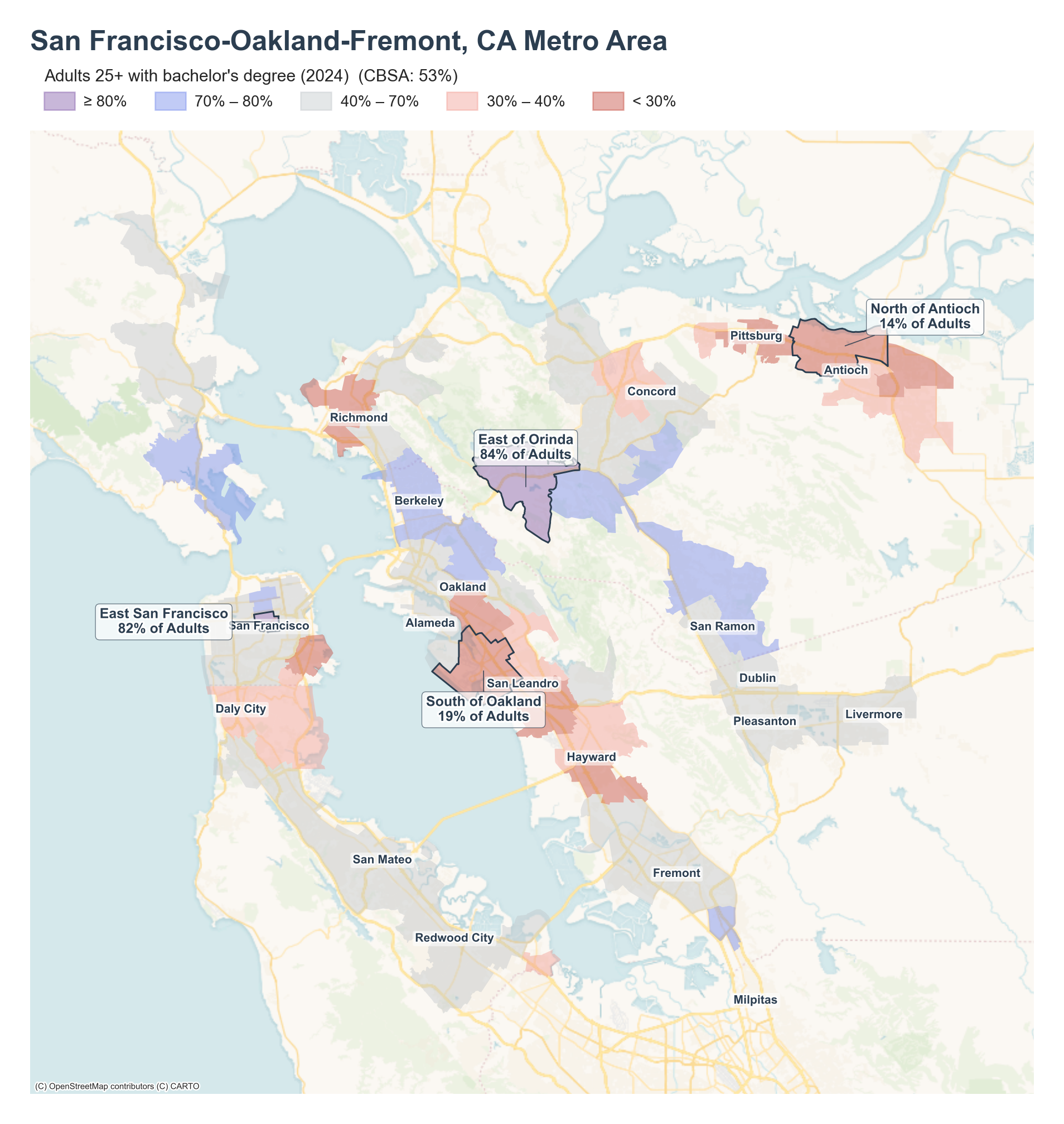
The cluster around East of Orinda is the most credentialed at 84%, followed by the cluster around East San Francisco at 82% and the cluster around North of Mill Valley at 78%. The cluster around North of Antioch sits at the bottom at 14%, a far-eastern Delta neighborhood whose workforce skews toward trades, logistics, and service work tied to the Delta and the I-4 corridor. The high band continues with the cluster around East of Albany (79%) and the cluster around North of Oakland (79%) — both in the Berkeley-adjacent hills. The low band picks up the cluster around South Richmond (19%), the cluster around Pittsburg (19%), the cluster around East of Richmond (19%), and the cluster around South of Oakland (19%), all well under the 53% metro share.
Where the metrics overlap
The cluster around North of Woodside is the single most concentrated high — top in both home value and household income — while the cluster around East of Orinda pairs the metro's highest income with its highest degree share. The cluster around North of Mill Valley sits high on home value, age, and degree share at once, the clearest example of older, credentialed wealth holding the north end of the wishbone. At the opposite end, the cluster around South Richmond is bottom in all four metrics simultaneously, and the cluster around North of Antioch is bottom in three (home value, income, degree share). Where the metrics diverge: the cluster around Berkeley reads young but not low-income, and the cluster around North Oakland reads young and low-income but not low-degree — a different profile from the eastern Delta clusters that share the income or degree-share bottom.
Key Takeaways
- The cluster around North of Woodside leads the metro on home value ($2.0M) and household income ($239K).
- High home values trace a wishbone from southern Marin down the Peninsula and east into the Lamorinda–Tri-Valley hills.
- The cluster around South Richmond is bottom-ranked across all four metrics — home value, income, age, and degree share.
- The far-eastern Delta clusters around Antioch and Pittsburg sit at the bottom on home value (~$530K) and degree share (14–19%).
- The cluster around East of Lafayette is the oldest at 55; the cluster around Berkeley is the youngest at 34.
- The cluster around East of Orinda pairs the highest household income ($223K) with the highest degree share (84%).