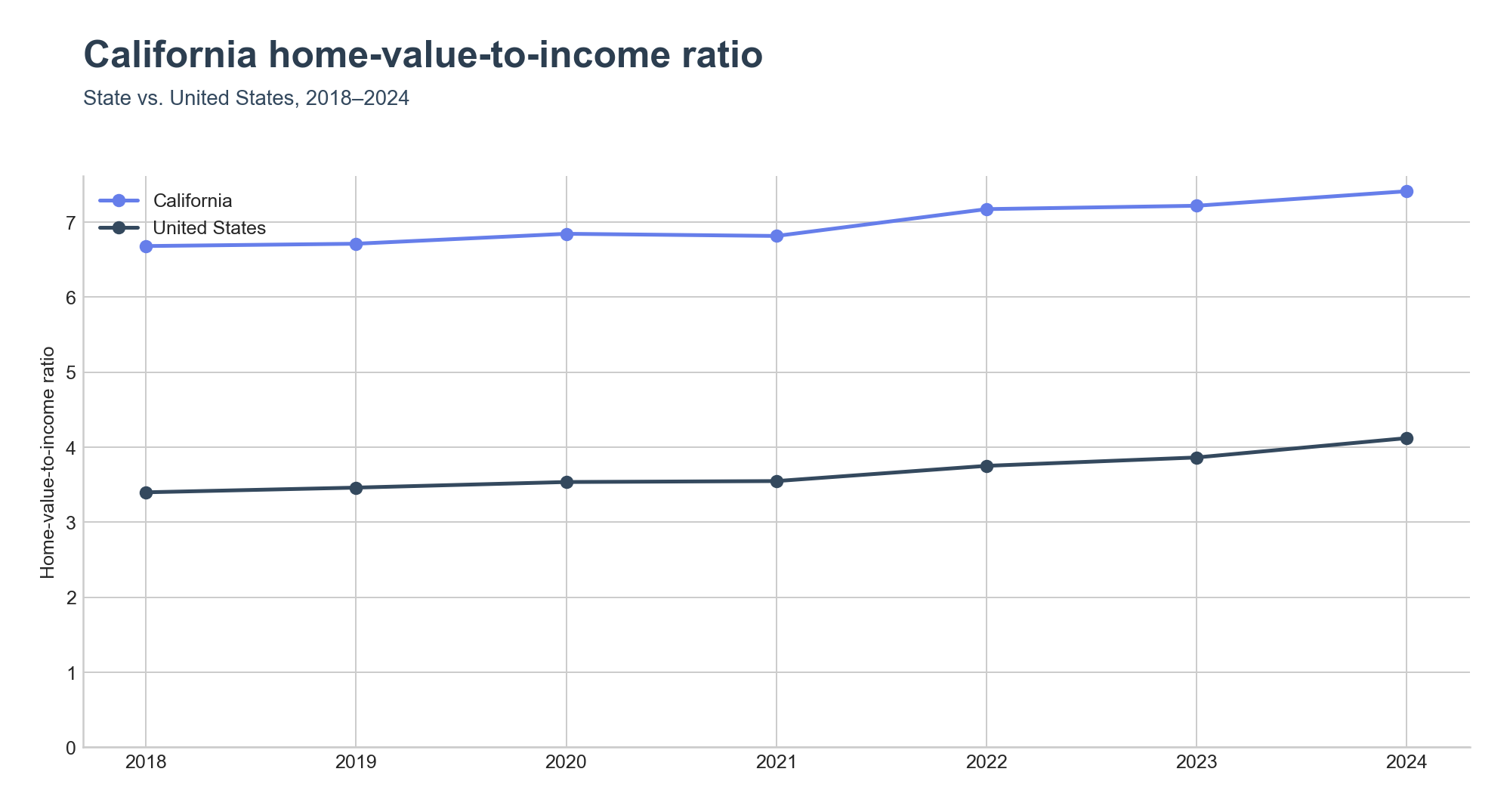
California sits roughly 1.8x above the U.S. and has stayed there.
California's statewide home-value-to-income ratio reached 7.41x in 2024, up from 6.68x in 2018. The United States moved from 3.40x to 4.12x over the same window. California started 3.28x above the national ratio and ended 3.29x above — a gap that has barely moved in absolute terms because the state's +0.73x climb tracked the national +0.72x almost exactly. The bigger change happened in 2021–2022, when both lines stepped up together and California's ratio jumped from 6.82x to 7.17x.
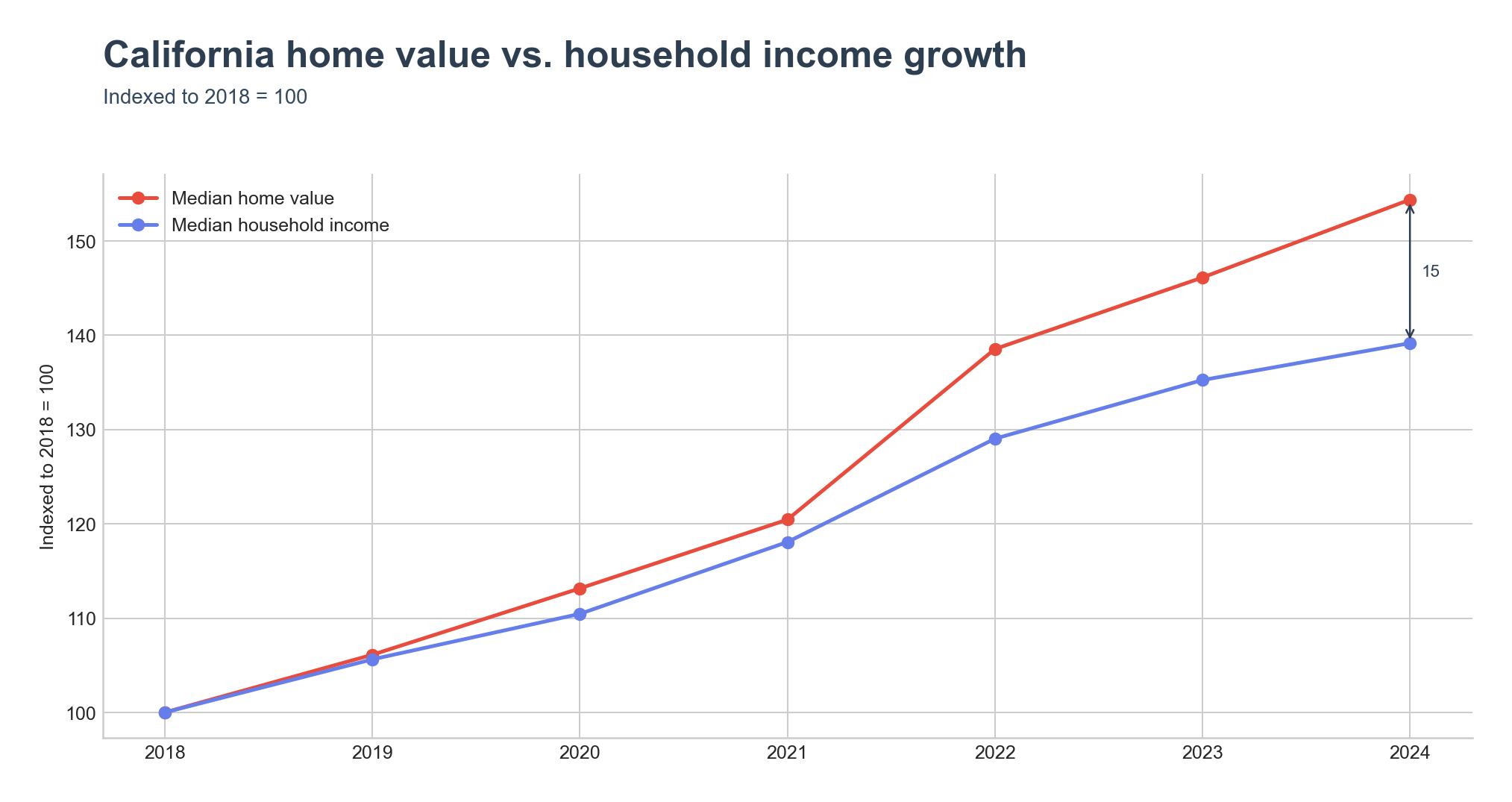
Home values rose 54% while incomes rose 39%.
Indexed to 2018 = 100, California's median home value reached 154 by 2024 while median household income reached 139 — a 15-point gap. The typical California home went from $475,900 to $734,700 (a +54% move) while median household income rose from $71,228 to $99,122 (a +39% move). The two series tracked each other through 2020 and split decisively from 2021 onward.
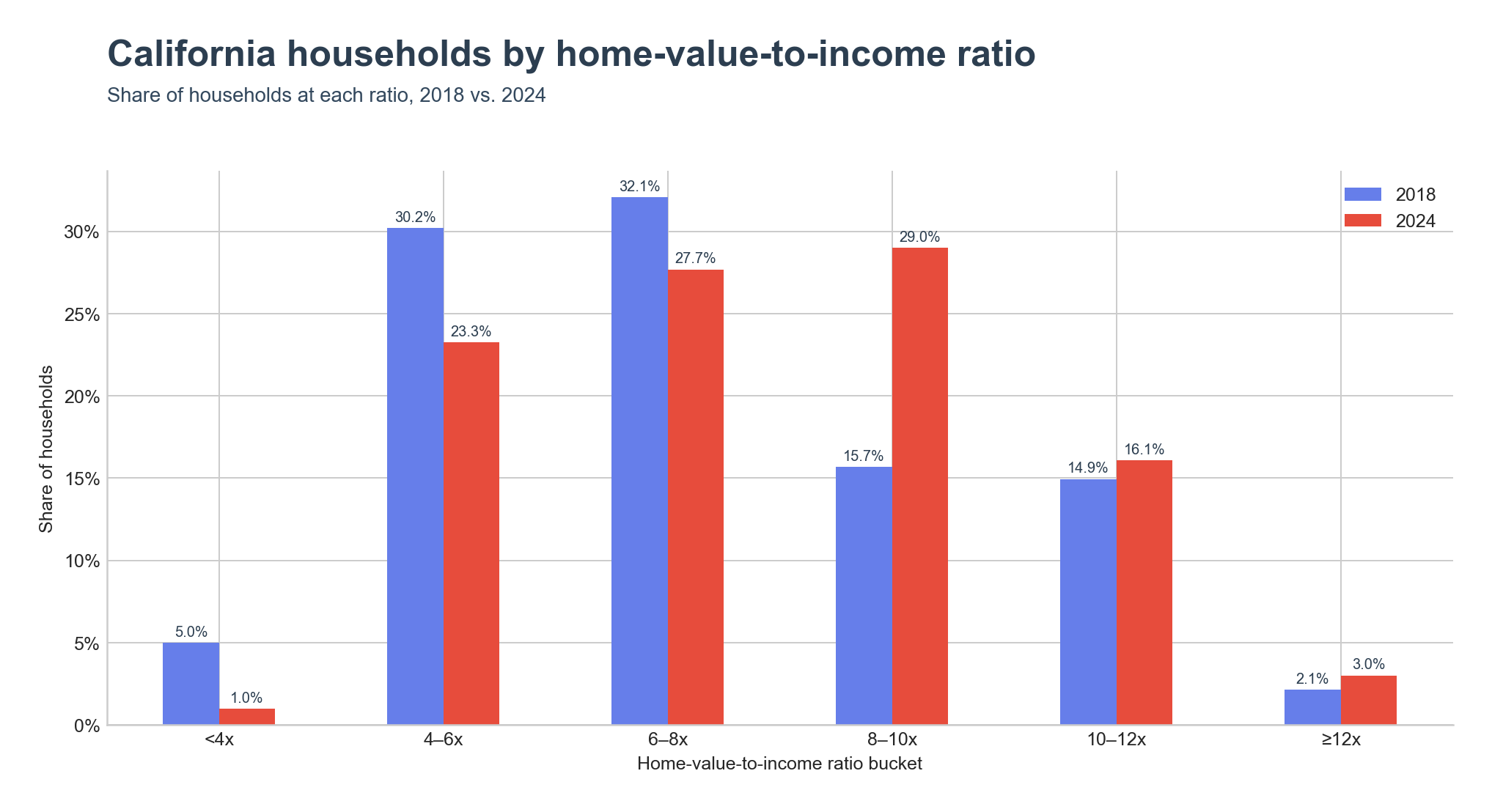
The 8–10x bucket nearly doubled.
In 2018, 32.7% of California households lived in places at 8x or higher. By 2024 that share was 48.1%. The biggest movement was the 8–10x bucket, which jumped from 15.7% to 29.0% as the 4–6x and 6–8x buckets each gave up around three to four points. The <4x bucket nearly emptied, falling from 5.0% to 1.0%, and the ≥12x bucket grew from 2.1% to 3.0%.
High ratios concentrate on the coast from Marin to Santa Cruz and across coastal Southern California; low ratios sit in the far northeast and the southern Central Valley.
The county map runs cool along the coast and warm through the interior. Marin County tops the state at 10.11x on a median home value of $1,507,300 against a median household income of $149,091. San Francisco County sits right behind at 9.89x and San Mateo County at 9.82x — the three Bay Area counties on the west side of the bay all carry home values around $1.4M–$1.6M against six-figure incomes. Los Angeles County at 9.26x and Santa Cruz County at 9.25x round out the top five, extending the high-ratio band down the central and southern coast.
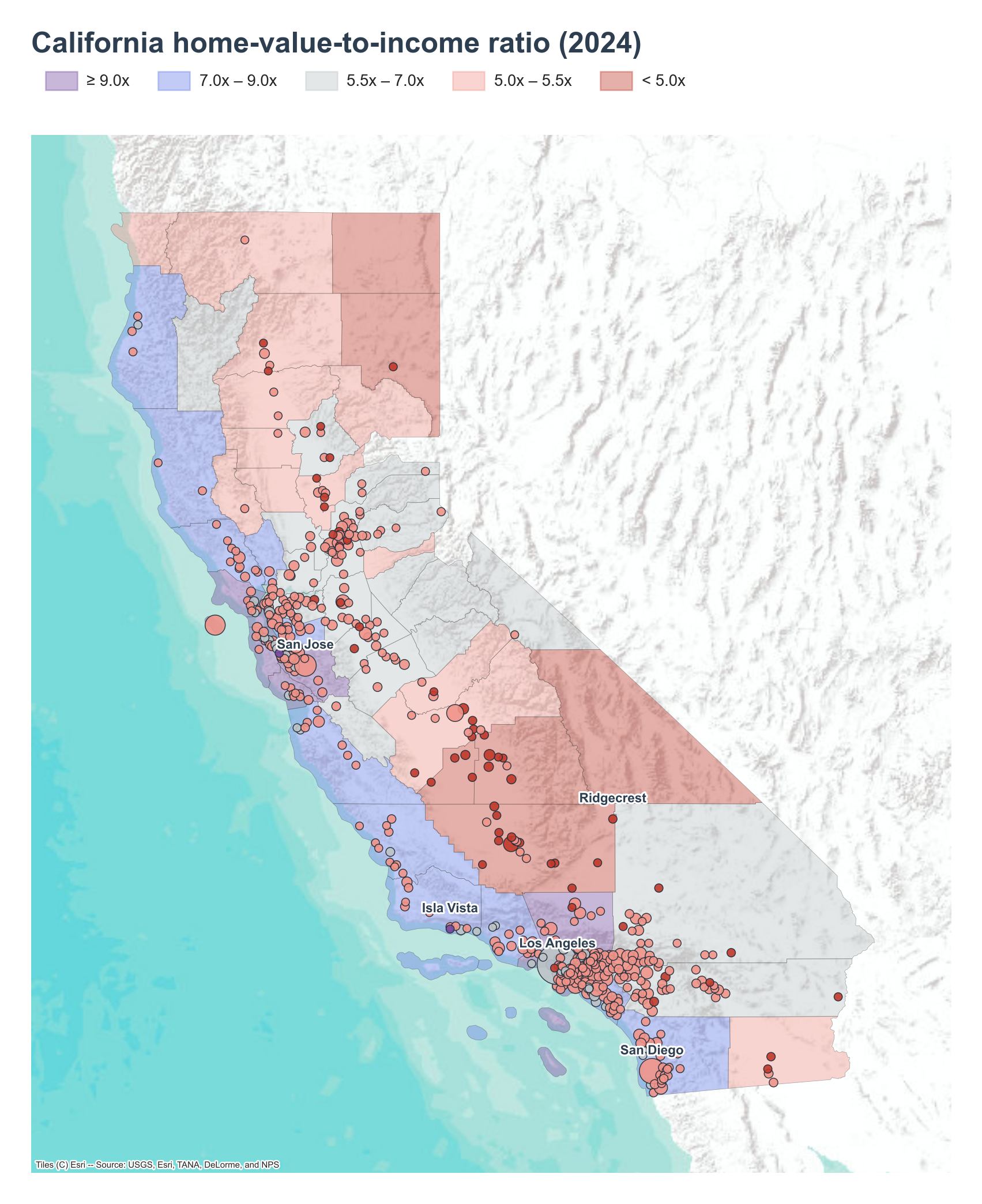
The bottom of the county distribution is the northeastern corner and the southern Central Valley. Modoc County at 3.78x is the state's northeastern-most county, a sparsely populated high-desert ranching area. Lassen County at 3.94x sits just to its south and houses two state prisons that anchor local employment. Kings County at 4.57x and Tulare County at 4.63x are southern San Joaquin Valley agricultural counties, and Inyo County at 4.71x runs along the eastern side of the Sierra Nevada from the Owens Valley up toward Mono.
Place rankings are dominated by university towns and coastal wealth on top, and military/oil/desert communities on the bottom.
Isla Vista leads the state at 46.93x — the unincorporated community immediately adjacent to UC Santa Barbara has a median home value of $1,218,800 sitting on a student-driven median household income of just $25,972, which is what produces the extreme ratio. Stanford at 26.59x is the same pattern at a different scale: the on-campus residential community has a median home value reported at $2,000,001 (the Census top-code) against a $75,208 median household income skewed by graduate-student housing. Santa Monica at 15.28x, Beverly Hills at 15.04x, and Coronado at 14.87x round out the top five — the two Los Angeles–area coastal cities both top-coded at $2,000,001, and Coronado's island-and-peninsula setting across San Diego Bay carries a $2,000,001 median home value against a $134,534 median household income. The top five split into two patterns: university-driven low-income denominators (Isla Vista, Stanford) and coastal Southern California wealth (Santa Monica, Beverly Hills, Coronado).
The bottom five are mostly inland communities with employment that holds incomes up against modest housing stock. Ridgecrest at 2.84x sits in the Indian Wells Valley in Kern County alongside Naval Air Weapons Station China Lake , where federal civilian and contractor employment supports an $89,250 median household income against a $253,900 median home value. Marina del Rey at 3.13x is the outlier in this group — the Los Angeles County coastal community has a high $146,623 median household income and a relatively modest $458,800 median home value, a function of its condominium-heavy housing mix. Taft at 3.47x is a Kern County oil town in the Midway-Sunset field, and Coalinga at 3.48x is a Fresno County oil-and-state-institutional town. Thousand Palms at 3.49x is an unincorporated Coachella Valley community in Riverside County.
Key Takeaways
- California's home-value-to-income ratio reached 7.41x in 2024, 3.29x above the U.S. 4.12x.
- The state rose +0.73x since 2018, almost exactly matching the national +0.72x, with most of the move concentrated in 2021–2022.
- Median home value grew 54% ($475,900 → $734,700) while median household income grew 39% ($71,228 → $99,122).
- The share of Californians living in places at 8x or higher went from 32.7% in 2018 to 48.1% in 2024, driven almost entirely by the 8–10x bucket nearly doubling from 15.7% to 29.0%.
- High ratios concentrate in the west-bay Bay Area (Marin, San Francisco, San Mateo) and the coastal Los Angeles–Santa Cruz band, with extreme place-level ratios at university communities (Isla Vista, Stanford) and coastal wealth enclaves (Santa Monica, Beverly Hills, Coronado).
- Low ratios sit in the far-northeastern counties (Modoc, Lassen), the southern San Joaquin Valley (Kings, Tulare), and the eastern Sierra (Inyo), with the lowest place ratios at military, oil, and desert communities (Ridgecrest, Taft, Coalinga, Thousand Palms) plus condo-heavy Marina del Rey.