The Los Angeles–Long Beach–Anaheim metro holds 12.97M residents (per 2024 ACS 5-year Estimates ) with a median household income of $96K, a median home value of $871K, a median age of 38, and 38% of adults 25+ holding a bachelor's degree. The analysis below groups neighborhoods within the metro's urbanized areas and covers 12.19M of the metro's 12.97M residents. The maps show a coastal wedge from West Los Angeles south through the Palos Verdes peninsula into south Orange County sitting at the top of every metric, while a contiguous inland band running from central Los Angeles east through the San Gabriel Valley to the Pomona–Ontario edge sits near the bottom.
Median home value
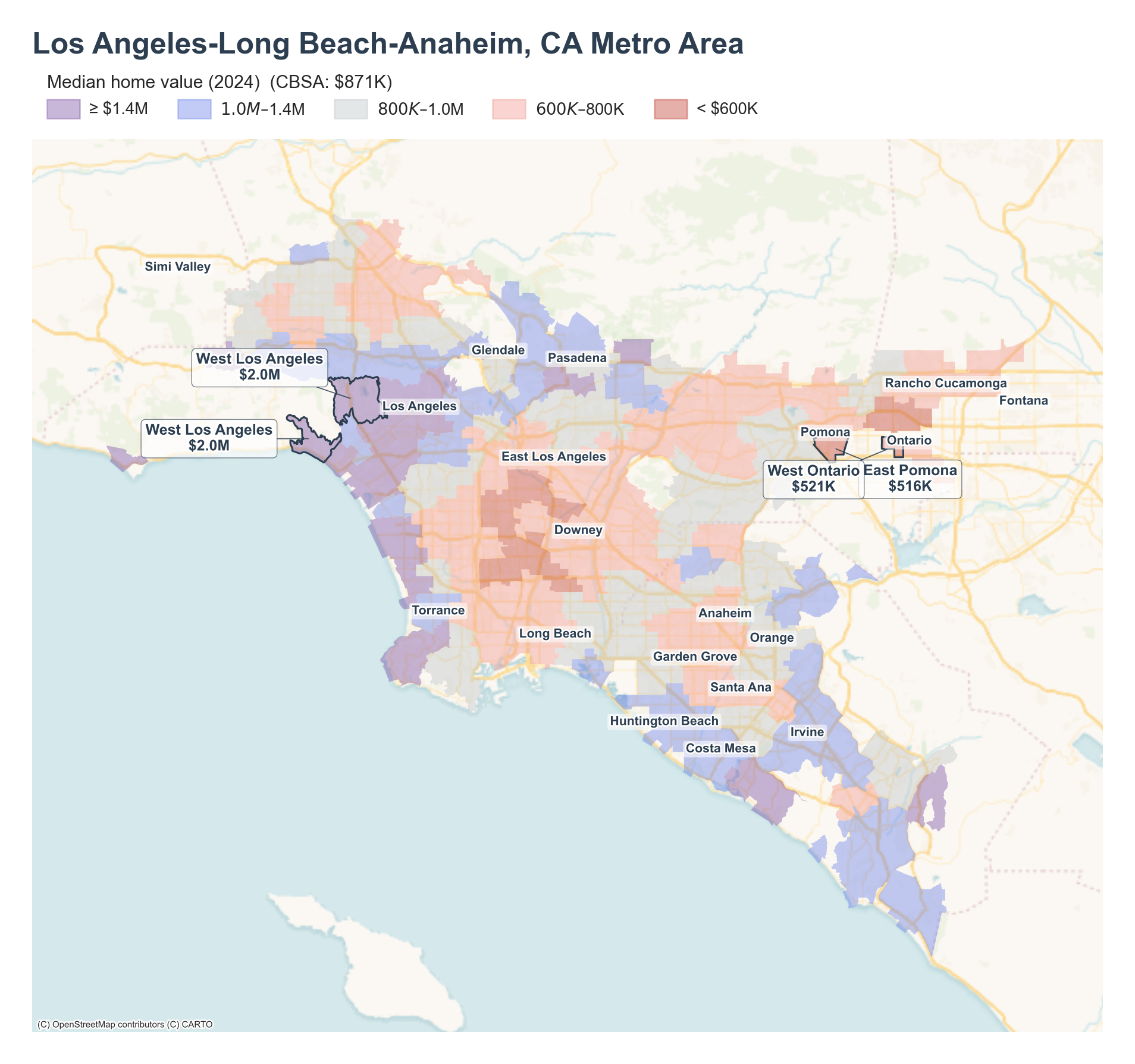
Two neighborhood clusters around West Los Angeles top the metro at $2.0M, both well above the metro median of $871K. The Westside corridor stretches across Beverly Hills , Bel Air , and Pacific Palisades , a long-running concentration of the metro's most expensive housing. The floor sits inland: the cluster around East Pomona at $516K and the cluster around West Ontario at $521K anchor the Inland Empire ) end of the distribution, where housing prices step down sharply as you move east of the San Gabriel Valley. A second band of low values traces the cluster around South of Los Angeles at $555K and the cluster around North of Ontario at $559K.
Median household income
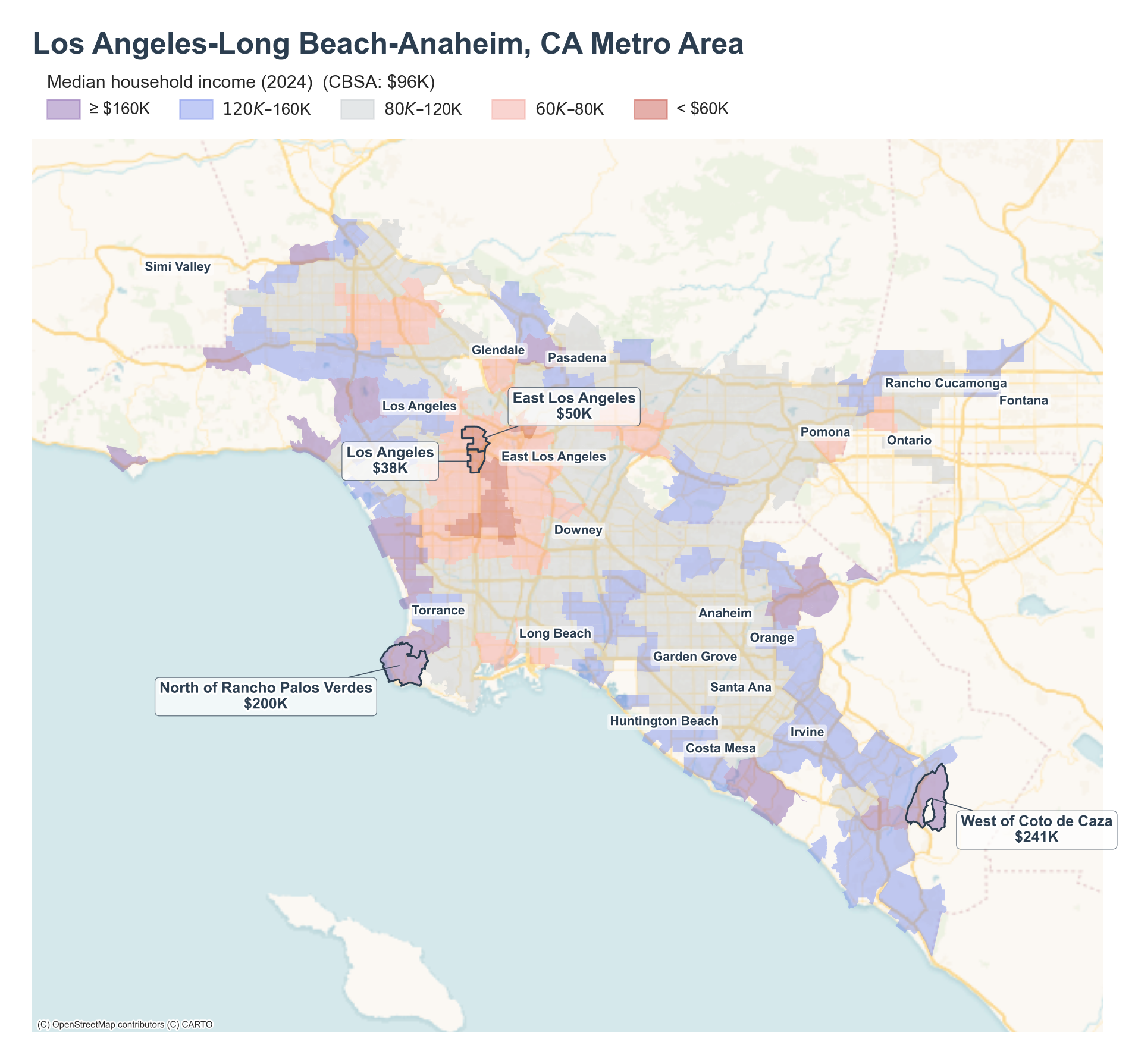
The cluster around West of Coto de Caza tops the metro at $241K, more than double the metro median of $96K. Coto de Caza is a gated south-Orange-County community that consistently ranks among the highest-income places in California. The cluster around West Los Angeles follows at $191K, and the cluster around North of Rancho Palos Verdes at $200K picks up the wealthy Palos Verdes peninsula on the South Bay coast. At the other end, the cluster around Los Angeles sits at $38K and the cluster around East Los Angeles at $50K — adjacent low-income tracts threading from downtown LA east through unincorporated East Los Angeles , one of the largest majority-Hispanic communities in the country. The cluster around South of Los Angeles registers $56K, extending the low-income band south toward the Gateway Cities .
Median age
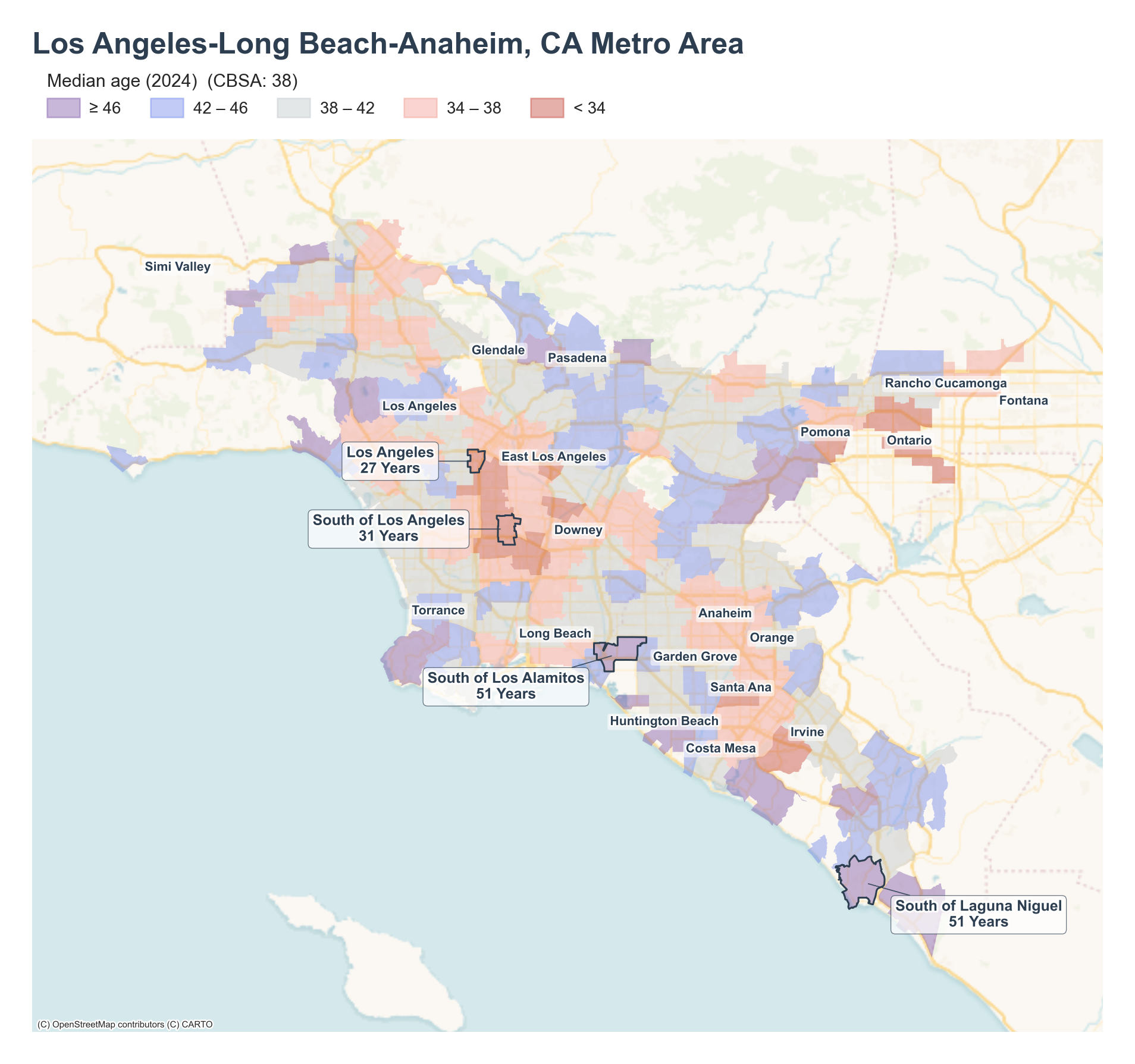
The oldest neighborhoods are in south Orange County and the South Bay: the cluster around South of Laguna Niguel at 51, the cluster around South of Los Alamitos at 51, and the cluster around North of Rancho Palos Verdes at 49 all run more than a decade above the metro median of 38. The cluster around East of Glendale registers 48. The youngest cluster sits around Los Angeles at 27, reflecting the dense, renter-heavy core near downtown LA and Koreatown . The cluster around South of Los Angeles at 31, the cluster around South Irvine at 32, and the cluster around East Los Angeles at 32 fill out the young end — a mix of immigrant-heavy inland neighborhoods and the student-anchored area near UC Irvine .
Adults 25+ with a bachelor's degree
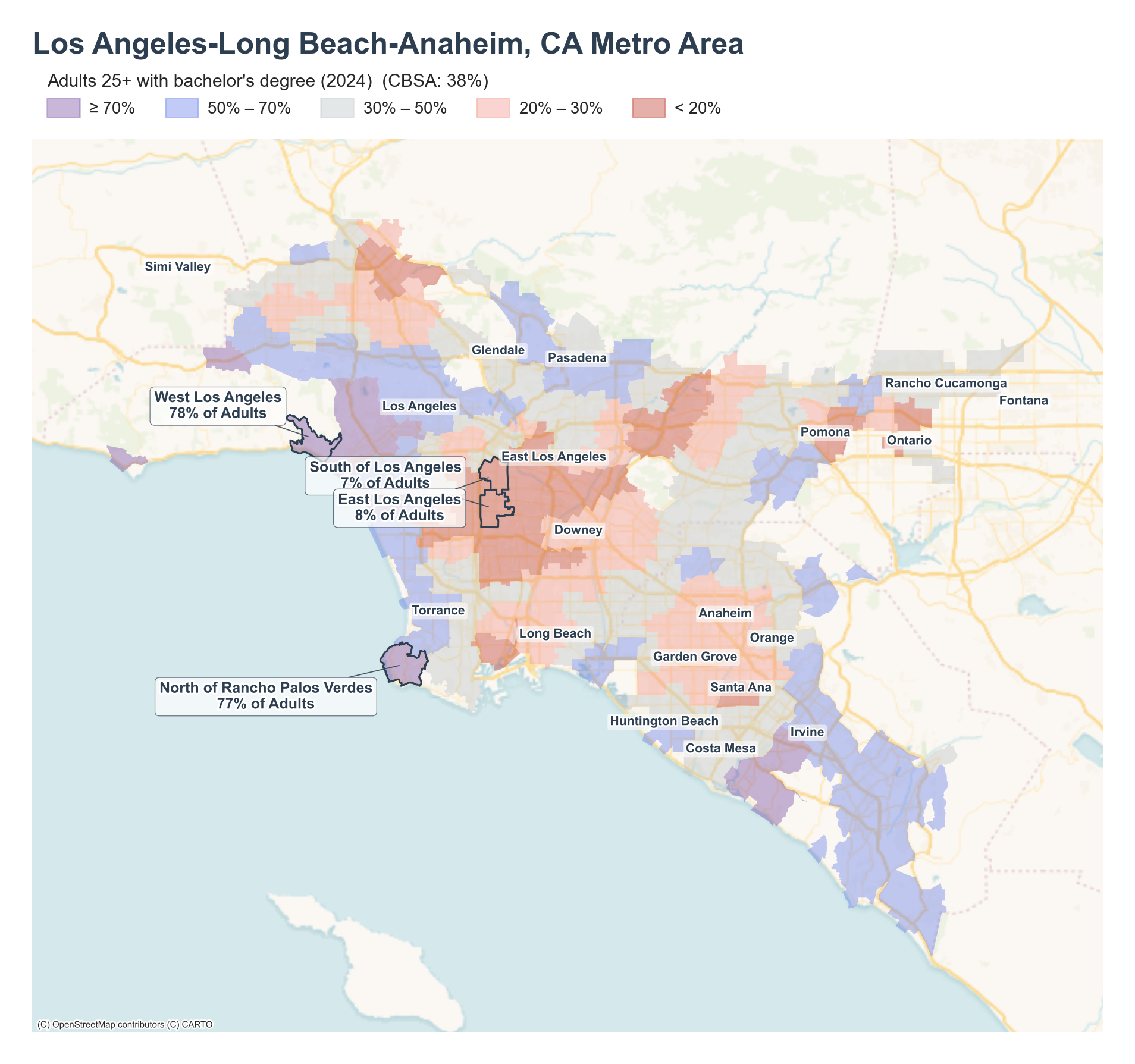
Education tracks the same coastal wedge as home value and income. The cluster around West Los Angeles reaches 78% and a second around West Los Angeles 74%, both roughly double the metro share of 38%. The cluster around North of Rancho Palos Verdes hits 77% and the cluster around Santa Monica 73% — Santa Monica and the Westside corridor remain the metro's degree-density spine. The floor sits in the inland and south-central band: the cluster around South of Vernon at 8%, the cluster around South of Los Angeles at 9%, the cluster around East of Compton at 9%, and the cluster around East Los Angeles at 8% — neighborhoods around Vernon and Compton with long industrial-corridor histories and historically lower college-completion rates.
Where the metrics overlap
The Westside corridor and the Palos Verdes peninsula sit at the top of home value, income, and bachelor's share simultaneously, and the Palos Verdes cluster adds median age to that stack. The inland-east band — central LA, East Los Angeles, and the South of LA cluster — sits at the bottom of income, age, and bachelor's share together. The clearest divergence is between home value and income: the lowest-value housing sits in the eastern Inland Empire (Pomona, Ontario), but the lowest-income clusters sit closer in, around central LA and East LA, where rents and density are higher than purchase prices alone suggest.
Key Takeaways
- The coastal wedge from West Los Angeles through Palos Verdes and into south Orange County anchors the top of every metric, with home values at $2.0M, incomes above $190K, and bachelor's shares near 78%.
- The cheapest housing in the metro is in the eastern Inland Empire, where the cluster around East Pomona at $516K and the cluster around West Ontario at $521K sit below the metro's $871K median.
- Central LA holds the metro's youngest neighborhoods, with the cluster around Los Angeles at a median age of 27 and a household income of $38K.
- The South of Vernon, South of Los Angeles, and East Los Angeles clusters all register bachelor's shares under 10%, well below the metro's 38%.