The Sacramento–Roseville–Folsom metro holds roughly 2.43M people (per 2024 ACS 5-year Estimates ) in 882K households, with a median home value of $590K, median household income of $97K, median age of 38, and 37% of adults 25+ holding a bachelor's degree. The neighborhood-level analysis below covers the metro's urbanized areas — about 1.85M residents, or 76% of the metro total. The dominant pattern in the maps is a wealthy northeast suburban band running from Granite Bay through Rocklin and Folsom out to El Dorado Hills, set against a cooler-valued core that wraps around inner Sacramento and the North Highlands corridor.
Median home value
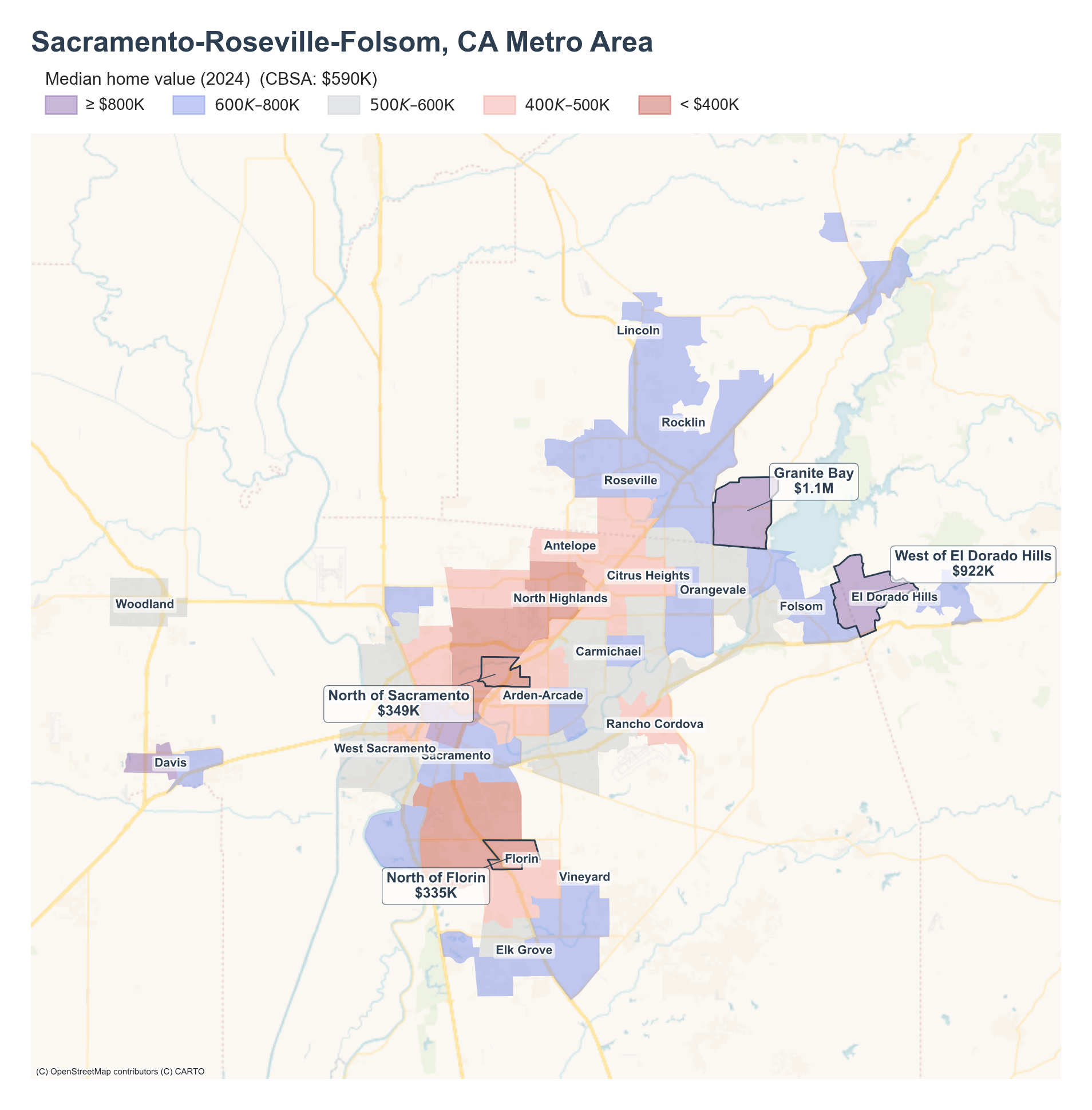
The northeast suburbs hold the top end. The cluster around Granite Bay leads at $1.1M, followed by the cluster around West of El Dorado Hills at $922K, the cluster around Davis at $885K, the cluster around West Sacramento at $800K, and the cluster around North Folsom at $776K. Granite Bay is a low-density Placer County community where the median household income is around $190K and 62% of adults hold a bachelor's degree, which lines up with both the home-value and income standings here. El Dorado Hills sits among the highest-income places in the country at its size class, with a 2023 median household income of $163K.
The bottom end runs through the urban core. The cluster around North of Florin comes in at $335K, the cluster around North of Sacramento at $349K, the cluster around North Sacramento at $357K, the cluster around West of North Highlands at $358K, and the cluster around South of Sacramento at $366K. These all sit inside or just north of the city of Sacramento on the map, well below the metro's $590K reference.
Median household income
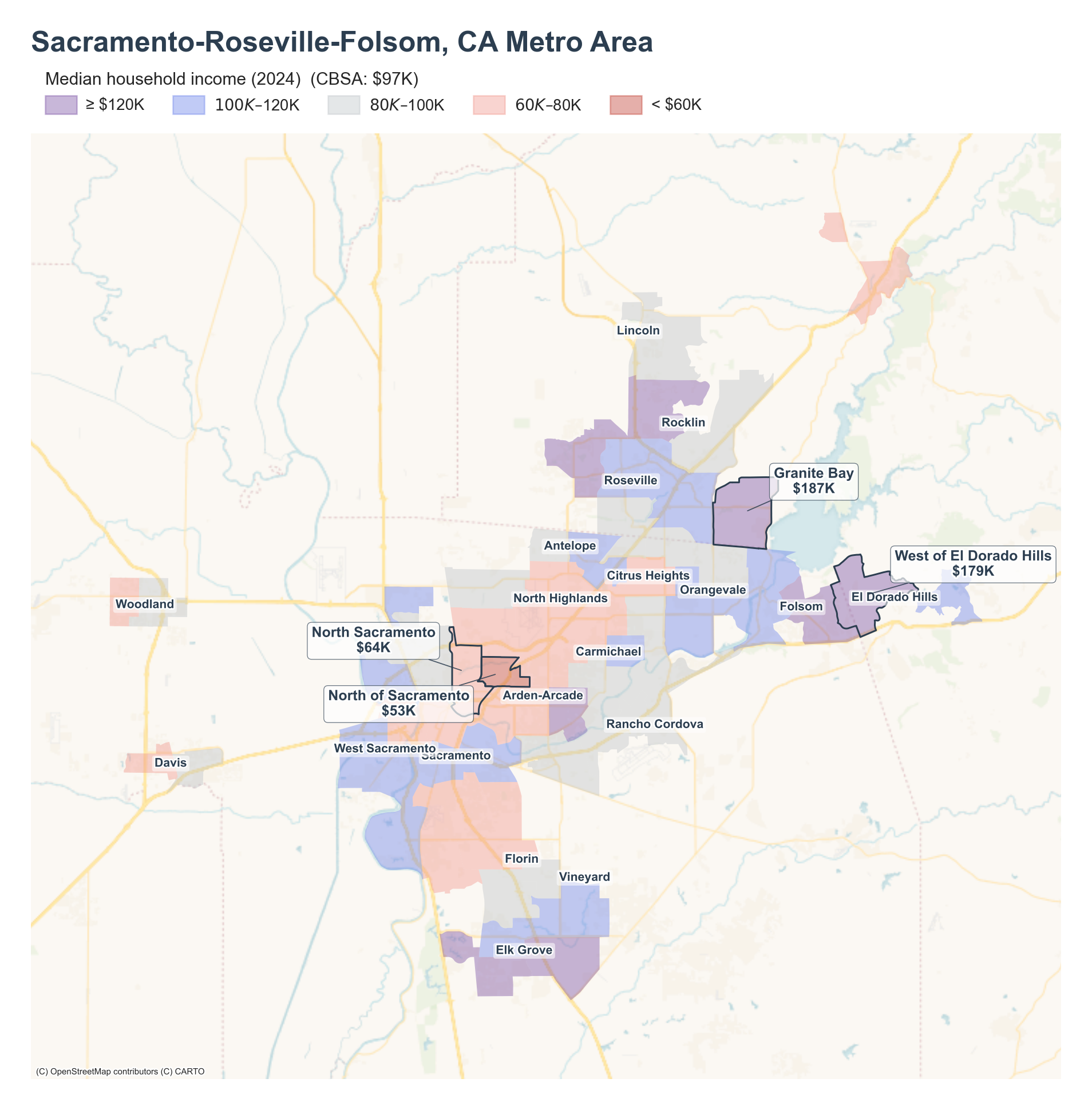
Income tracks home value closely. The cluster around Granite Bay tops the metro at $187K, with the cluster around West of El Dorado Hills at $179K, the cluster around Folsom at $152K, the cluster around West of Rocklin at $147K, and the cluster around East of Arden-Arcade at $135K. All five sit along the northeast suburban band visible on the map.
At the bottom, the cluster around North of Sacramento posts $53K, the cluster around North Sacramento $64K, the cluster around West of North Highlands $66K, the cluster around South of Sacramento $66K, and the cluster around North of Arden-Arcade $66K — all near or below the metro's $97K reference, and concentrated in the inner-city ring and the North Highlands corridor north of the American River, where the area around the former McClellan Air Force Base has long carried higher poverty rates than the metro overall.
Median age
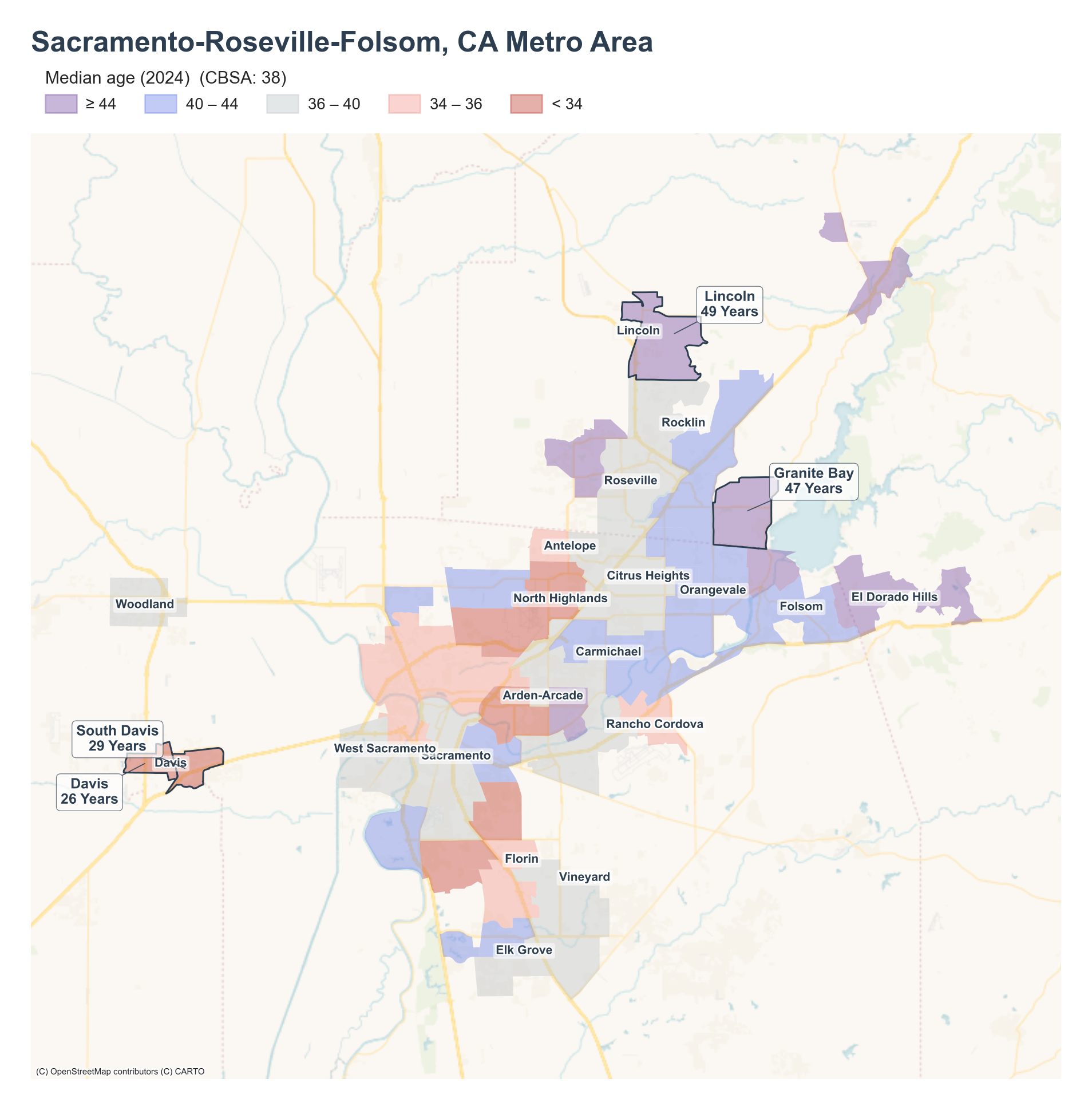
The oldest neighborhoods sit on the outer northern edge. The cluster around Lincoln leads at 49, followed by the cluster around Granite Bay at 47, the cluster around North Folsom at 47, the cluster around North Roseville at 46, and the cluster around East of Arden-Arcade at 46. Lincoln has a notably older population overall, with 28% of residents aged 65 or older.
The youngest clusters sit in and around Davis and inside the Sacramento core. The cluster around Davis comes in at 26 and the cluster around South Davis at 29, both pulled down by the UC Davis student population — the university enrolls roughly 41K students and is by far the city's largest employer. The cluster around West of North Highlands sits at 32, the cluster around South of Sacramento at 32, and the cluster around West of Arden-Arcade at 33, all below the metro's 38 reference.
Adults 25+ with a bachelor's degree
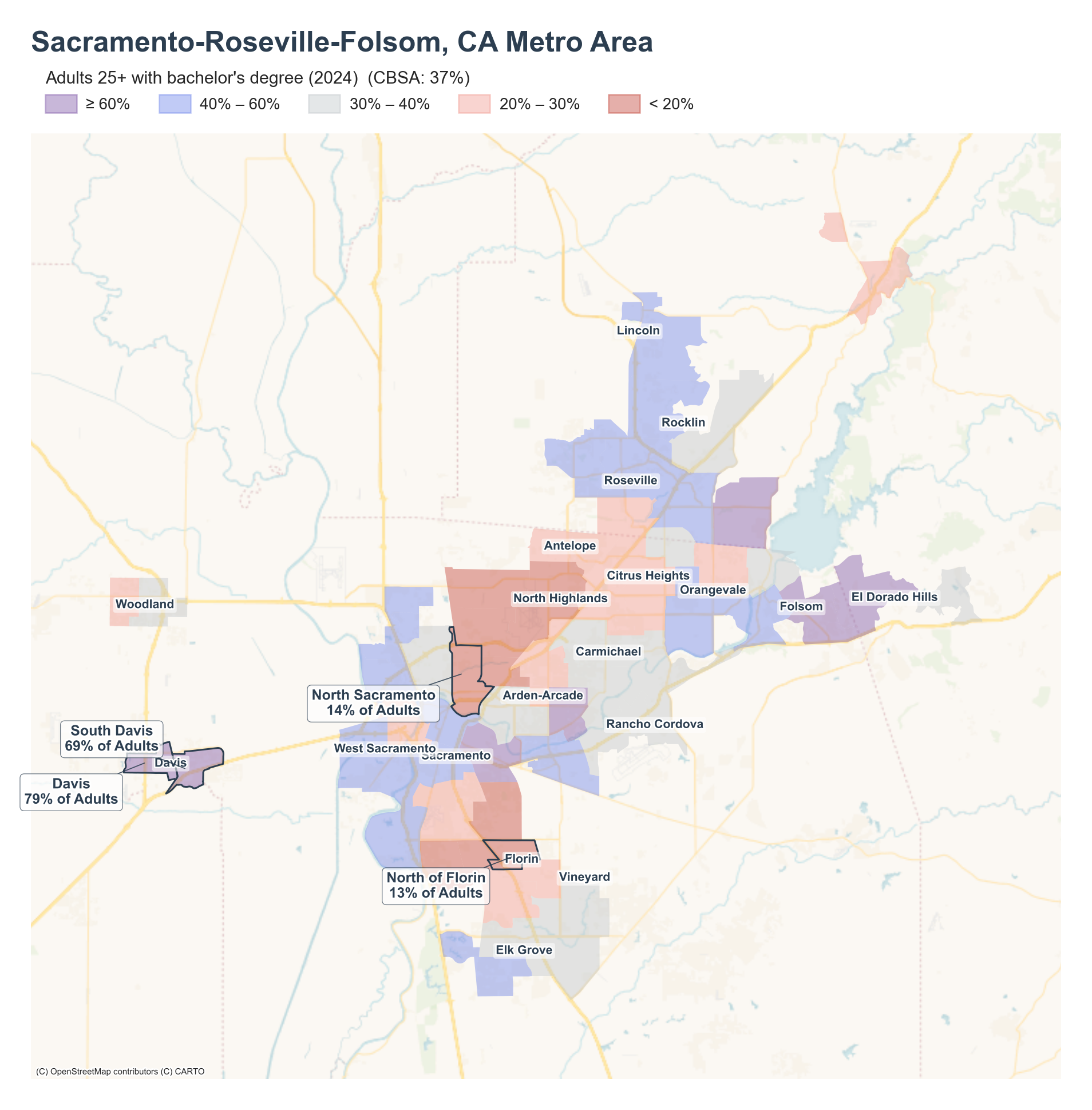
Education shows the widest spread. The cluster around Davis tops the metro at 79%, followed by the cluster around South Davis at 69%, the cluster around Sacramento at 66%, the cluster around West of El Dorado Hills at 64%, and the cluster around Granite Bay at 62%. Davis's standing is consistent with a city whose economy and population revolve around UC Davis .
The bottom clusters are inner-Sacramento neighborhoods that also rank low on income and home value. The cluster around North of Florin sits at 13%, the cluster around West of North Highlands at 14%, the cluster around North Sacramento at 14%, the cluster around South Sacramento at 15%, and a separate cluster around North Sacramento at 15% — all far below the metro's 37% reference.
Where the metrics overlap
The northeast suburban band — Granite Bay, West of El Dorado Hills, North Folsom — shows up at the top across home value, income, and (for Granite Bay and West of El Dorado Hills) bachelor's share, with older median ages folded in. The inner-Sacramento ring around North Sacramento, North of Florin, and West of North Highlands shows the inverse: bottom-end home values, bottom-end incomes, and bottom-end education, with younger ages. Davis breaks the pattern: it sits at the top on home value and education but at the bottom on age, with student households driving the divergence.
Key Takeaways
- The cluster around Granite Bay is the metro's top neighborhood on home value ($1.1M), income ($187K), age (47), and bachelor's share (62%) all at once.
- The cluster around West of North Highlands is the only neighborhood at the bottom on all four metrics, sitting below the metro reference on home value ($358K), income ($66K), age (32), and bachelor's share (14%).
- Wealth concentrates on the northeast suburban band from Granite Bay through Folsom to El Dorado Hills; lower values concentrate in the inner-Sacramento ring and the North Highlands corridor.
- Davis is the metro's education outlier at 79% bachelor's share but also its youngest at a median age of 26, reflecting the UC Davis student population.
- Lincoln anchors the older end at a median age of 49, with the rest of the older clusters sitting along the metro's northern suburban edge.