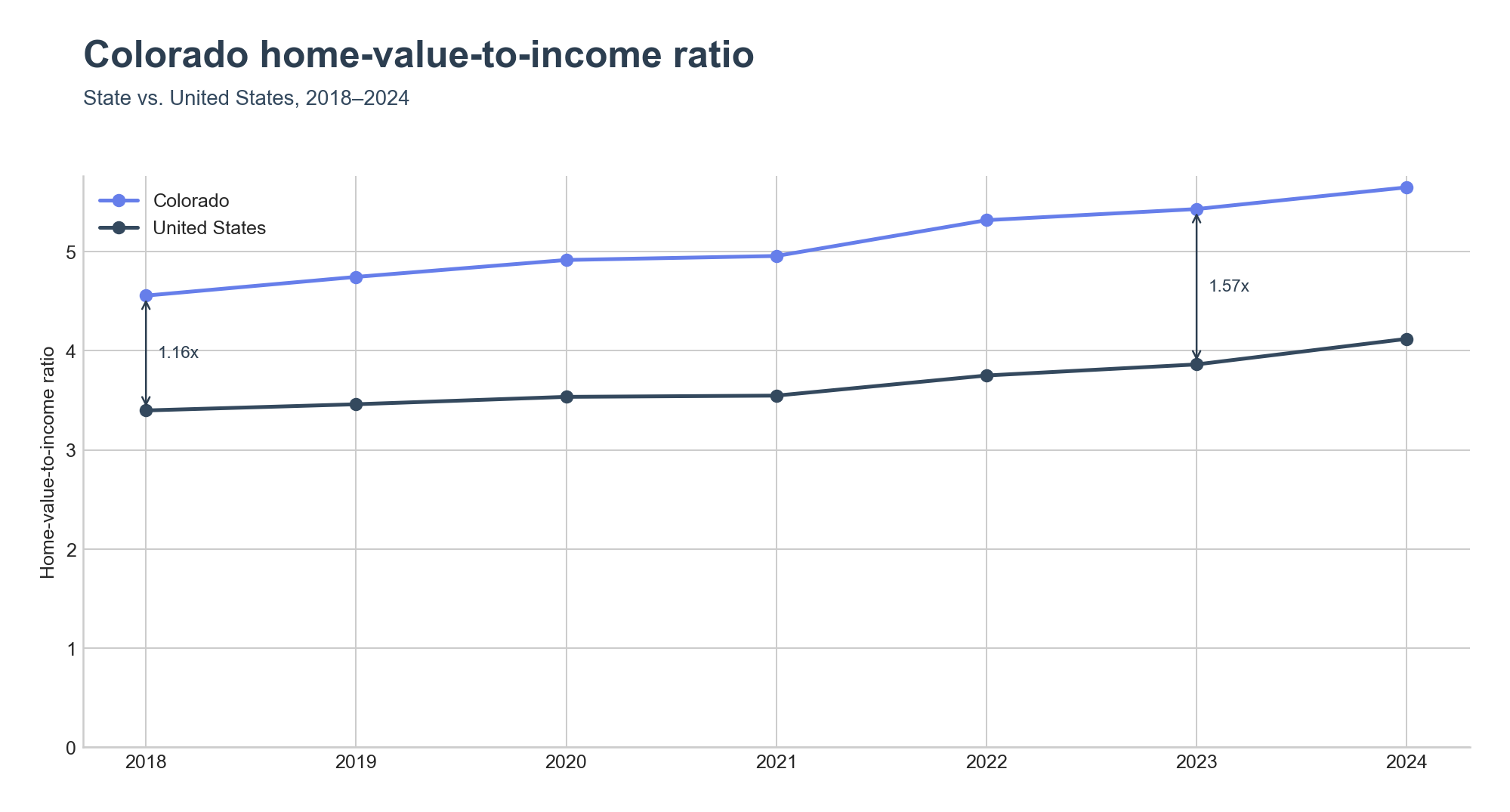
Colorado ended 2024 with a home-value-to-income ratio of 5.65x, well above the United States figure of 4.12x. The gap widened from 1.16x in 2018 to 1.53x in 2024 as Colorado pulled away from the national trend rather than tracking it.
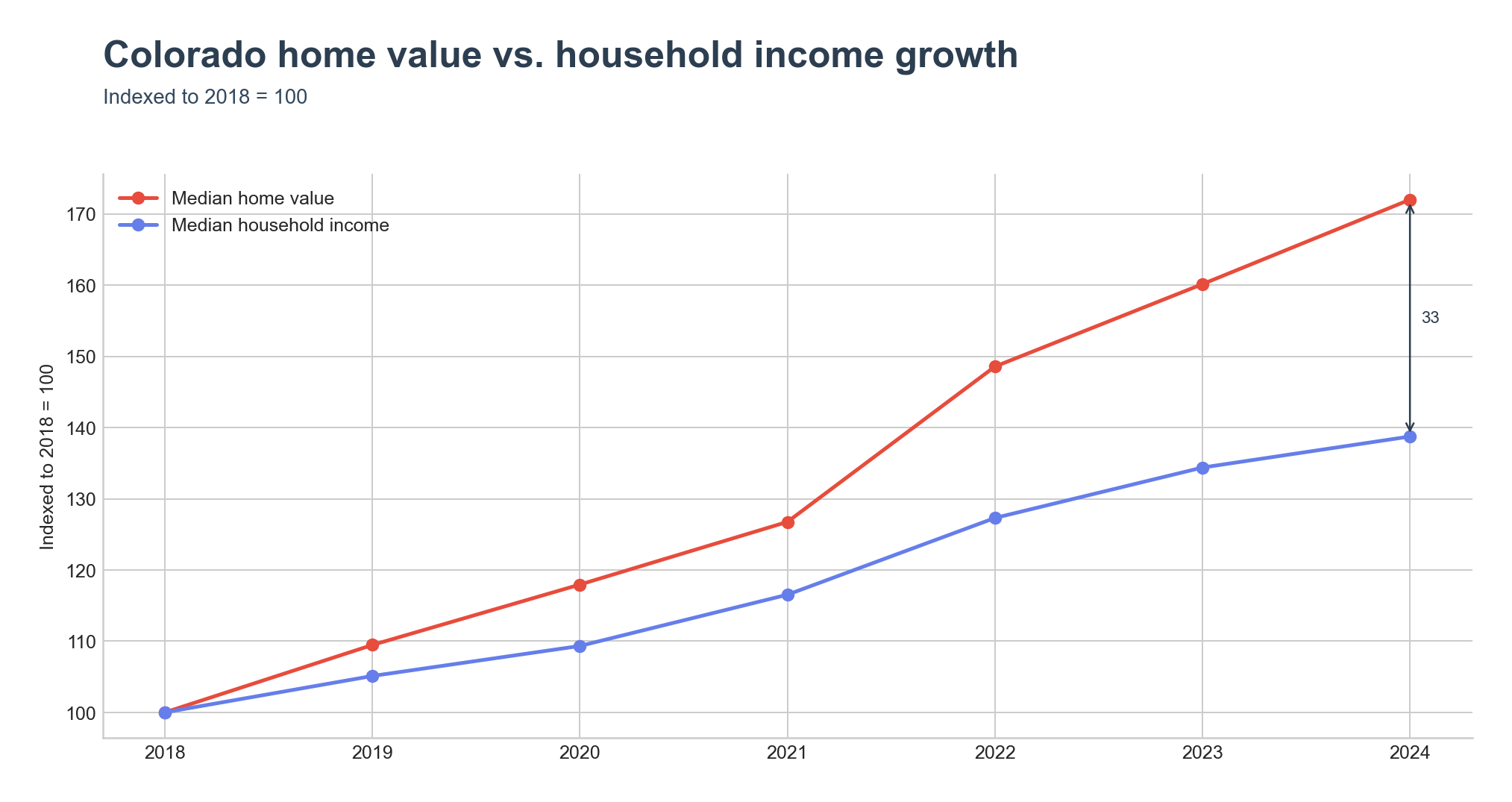
The component view shows why. Indexed to 2018, median home value reached 172 by 2024 while median household income reached 139 — a 33-point gap, with most of the divergence opening between 2021 and 2022.
Where the ratio is highest
The top of the place ranking is the mountain resort corridor. Boulder leads the state at 11.88x on a $1.04M median home value — driven by a constrained housing supply that the city's voter-approved Blue Line ) and height limits have held in place for decades, alongside the University of Colorado Boulder student-renter base. Edwards follows at 11.44x and Aspen at 11.07x; both sit in the I-70 ski corridor where second-home demand has long detached home values from local wages. Steamboat Springs (9.35x) and Salida (9.26x) round out the top five — Steamboat is a Routt County ski resort, Salida a smaller Arkansas River recreation town in Chaffee County.
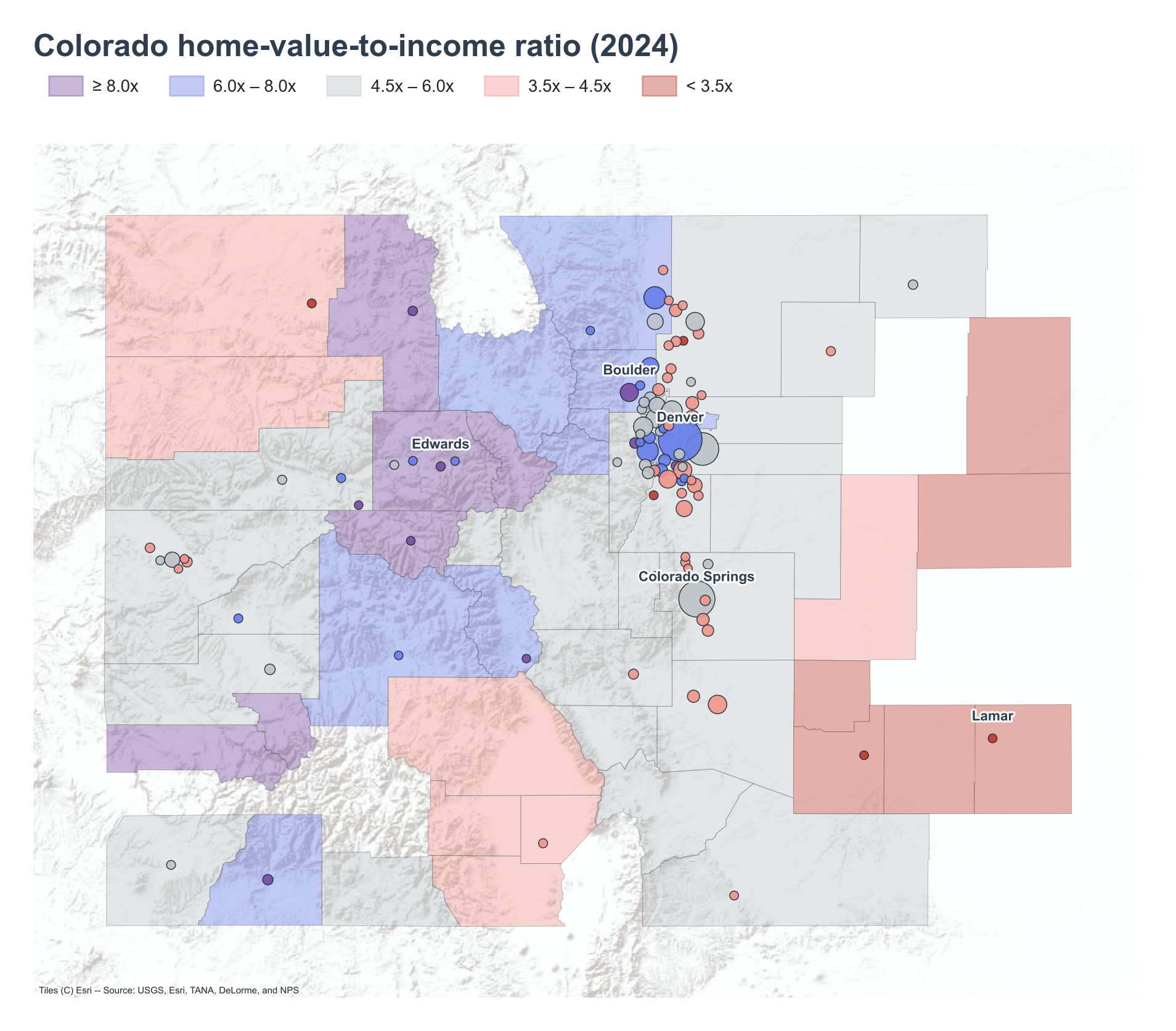
The county ranking confirms the geography. Pitkin (11.10x, containing Aspen), San Miguel (9.12x, containing Telluride), Summit (8.56x, containing Breckenridge), Ouray (8.13x), and Eagle (8.06x, containing Vail) form a contiguous band of ski-resort counties across the central and southwestern Rockies, visible on the map as the dark purple cluster west of the Front Range.
Where the ratio is lowest
The bottom of the place ranking sits in the Denver northern suburbs and the southeastern plains. Federal Heights — an Adams County suburb north of Denver — leads at 1.68x on a $95,300 median home value, an outlier driven by a housing stock heavy in older manufactured-home parks. The other four lowest places — Lamar (2.87x), La Junta (3.72x), Milliken (3.78x), and Craig (3.83x) — are Arkansas Valley and rural agricultural towns where home values stayed under $280,000 in 2024.
The county map mirrors this: Crowley (2.38x), Bent (2.93x), Prowers (3.00x), and Otero (3.13x) form a contiguous southeastern-plains block along the Arkansas River, with Kit Carson (3.41x) on the eastern border.
How the distribution shifted
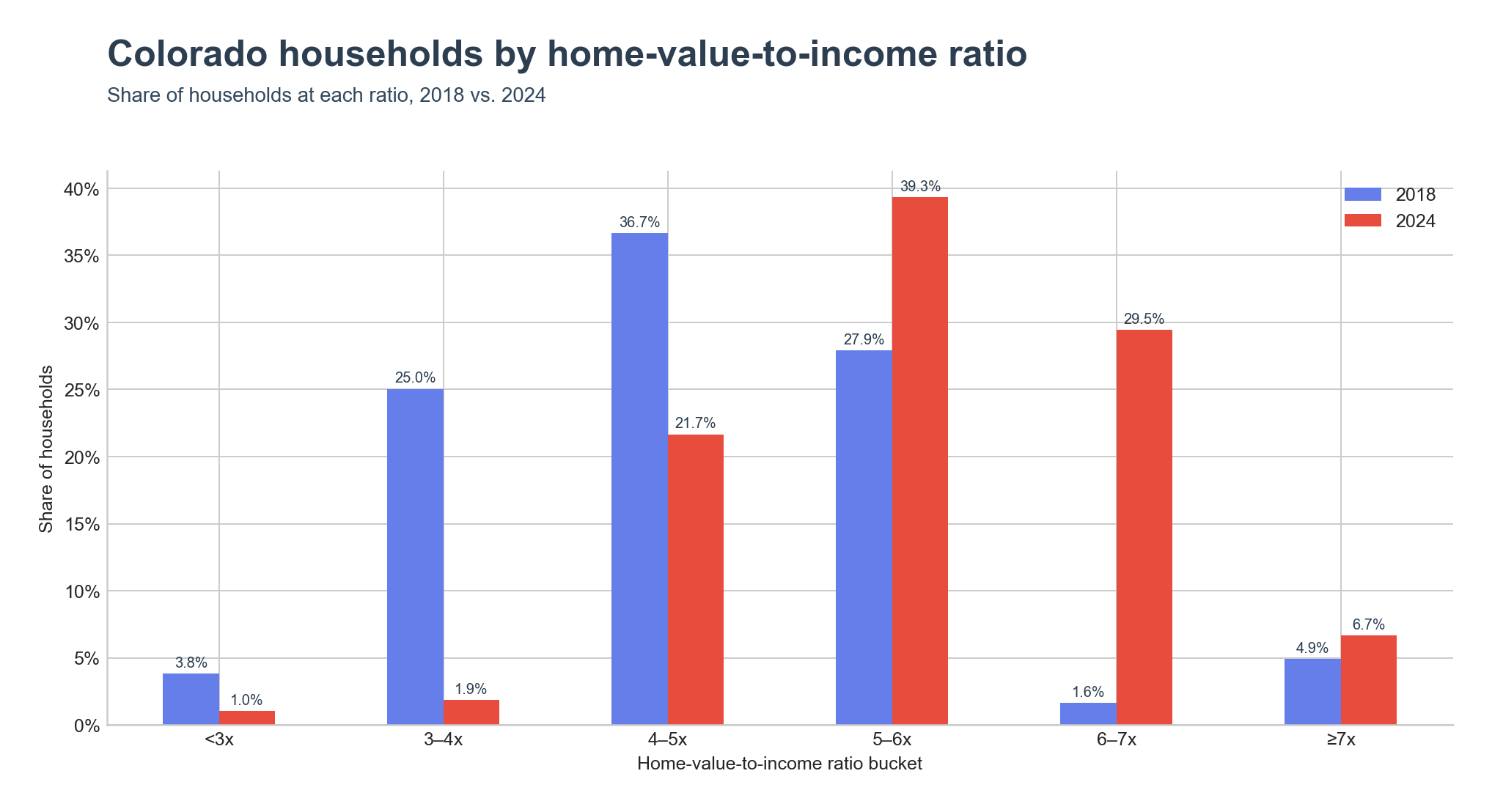
Colorado's place-level distribution moved up by roughly one bucket between 2018 and 2024. The 4–5x bucket — which housed 36.7% of Colorado households in 2018 — shrank to 21.7% by 2024. The 5–6x bucket grew from 27.9% to 39.3% and the 6–7x bucket from 1.6% to 29.5%. The combined share at 5x or higher went from 34.4% in 2018 to 75.5% in 2024.
Key Takeaways
- Colorado is 1.53x above the United States on the home-value-to-income ratio, with the gap wider than the 1.16x spread in 2018.
- Median home values grew 72% since 2018 against 39% for median household income, a 33-point index gap.
- The I-70 ski corridor and Boulder concentrate the highest ratios, with five contiguous mountain counties above 8x.
- The southeastern plains along the Arkansas River and Federal Heights in the Denver northern suburbs remain the only places under 3x.
- Colorado households living in places at 5x or higher went from 34.4% in 2018 to 75.5% in 2024.