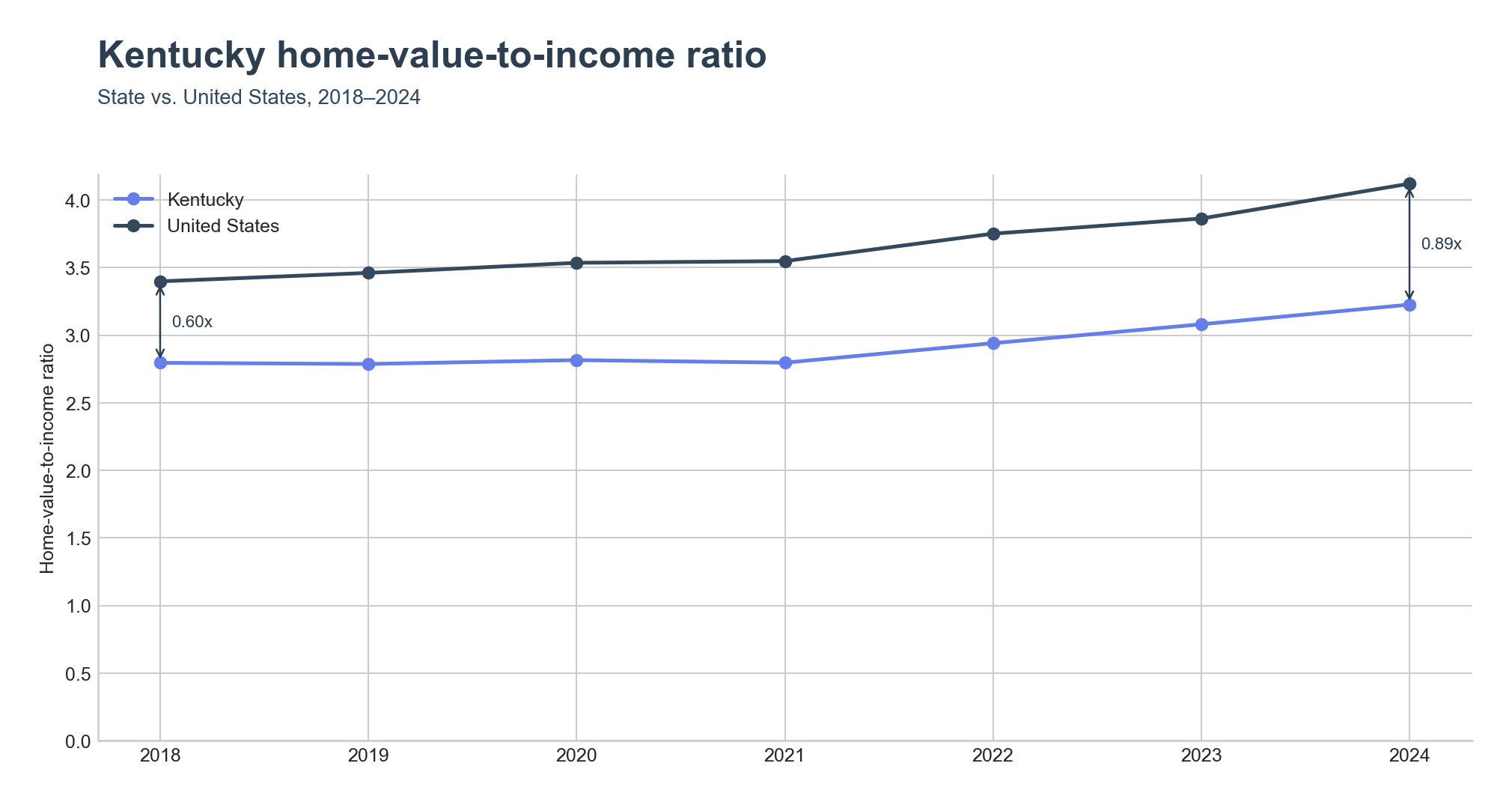
Kentucky's home-value-to-income ratio reached 3.23x in 2024, well below the United States ratio of 4.12x. The gap between the two has widened since 2018, when Kentucky stood at 2.80x against a national 3.40x — the state's ratio is rising, but the country's is rising faster.
Pikeville tops the state
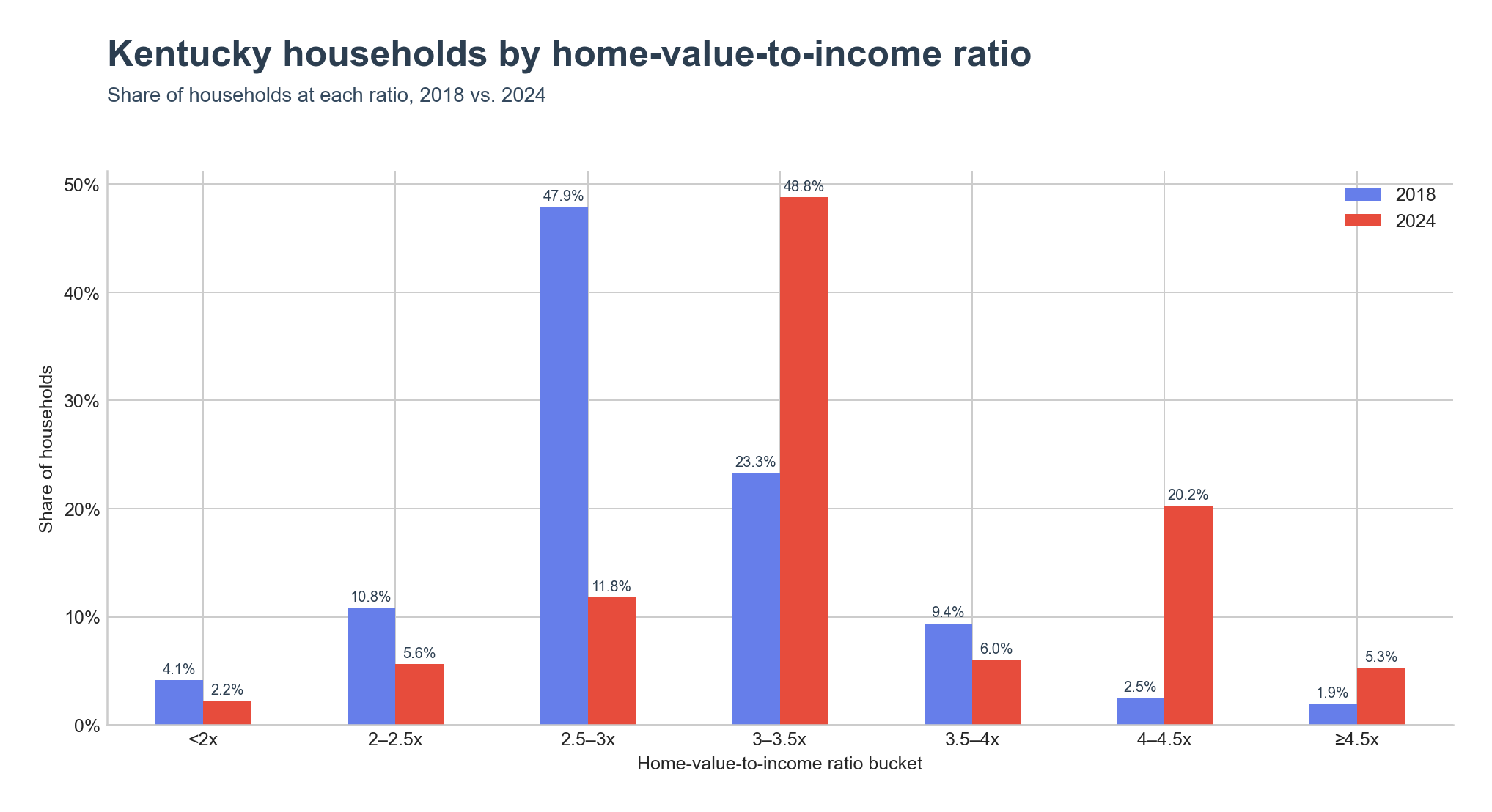
Pikeville posts the highest ratio among Kentucky places at 6.60x, on a median home value of $263,800 against median household income of $39,955. The city is the economic hub of the central Appalachian coalfield, where mining employment has collapsed from its mid-century peak — a shift that has left area incomes low relative to home values even as the city has diversified into healthcare and education.
Bowling Green, home to Western Kentucky University , follows at 4.95x (home value $241,900, income $48,873). Versailles, seat of Woodford County's thoroughbred horse-farm country, ranks third at 4.59x (home value $286,100, income $62,368). Murray, home to Murray State University , reaches 4.42x (home value $195,000, income $44,091), and Douglass Hills, a Louisville suburb, rounds out the top five at 4.41x (home value $346,300, income $78,482).
The most affordable places cluster in the north and east
Flatwoods has the lowest ratio among Kentucky places at 1.91x (home value $114,600, income $59,972). It sits near Ashland in the state's northeastern corner along the Ohio River, which posts the third-lowest ratio at 2.37x (home value $125,000, income $52,715); Ashland grew around the Armco steel mill , whose decline and eventual closure removed the city's anchor employer.
The rest of the bottom five sit in the Cincinnati-suburb cluster in far-northern Kentucky: Burlington, the Boone County seat across the Ohio River from Cincinnati, has the second-lowest ratio at 2.33x (home value $254,300, income $109,308) — Boone County is part of the Cincinnati metropolitan area . Dayton follows at 2.48x (home value $163,500, income $65,992), and Francisville at 2.50x carries the highest income of any highlighted place, $159,371, against a home value of $398,000.
Counties: central Kentucky leads, Appalachian coalfield trails
Among counties, Fayette County — home to Lexington — leads at 4.22x (home value $293,500, income $69,479), followed by Warren County (Bowling Green) at 3.92x, Simpson County at 3.83x, Bourbon County, in the same horse-farm belt as Versailles, at 3.74x, and Shelby County, a Louisville-area county, at 3.69x.
The lowest county ratios sit largely in the eastern Appalachian coalfield. Letcher County is lowest at 1.61x (home value $67,400, income $41,793). Union County, in western Kentucky, is next at 1.73x, then Harlan County at 1.77x and Knott County at 1.84x — the latter two in the same coal region as Pikeville, which has seen decades of mining decline. Bracken County, on the Ohio River in the north, rounds out the bottom five at 1.88x.
Home values are outrunning incomes
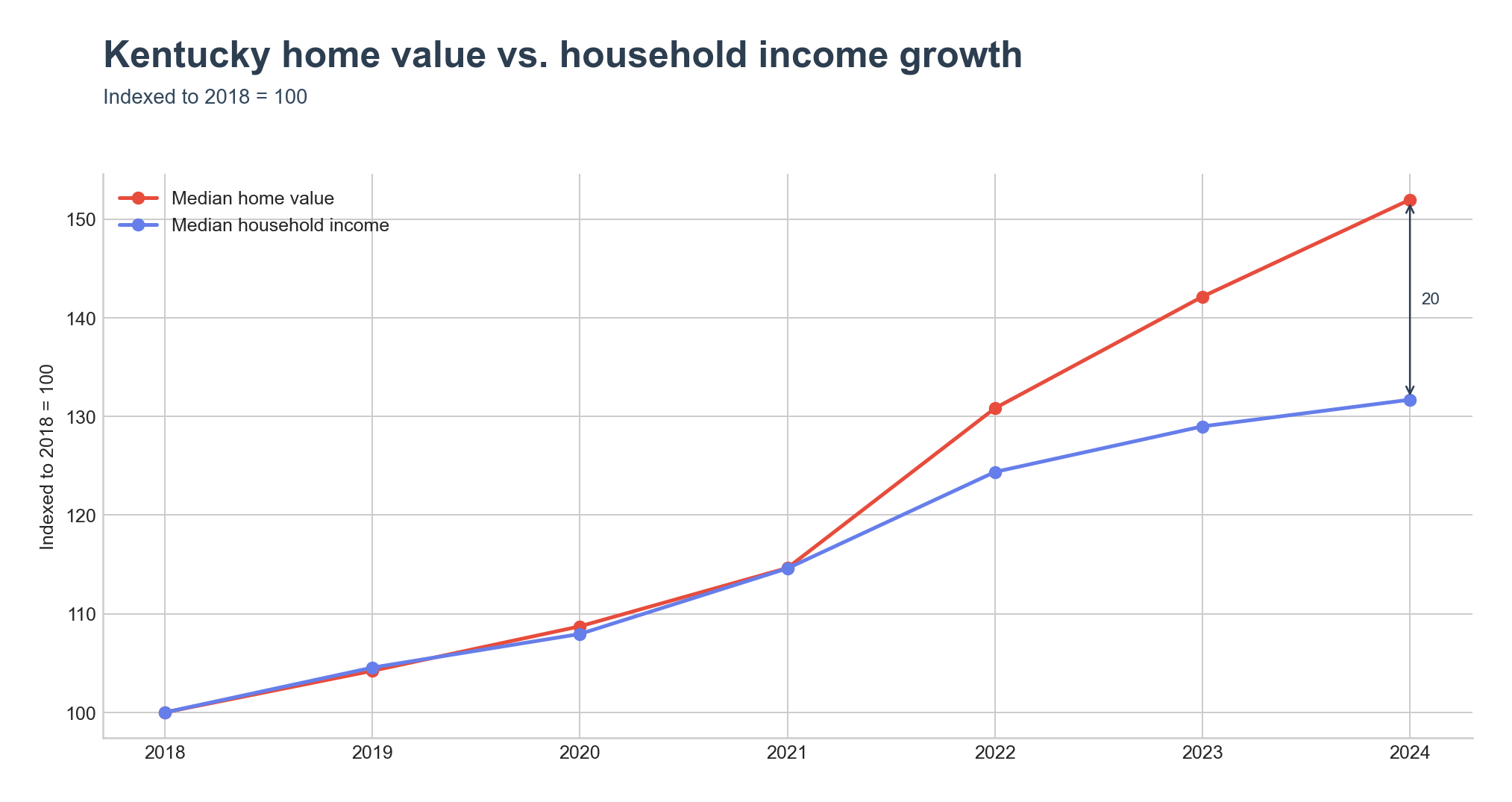
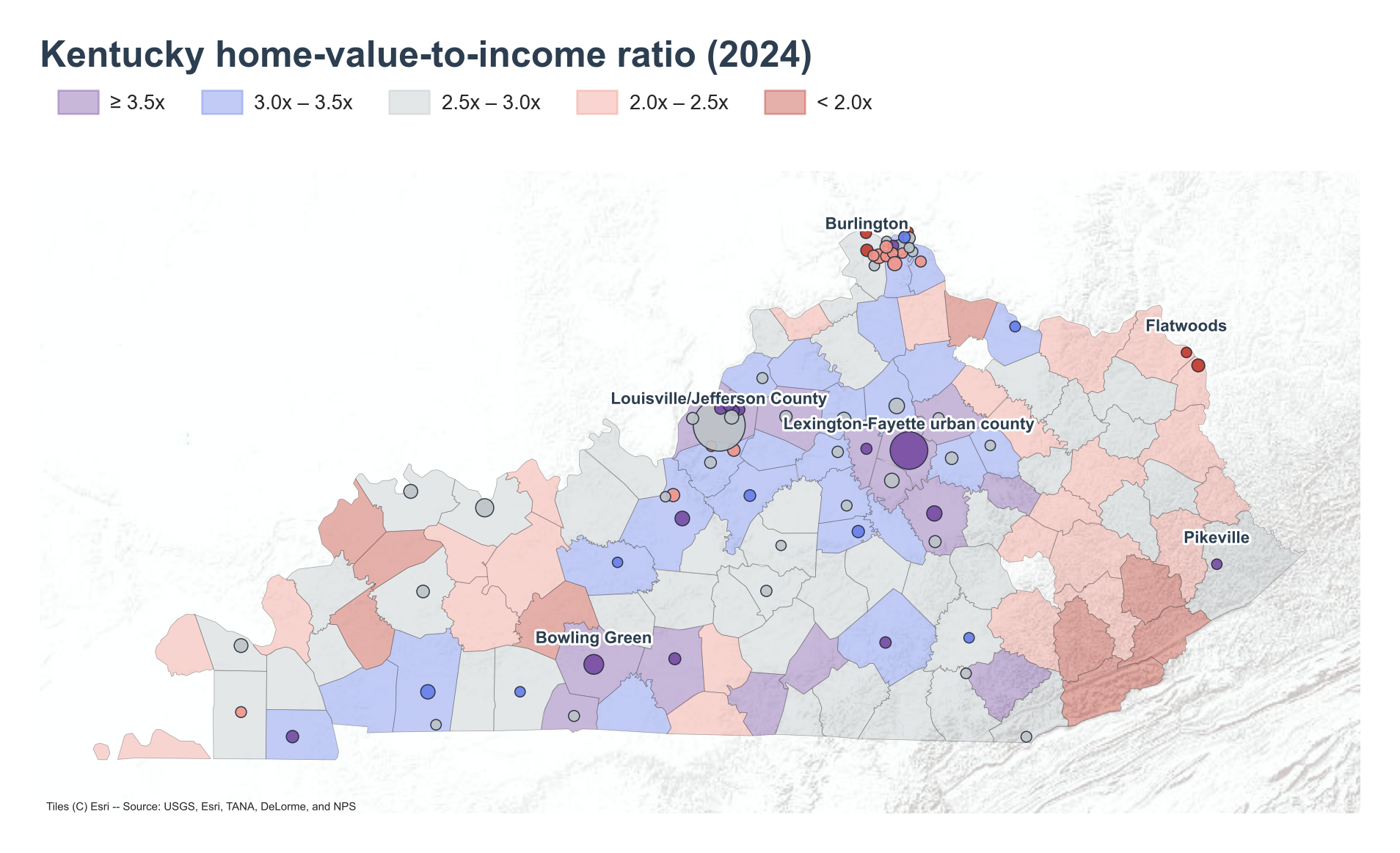
Kentucky's median home value rose from $135,300 in 2018 to $205,600 in 2024, while median household income rose from $48,392 to $63,726 over the same period. The share of Kentucky households in the 3–3.5x ratio bucket grew from 23.3% in 2018 to 48.8% in 2024, and the 4–4.5x bucket grew from 2.5% to 20.2% — a clear shift toward higher ratios, even as the state's overall ratio remains well under the national figure.
Key Takeaways
- Kentucky's home-value-to-income ratio was 3.23x in 2024, versus 4.12x nationally.
- The state-to-US gap widened from 2018 to 2024: Kentucky started at 2.80x against a national 3.40x, and stood at 3.23x against 4.12x by 2024.
- Pikeville had the highest place-level ratio in the state at 6.60x; Flatwoods had the lowest at 1.91x.
- Fayette County had the highest county-level ratio at 4.22x; Letcher County had the lowest at 1.61x.
- The share of Kentucky households in the 3–3.5x bucket rose from 23.3% to 48.8%, and the 4–4.5x bucket rose from 2.5% to 20.2%, between 2018 and 2024.