Missouri stays cheaper than the nation, and the gap has widened
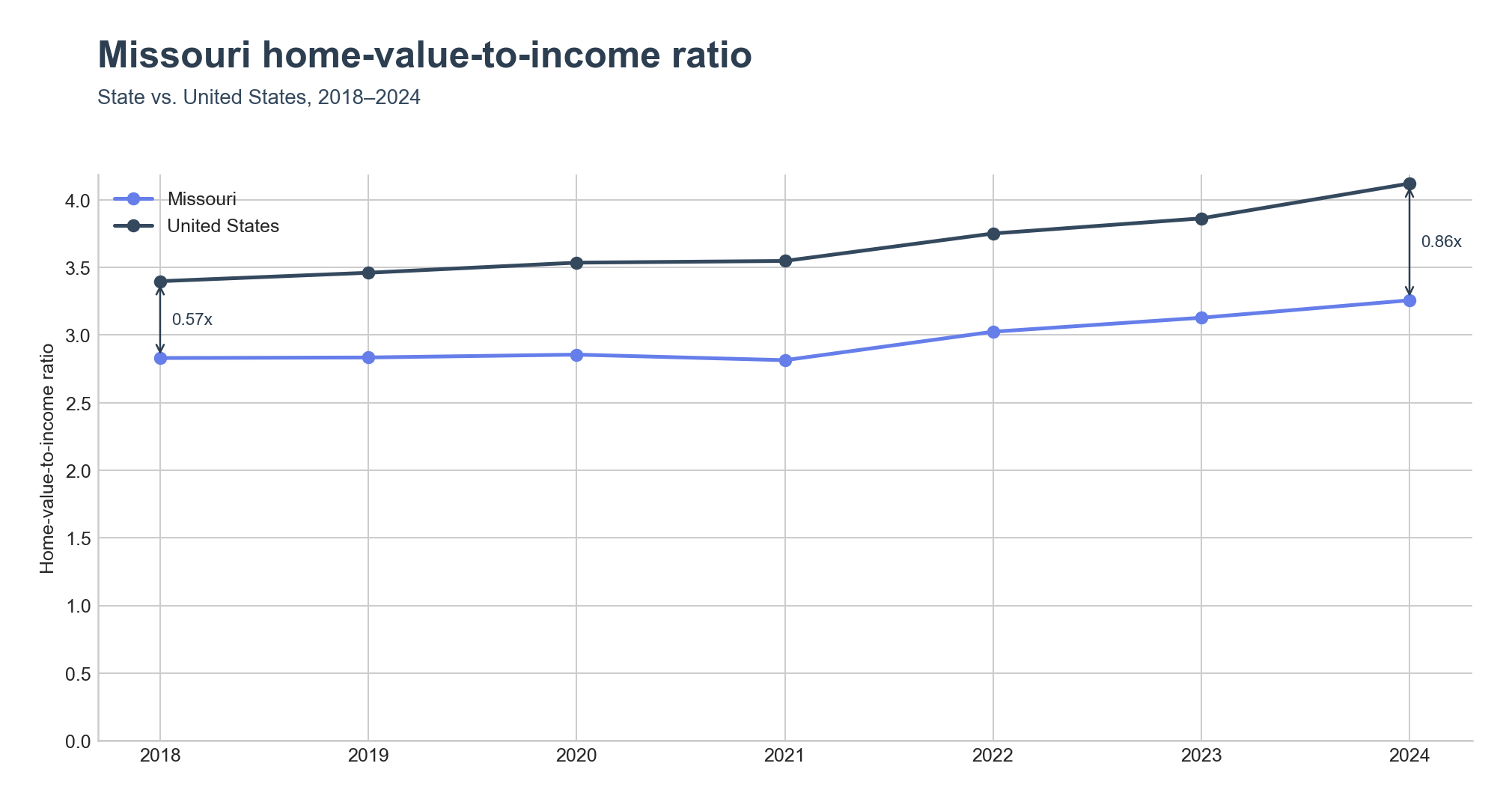
Missouri's home-value-to-income ratio reached 3.26x in 2024, well below the United States figure of 4.12x. In 2018 the state ratio stood 0.57x below the national figure; by 2024 that shortfall had widened to 0.86x, meaning the national ratio has climbed faster than Missouri's.
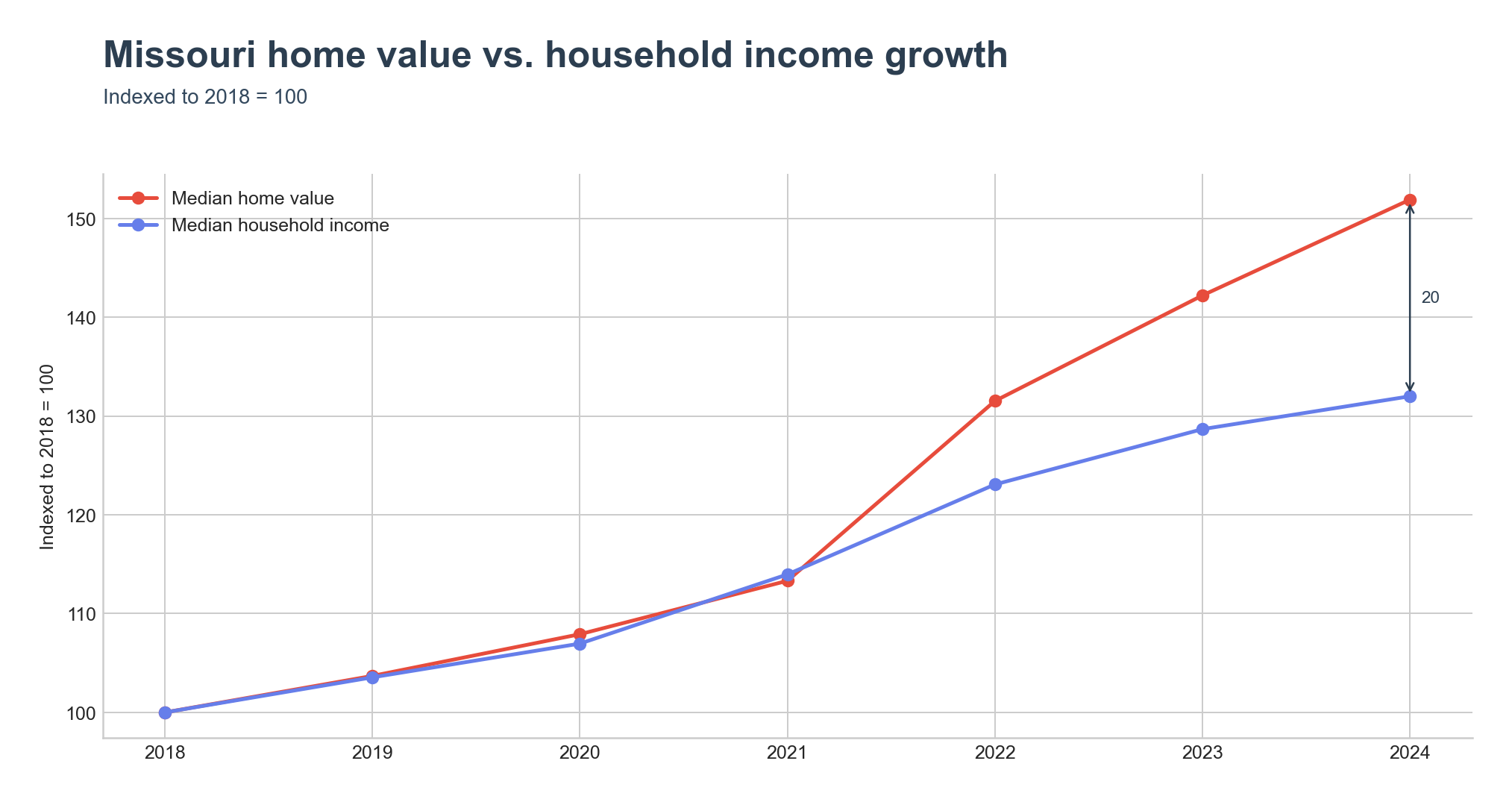
Missouri's median home value rose from $151,600 in 2018 to $230,300 in 2024, while median household income rose from $53,560 to $70,702 over the same span. Indexed to 2018, home value growth pulled 20 points ahead of income growth by 2024.
Where the ratio runs highest
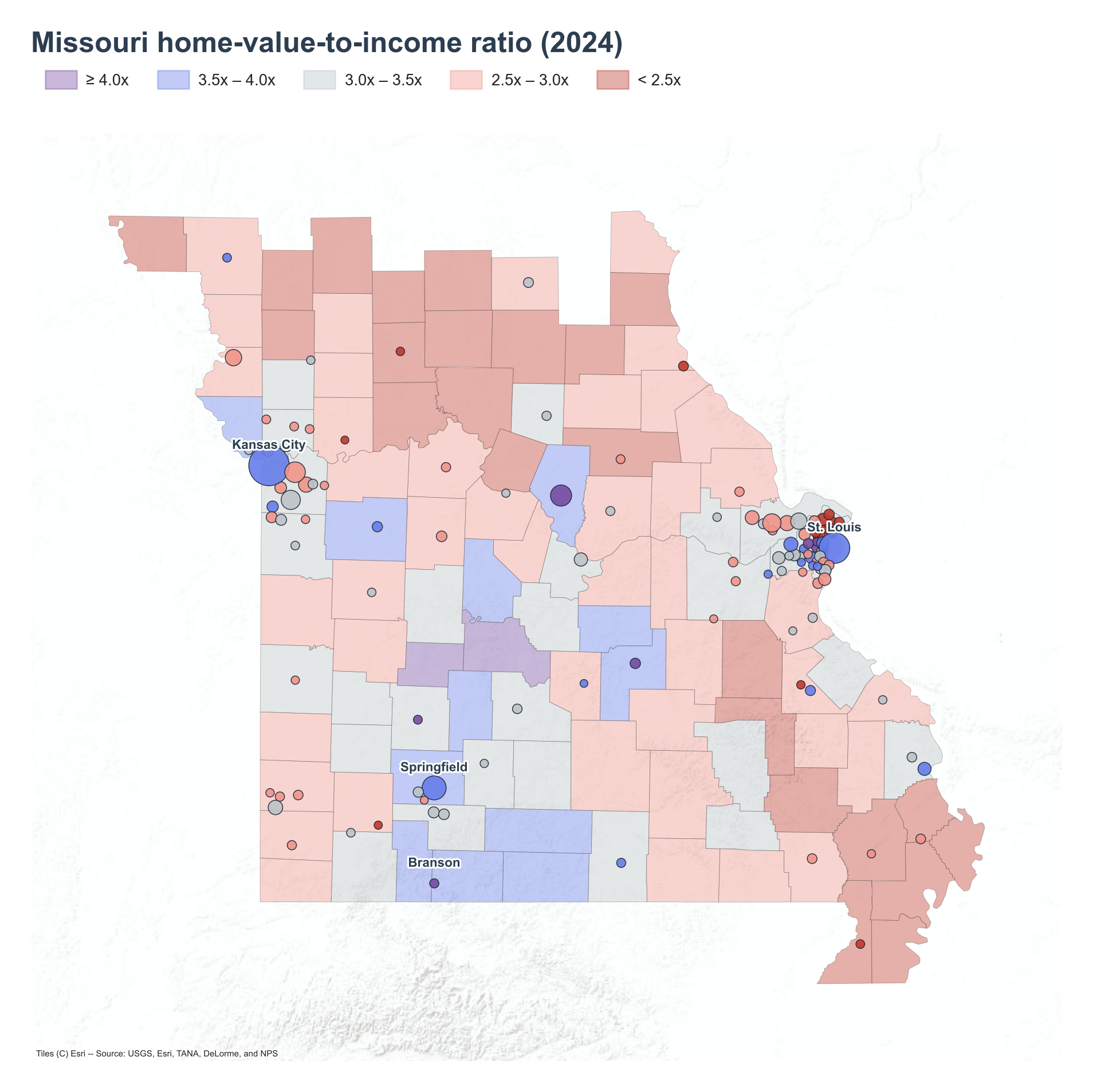
Clayton, the county seat of St. Louis County and an affluent professional hub bordering the city of St. Louis, tops the state at 6.75x, on a median home value of $830,000 against median household income of $123,000. Clayton's downtown business district and dual-income population, per Wikipedia , help explain values that sit far above what local incomes alone would support.
Branson, in the Ozark lake country in the state's southwest, follows at 4.83x on a median home value of $251,000 against income of $51,978. Branson's economy runs on tourism — the town draws millions of visitors a year to its theater and entertainment district, per Branson's official city profile — a seasonal, service-wage economy that keeps local incomes well below what its resort-driven home values reflect.
Creve Coeur (4.83x) and Ladue (4.23x) are St. Louis County suburbs near Clayton, both shaded among the highest-ratio place markers clustered around St. Louis on the county map. Columbia, home to the University of Missouri, ranks fourth at 4.28x on a median home value of $284,600 against income of $66,498 — a college-town market where the university anchors demand, per Wikipedia .
At the county level, the highest ratios cluster in the Lake of the Ozarks and Branson-area counties in south-central Missouri: Camden County (4.60x), Hickory County (4.47x), Stone County (3.92x), Taney County (3.87x), and Ozark County (3.82x) — all shown in the blue-shaded band southwest of the state's center on the county map, where vacation and second-home demand pushes values above what year-round local income would support.
Where the ratio runs lowest
Jennings, a St. Louis County suburb a few miles north of the city of St. Louis, has the state's lowest ratio at 1.76x, on a median home value of just $68,800 against income of $38,984. Berkeley (1.86x), St. John (1.98x), and Bellefontaine Neighbors (2.03x) sit alongside Jennings in the same north St. Louis County cluster visible on the county map near the "St. Louis" label, all with home values in the low six figures or below.
Kennett, in Missouri's southeastern Bootheel near the Arkansas border, posts a 2.13x ratio on a median home value of $112,000 against income of $52,500. The Bootheel is a mostly agricultural region, per Wikipedia , where flat farmland economics keep home values low relative to local pay.
The lowest county ratios sit in the sparsely populated northern tier of the state — Atchison County (1.82x) in the state's extreme northwest corner, Carroll County (1.89x), Shelby County (1.94x), Linn County (2.00x), and Harrison County (2.01x) — all in the reddest-shaded band across northern Missouri on the county map.
The distribution has shifted toward higher ratios
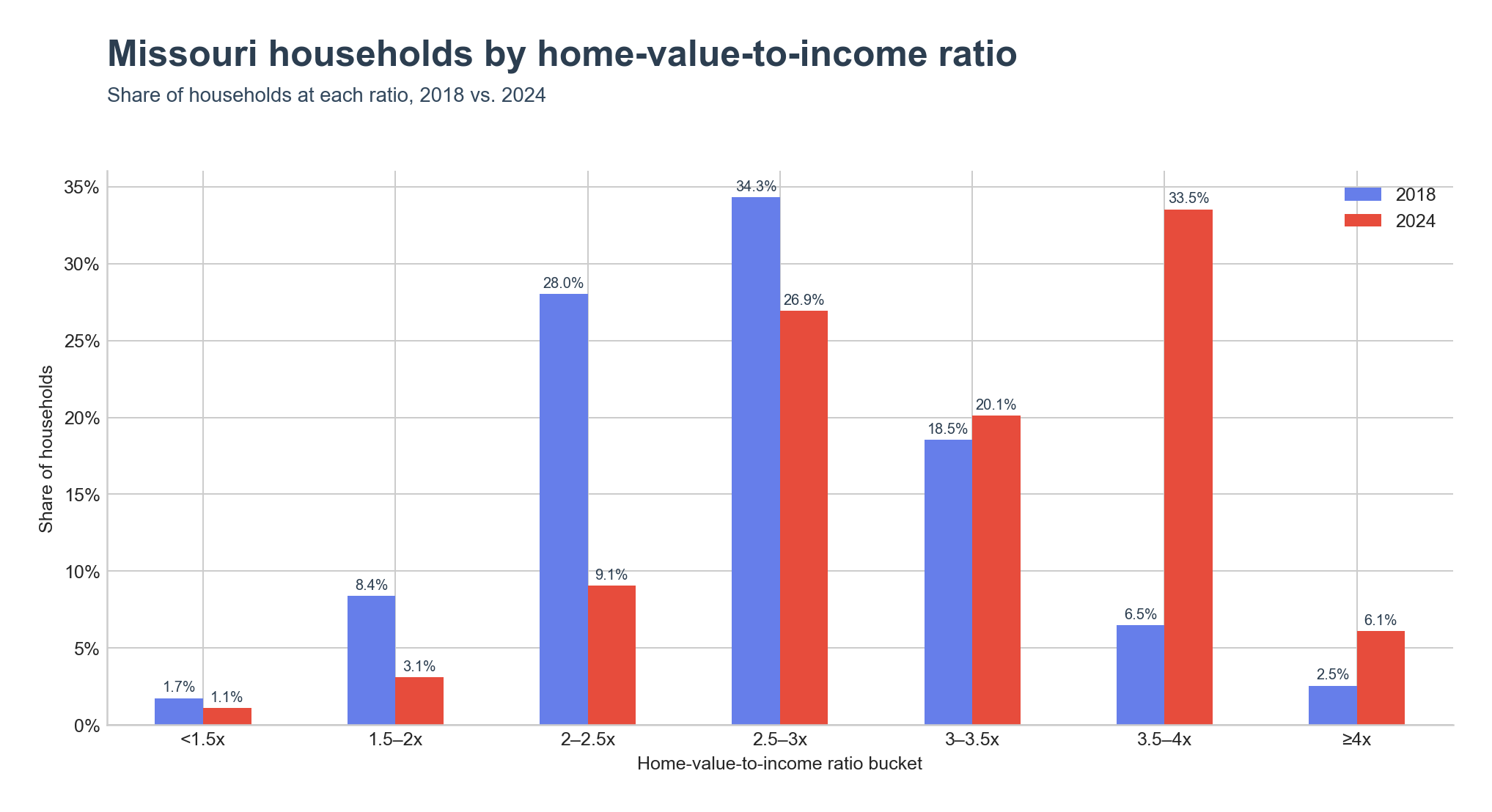
In 2018, 34.3% of Missouri households lived in places with a ratio between 2.5x and 3x, the single largest bucket. By 2024, that share fell to 26.9%, while the 3.5x–4x bucket grew from 6.5% to 33.5% of households — now the largest bucket in the state. The ≥4x bucket also grew, from 2.5% to 6.1%.
Key Takeaways
- Missouri's home-value-to-income ratio was 3.26x in 2024, versus 4.12x for the United States.
- The gap to the national ratio widened from 0.57x in 2018 to 0.86x in 2024.
- Missouri's median home value rose from $151,600 to $230,300 between 2018 and 2024; median household income rose from $53,560 to $70,702.
- Clayton had the highest ratio among Missouri places at 6.75x; Jennings had the lowest at 1.76x.
- Camden County led Missouri counties at 4.60x; Atchison County was lowest at 1.82x.
- The 3.5x–4x household share grew from 6.5% in 2018 to 33.5% in 2024, becoming the largest bucket in the state.