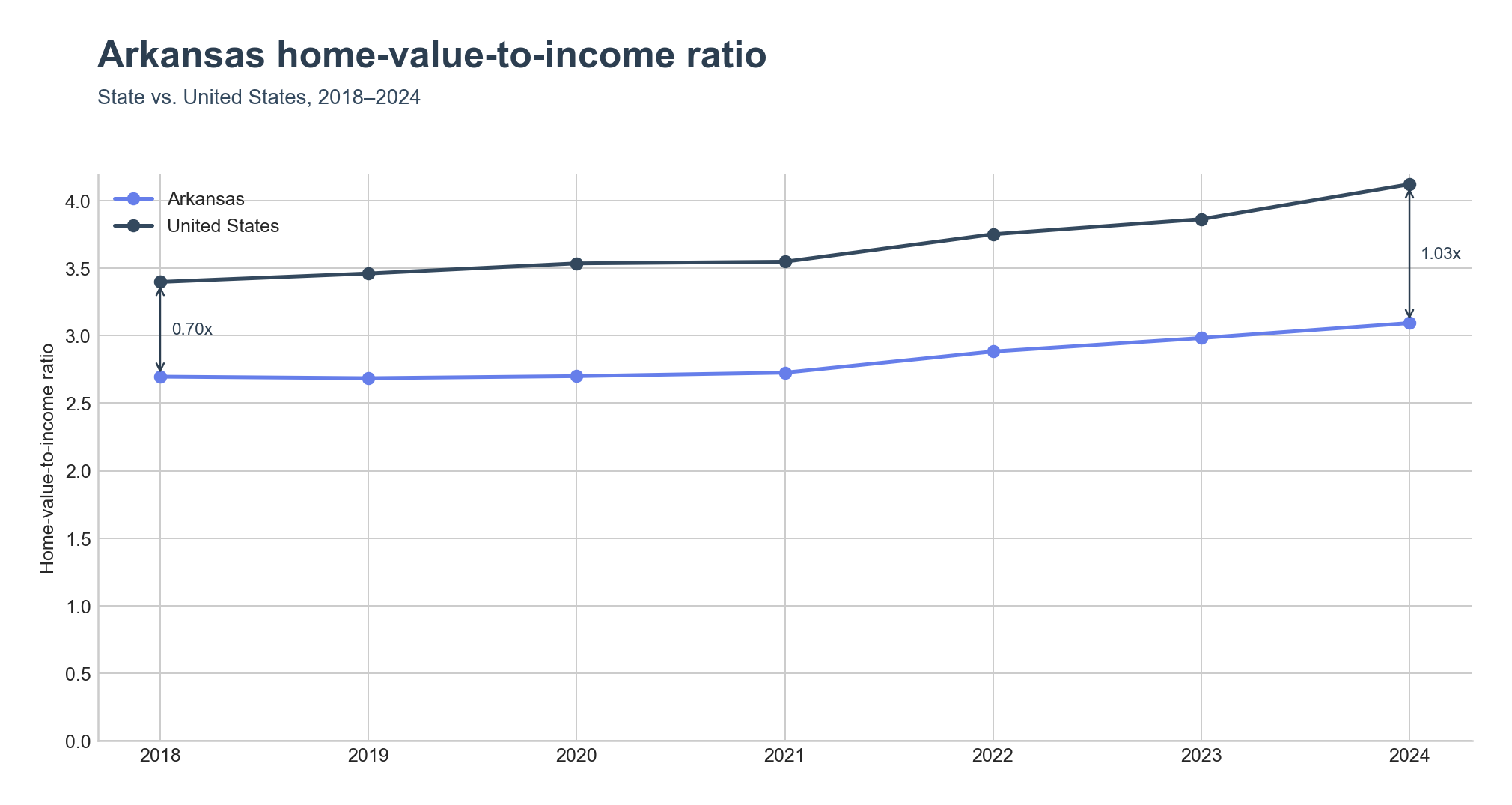
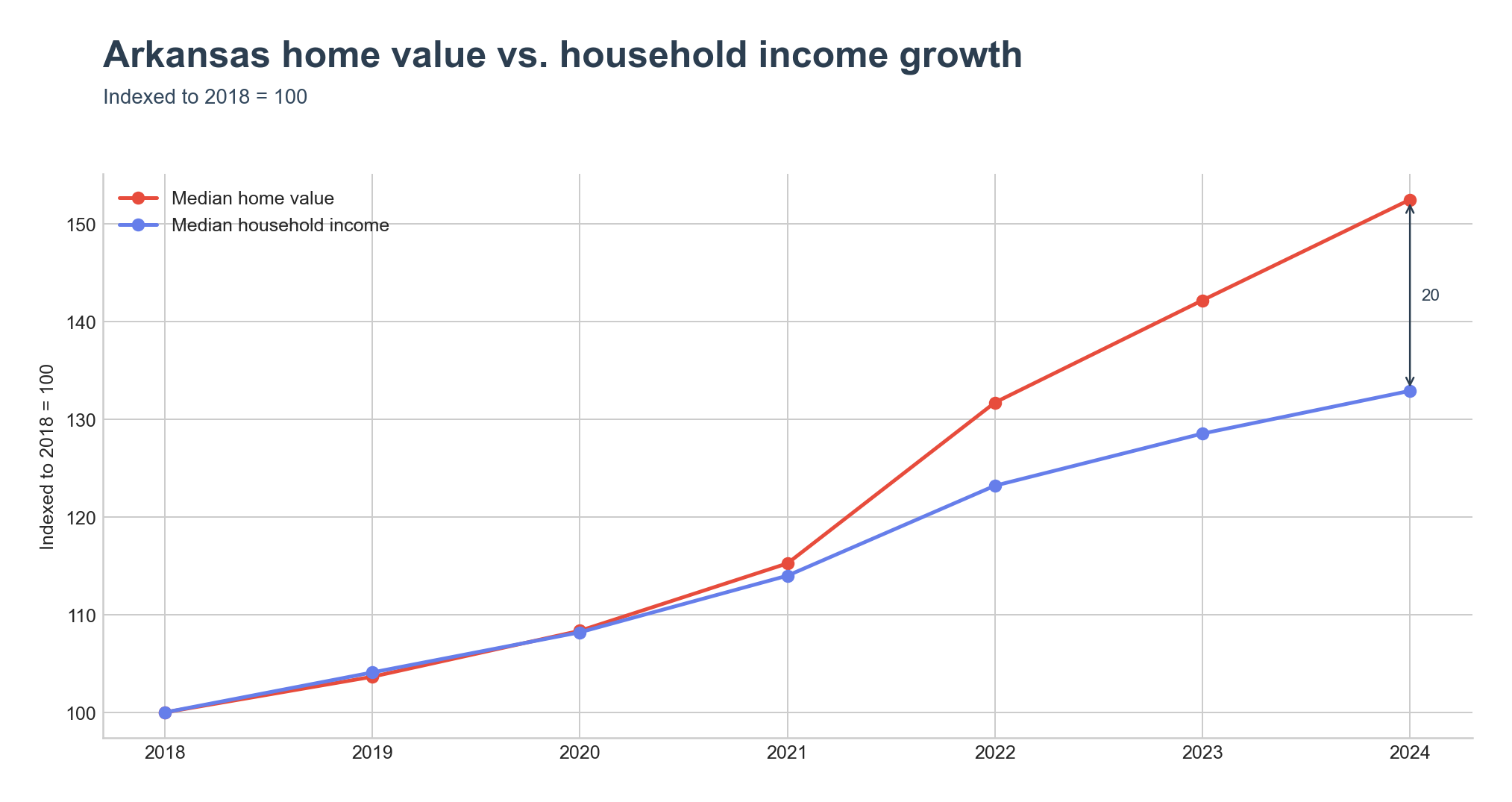
Arkansas's home-value-to-income ratio reached 3.09x in 2024, well below the United States figure of 4.12x. The gap between the two has widened since 2018, when Arkansas stood at 2.70x against a national 3.40x — home values have climbed faster than household income in the state, but the national ratio has risen faster still, leaving Arkansas further below the national line than it was six years ago.
Where the ratio runs highest
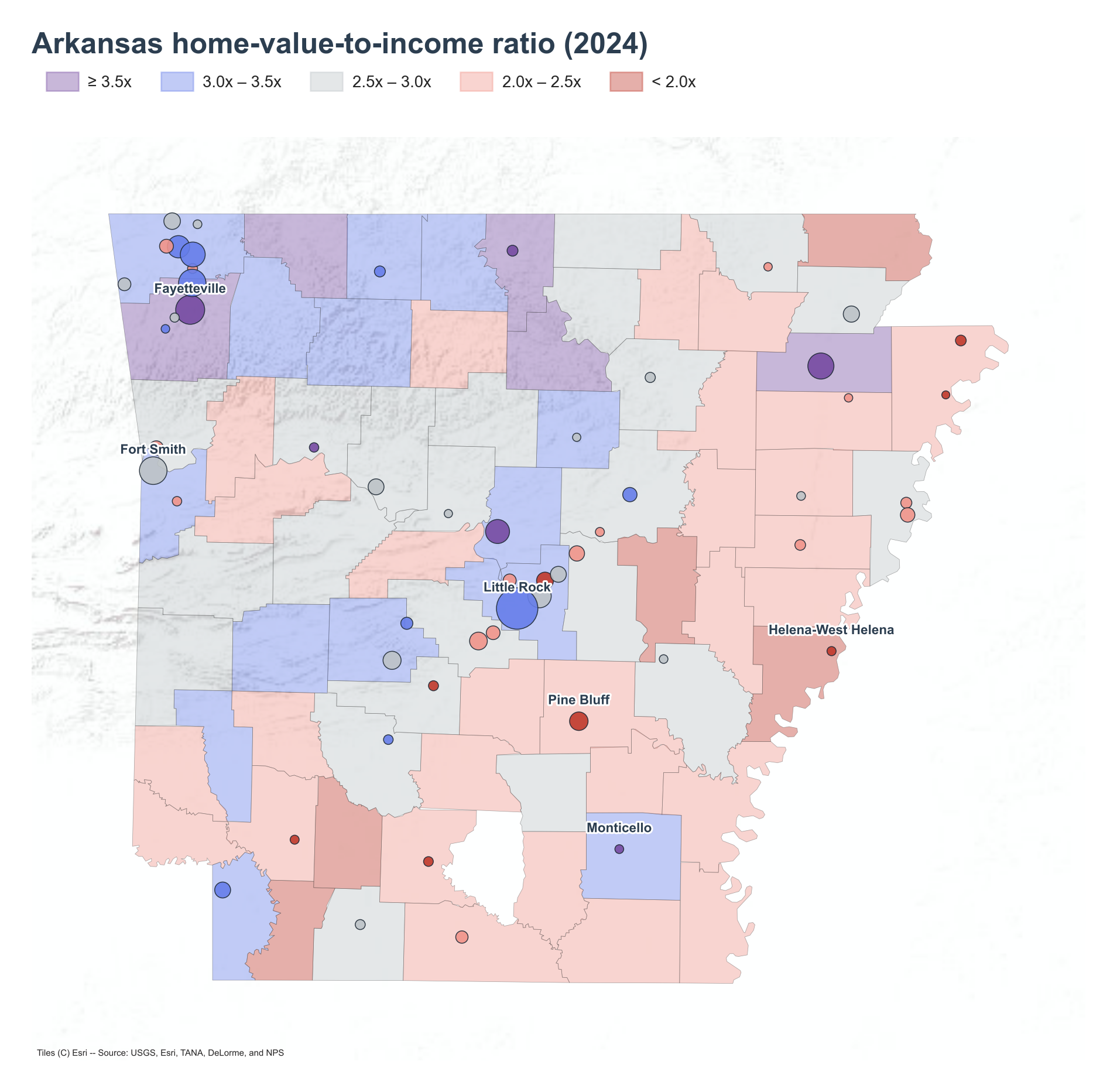
Fayetteville tops the state at 5.58x, the highest ratio among Arkansas places, driven by a home value of $349,600 against household income of $62,695. The city anchors the University of Arkansas , the flagship of the University of Arkansas System, in the state's northwest corner. Washington County, home to Fayetteville, is the top-ranked county at 4.22x, sitting inside the Fayetteville–Springdale–Rogers metropolitan area that also includes Walmart's and J.B. Hunt's headquarters.
Monticello follows at 5.05x, with a home value of $137,500 against a household income of just $27,238 — the lowest income among the top-ranked places, which pushes its ratio up despite modest home prices. The city is home to the University of Arkansas at Monticello , the state's only forestry-degree program.
Rounding out the top places are Clarksville (4.41x), Mountain Home (4.11x), and Jonesboro (4.03x). Among counties, Stone County (4.19x) and Carroll County (3.88x) follow Washington County — Stone County contains Mountain View, known as the Folk Music Capital of the World for its Ozark Folk Center and courthouse-square music gatherings, a tourism draw that keeps home values elevated relative to local income.
Where the ratio runs lowest
Helena-West Helena posts the lowest ratio in the state at 2.03x, with a home value of $73,200 against household income of $36,019. The city sits along the Mississippi River in eastern Arkansas, in Phillips County, whose economy has long centered on cotton agriculture. Pine Bluff follows close behind at 2.09x (home value $89,400, household income $42,718), in south-central Arkansas — a city that has lost population through decades of industrial decline.
Osceola (2.16x), Camden (2.18x), and Malvern (2.26x) round out the bottom places. Among counties, Nevada County is lowest at 1.55x, followed by Clay County (1.84x), Prairie County (1.87x), Phillips County (1.95x), and Lafayette County (1.96x) — all rural counties where low home values keep the ratio well under the state's own 3.09x.
How the distribution moved
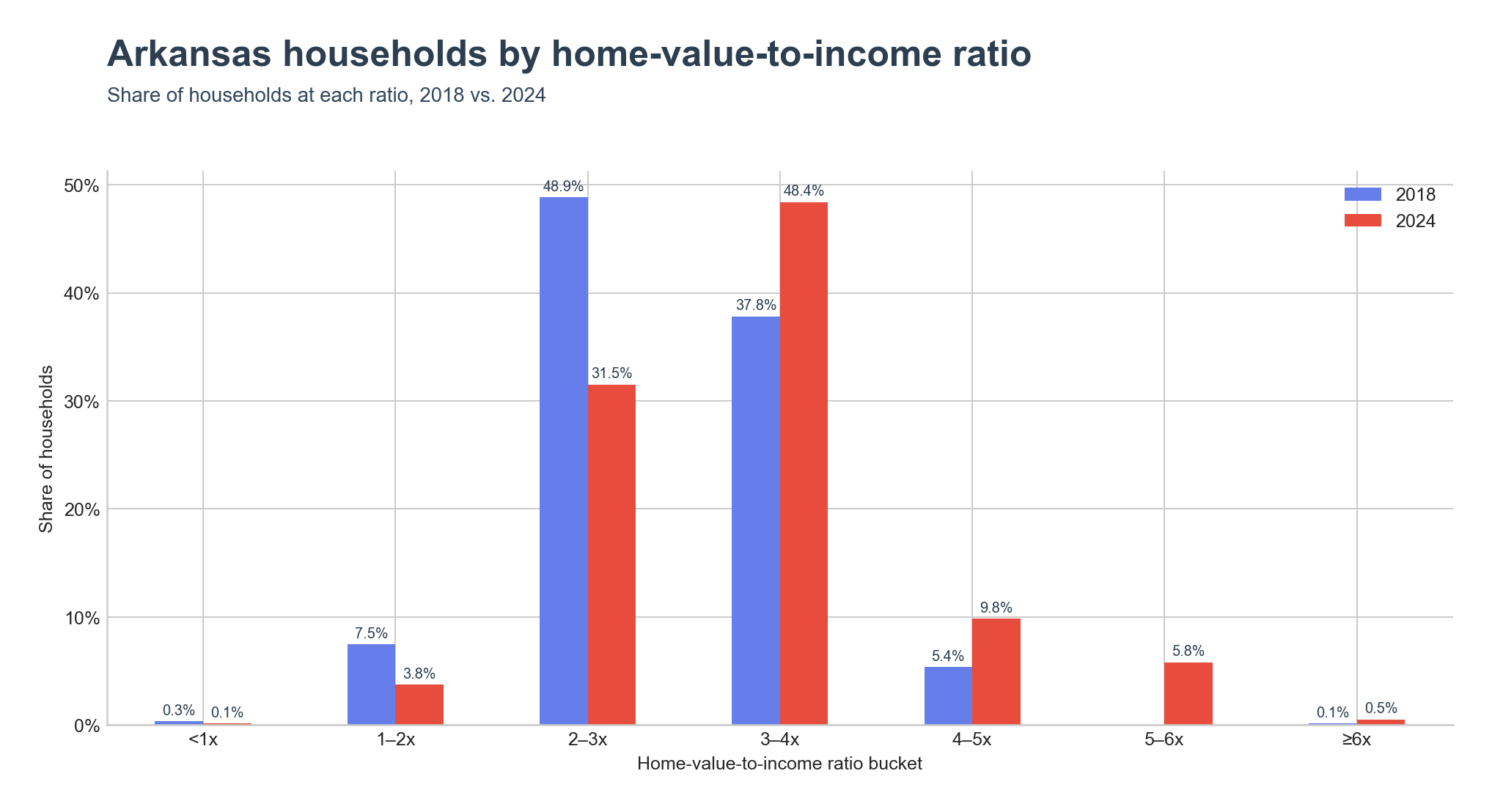
The distribution of Arkansas households has shifted markedly since 2018. The 2–3x band held the largest share of households in 2018 at 48.9%; by 2024 the 3–4x band had become the largest at 48.4%, while the 2–3x share fell to 31.5%. The 4–5x band grew from 5.4% to 9.8%, and a new 5–6x band appeared at 5.8% of households, up from essentially none in 2018.
Key Takeaways
- Arkansas's home-value-to-income ratio was 3.09x in 2024, up from 2.70x in 2018, and remains below the national ratio of 4.12x (versus 3.40x nationally in 2018).
- Fayetteville led all places at 5.58x; Washington County led all counties at 4.22x.
- Helena-West Helena had the lowest place-level ratio at 2.03x; Nevada County had the lowest county-level ratio at 1.55x.
- The share of Arkansas households in the 3–4x ratio band grew from 37.8% in 2018 to 48.4% in 2024, while the 2–3x band fell from 48.9% to 31.5%.