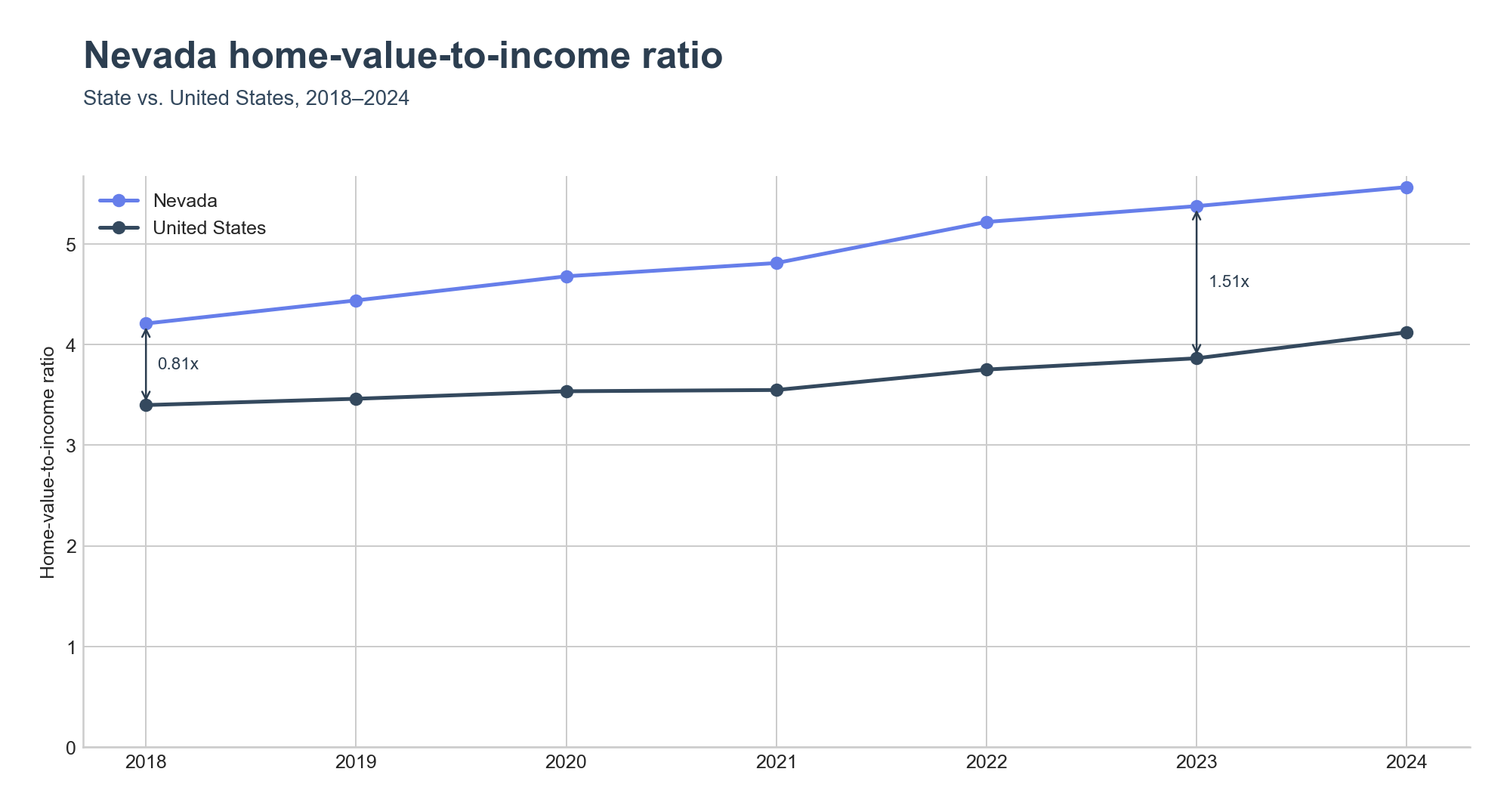
Nevada started above the U.S. ratio and pulled further ahead.
Nevada's statewide home-value-to-income ratio reached 5.56x in 2024, up from 4.21x in 2018. The United States moved from 3.40x to 4.12x over the same window. Nevada already sat above the national ratio in 2018 and stayed there through 2024, with the gap widening rather than closing as both lines climbed.
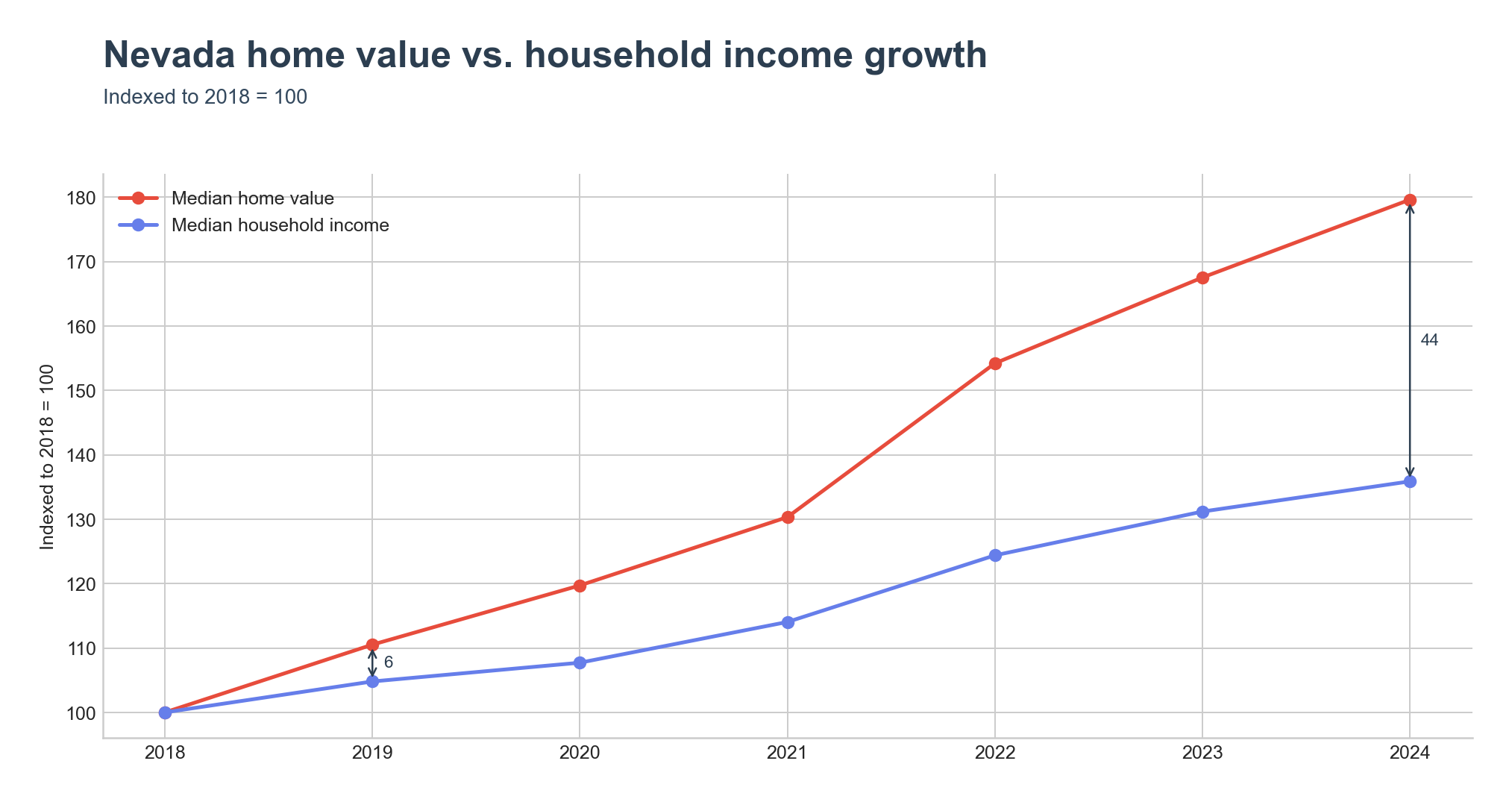
Home values rose faster than incomes across the whole window.
Indexed to 2018 = 100, Nevada's median home value and median household income both climbed steadily, with home value pulling further ahead of income each year through 2024. The typical Nevada home went from $242,400 to $435,400 while median household income rose from $57,598 to $78,260.
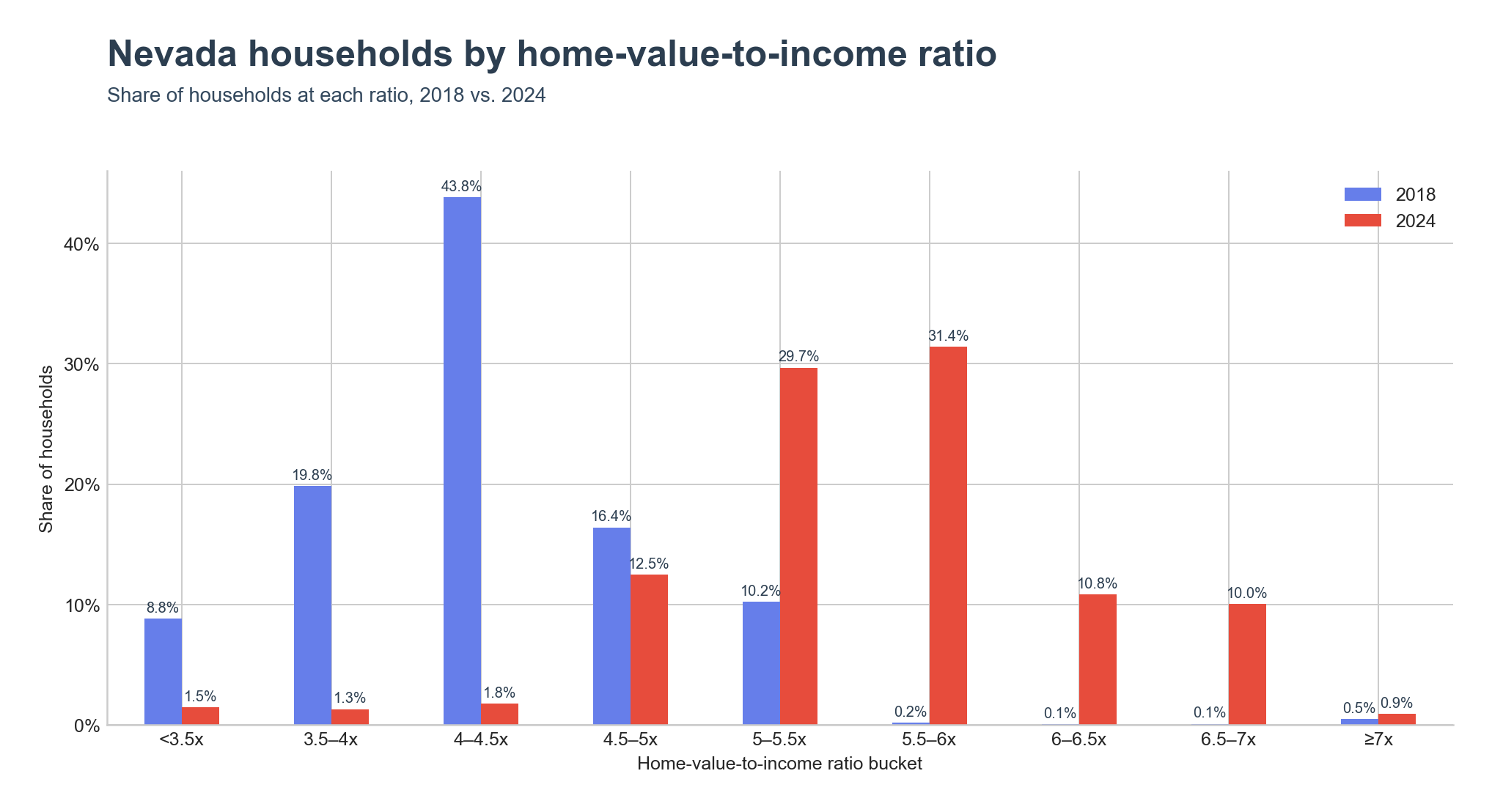
The Nevada distribution shifted from the 4–4.5x band to the 5.5–6x band.
In 2018, the largest share of Nevada households, 43.8%, lived in places at 4–4.5x. By 2024, that band held just 1.8%, and the largest share, 31.4%, sat at 5.5–6x, with another 29.7% at 5–5.5x. The ≥7x band, negligible in 2018 at 0.5%, still held only 0.9% in 2024 — the shift moved the middle of the distribution rather than stretching a long upper tail.
High ratios cluster around Lake Tahoe and the Carson Valley; low ratios sit in rural mining counties.
Incline Village tops the state at 8.71x, a community on the north shore of Lake Tahoe carrying some of the priciest real estate in the country, where the Nevada-side location has drawn residents registering homes to avoid California taxes — a median home value of $1,454,600 against a $167,069 median household income. Gardnerville follows at 7.83x, an agricultural-heritage town in the Carson Valley a few miles south of Carson City. Reno sits third at 6.79x; the Tesla Gigafactory just east of the city has drawn thousands of jobs and driven up regional housing demand. Paradise at 6.49x and Johnson Lane at 6.29x round out the top five, with Johnson Lane sitting alongside Gardnerville in the Carson Valley.
Among counties, Douglas County leads at 6.78x — it holds part of the Nevada shore of Lake Tahoe, a location advantage that helps explain its housing premium. Carson City , Nevada's independent consolidated city-county, follows at 6.26x, and Washoe County (Reno) at 6.13x.
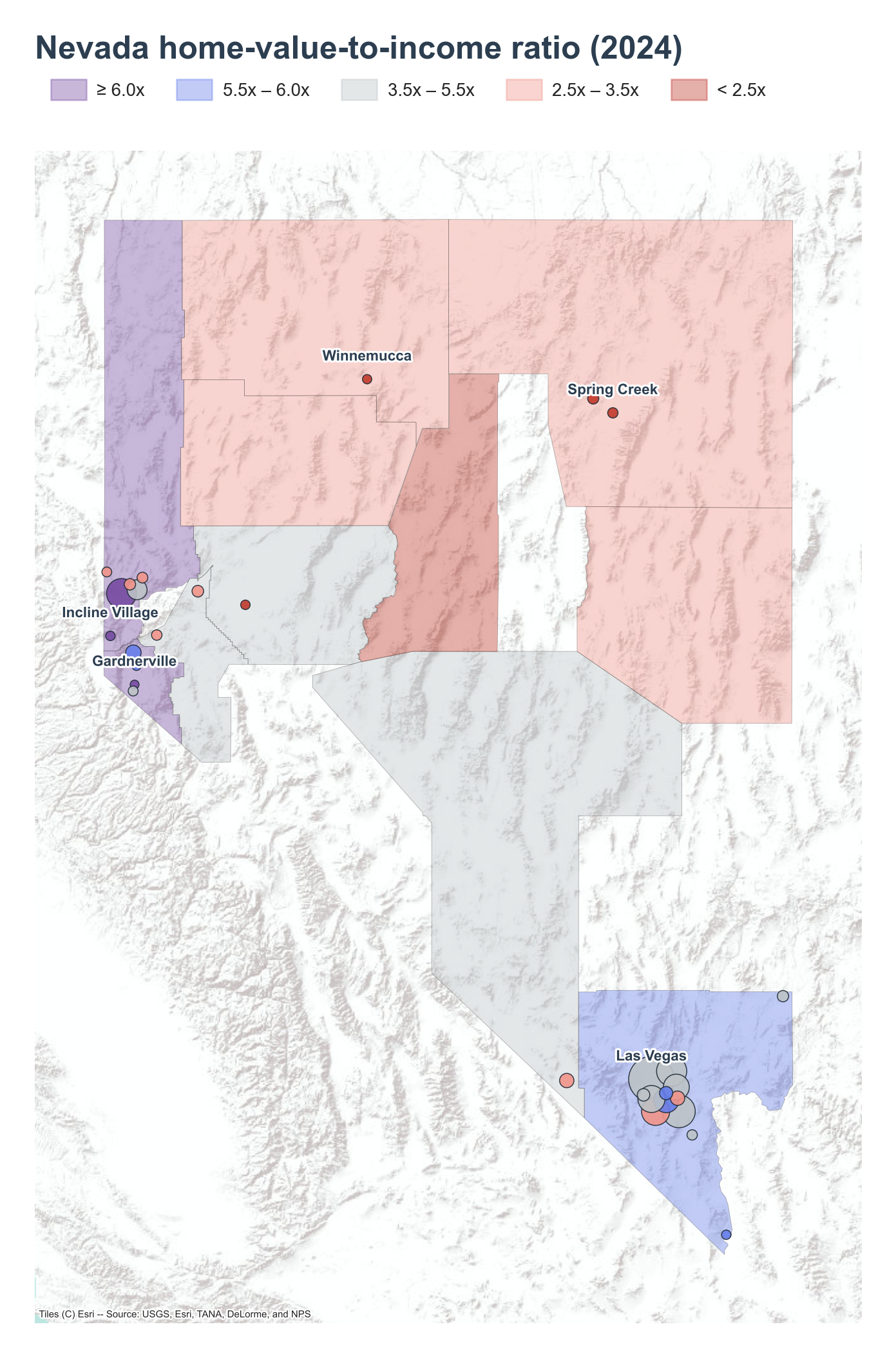
The lowest ratios cluster in Nevada's rural mining counties and towns. Lander County is the state's lowest at 2.40x, seated at Battle Mountain , whose economy rests primarily on gold mining. Pershing County follows at 2.68x and White Pine County at 3.02x. Among places, Spring Creek is lowest at 3.43x — a bedroom community for the businesses and industries around nearby Elko , whose own economy leans heavily on gold mining, which supports household incomes locally. Winnemucca follows at 3.78x, where residents are largely employed by gold mining companies including Newmont and Barrick Gold.
Key Takeaways
- Nevada's home-value-to-income ratio reached 5.56x in 2024, up from 4.21x in 2018, and stayed above the U.S. ratio of 4.12x the entire window, with the gap widening rather than closing.
- Median home value rose from $242,400 to $435,400 while median household income rose from $57,598 to $78,260.
- The modal band shifted from 4–4.5x (43.8% of households in 2018) to 5.5–6x (31.4% in 2024), with 29.7% more sitting at 5–5.5x.
- High ratios concentrate around Lake Tahoe and the Carson Valley: Incline Village, Gardnerville, Reno, Paradise, Johnson Lane, Douglas County, Carson City, and Washoe County.
- Low ratios sit in rural gold-mining counties and towns: Lander County (Battle Mountain), Pershing County, White Pine County, Spring Creek, and Winnemucca.