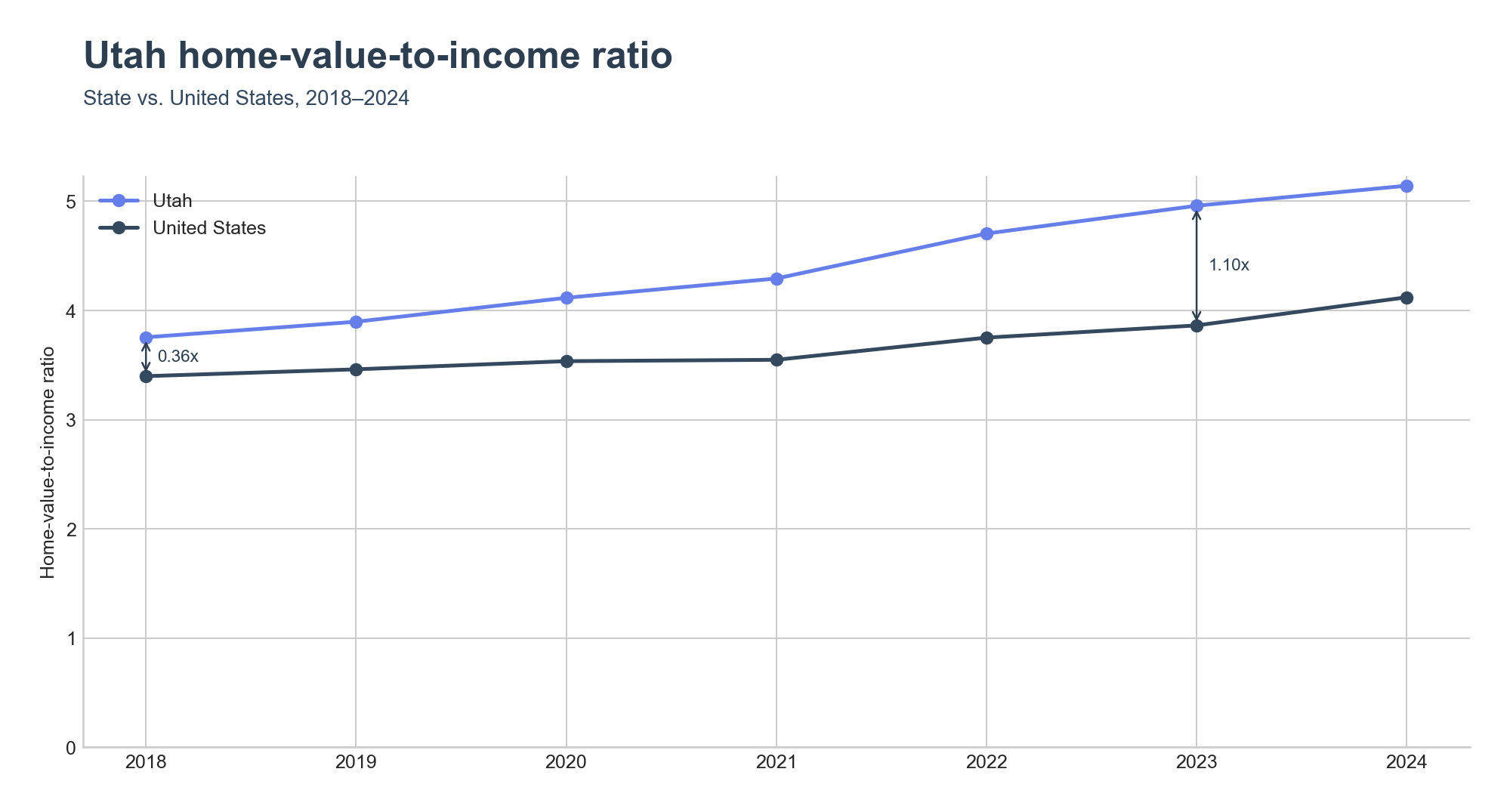
Utah's home-value-to-income ratio sits at 5.14x in 2024, more than a full point above the United States benchmark of 4.12x. In 2018 Utah was only 0.36x above the country; by 2024 that gap had stretched to roughly 1.02x, and Utah's line pulls steadily away from the national line every year.
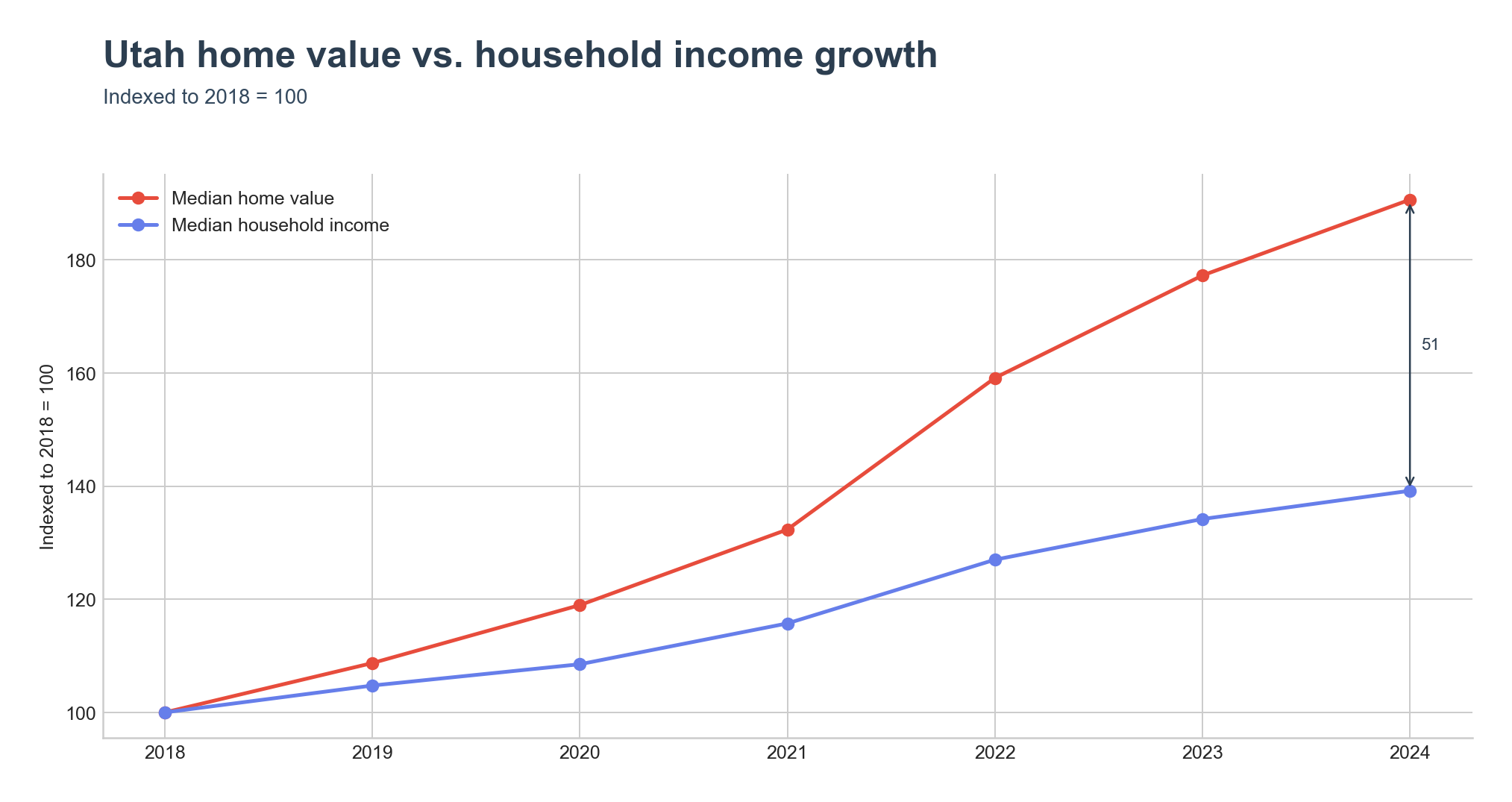
The driver is lopsided component growth. Median home value in Utah climbed to an index of 191 against a 2018 base of 100, while median household income only reached 139 — a 51-point gap that did not exist before 2020. Income rose from $68,374 to $95,166 while the typical home went from $256,700 to $489,400.
Where the metrics overlap
The map concentrates the highest ratios along the Wasatch Front and in the resort counties on either side of it.
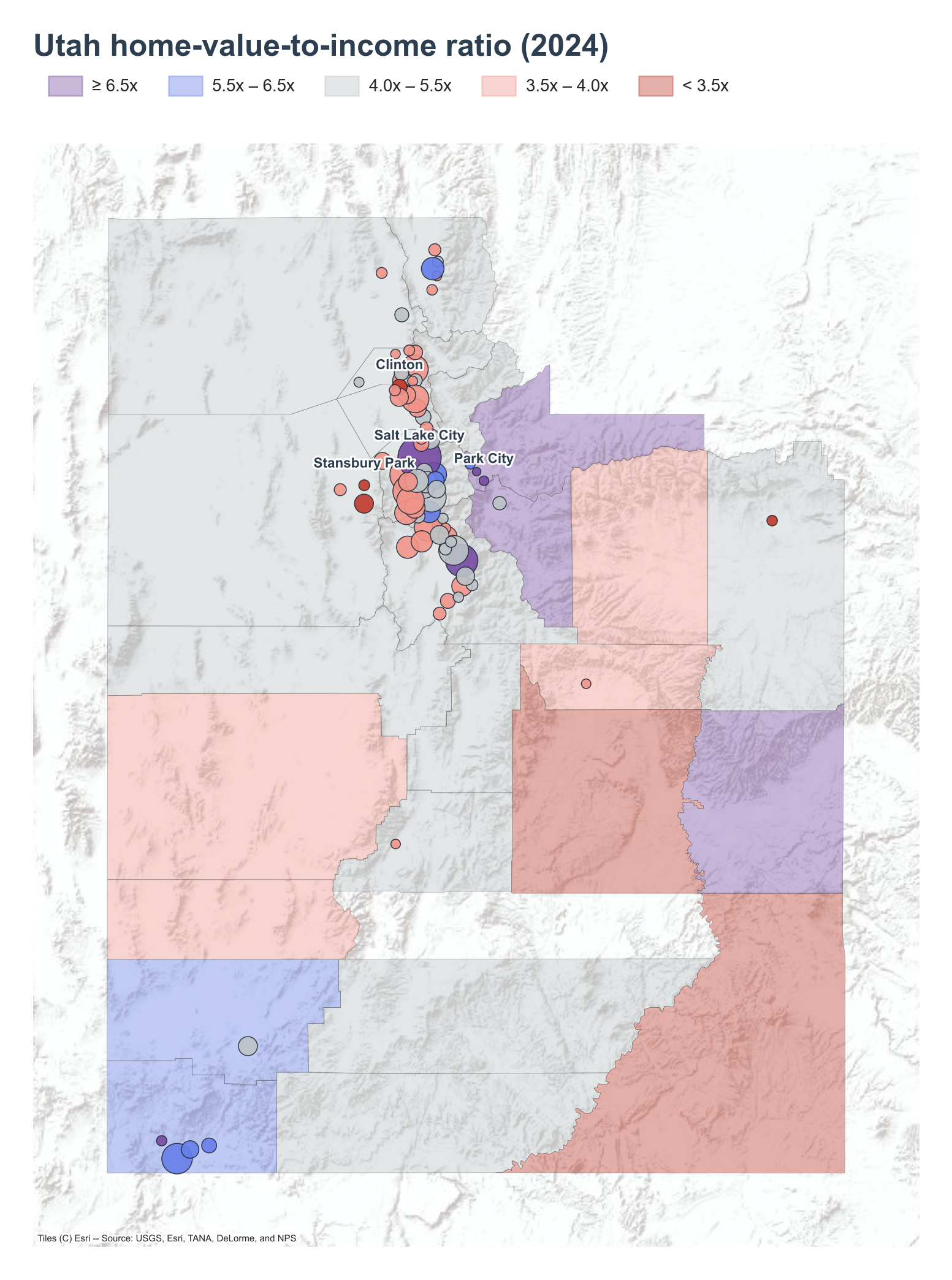
Park City tops every place in the state at 13.16x, with a median home value of $1,757,800 against household income of $133,558 — the resort economy of the 2002 Winter Olympics host town keeps incomes well above the state median but home values five times higher still. Just over the ridge, Snyderville sits at 7.69x on a $1,104,200 median value, and the surrounding Summit County registers 7.73x at the county level. Neighboring Wasatch County , anchored by Heber Valley, runs 6.69x.
The other high-ratio cluster is in southwestern Utah. Grand County , home to Moab and Arches National Park , is the highest county in the state at 8.03x — driven by a $538,700 home value against a county household income of only $67,106. Washington County (St. George) sits at 6.33x and Iron County (Cedar City) at 5.72x; within Washington County, Ivins reaches 7.61x at a $594,000 median value with income near the state average.
The Wasatch Front's two biggest cities show the same pattern at scale: Provo at 7.28x ($467,200 / $64,171, depressed in part by Brigham Young University's student-heavy population) and Salt Lake City at 7.18x ($539,500 / $75,090).
The lowest-ratio places are the working suburbs immediately north and west of Salt Lake City — Stansbury Park (3.81x), Clinton (3.87x), West Point (4.07x), and Tooele (3.96x) — where household incomes of $116,194, $120,687, and $126,526 are high enough to absorb home values in the $381,400–$491,100 range. The lowest counties are rural and resource-economy: Emery at 2.94x, San Juan at 3.48x, Beaver at 3.57x, Duchesne at 3.62x, and Millard at 3.87x — places where home values stayed under $285,000 even as the state's median nearly doubled.
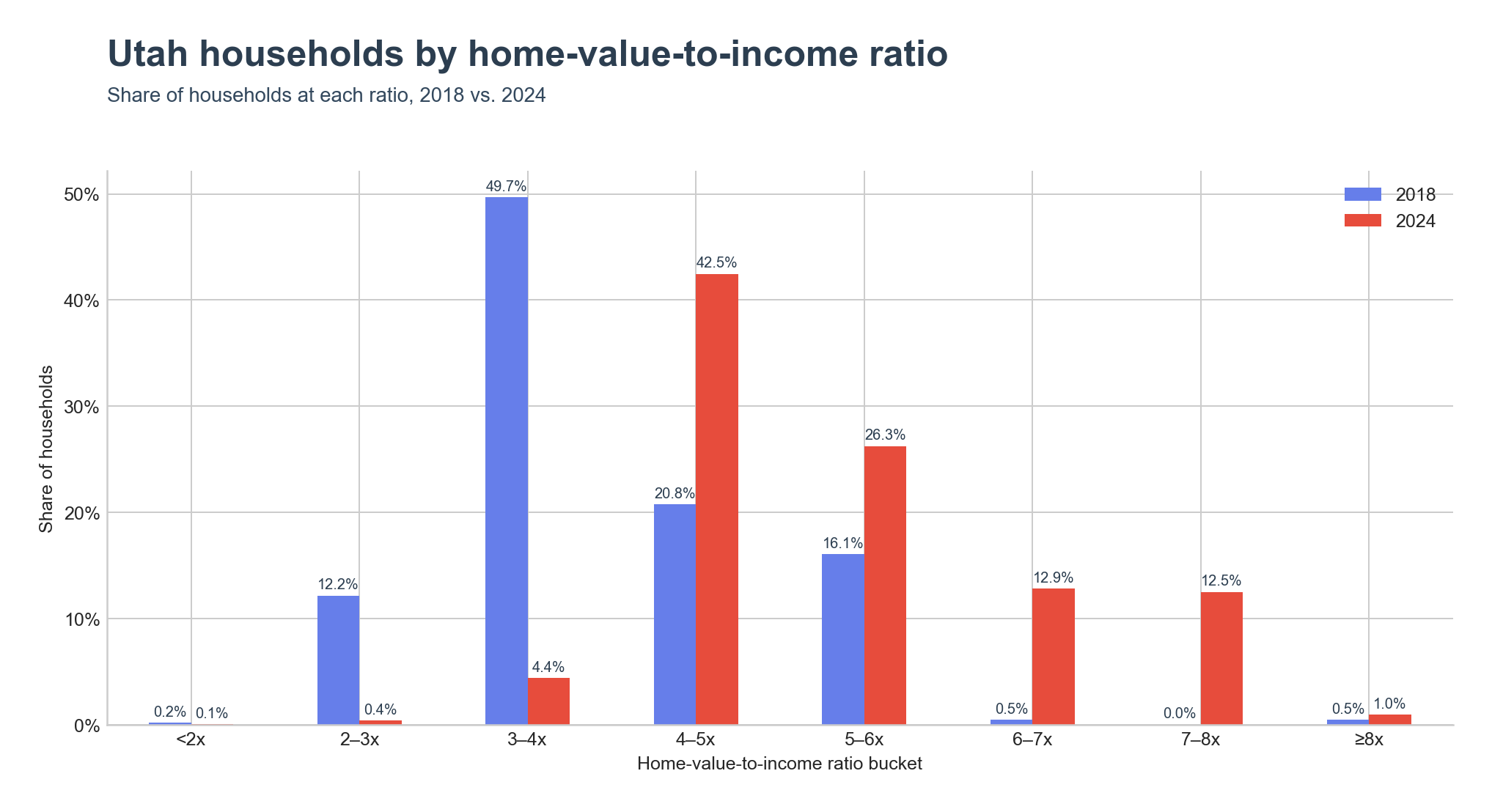
The household-level distribution shows how broadly the shift moved. In 2018, 49.7% of Utah households lived in places with a 3–4x ratio; by 2024 that bucket was down to 4.4%. The 4–5x bucket more than doubled from 20.8% to 42.5%, the 5–6x bucket rose from 16.1% to 26.3%, and the 6–7x and 7–8x buckets — essentially empty in 2018 — together hold 25.4% of households in 2024.
Key Takeaways
- Utah's home-value-to-income ratio reached 5.14x in 2024, 1.02x above the United States.
- Median home value grew by 91% since 2018 while median household income grew 39%.
- Resort counties — Summit, Wasatch, Grand, Washington — dominate the top of the state, with Park City at 13.16x.
- Provo and Salt Lake City both clear 7x, pulled up by home values near or above $500,000 against city-level incomes under $76,000.
- Davis and Tooele County suburbs north and west of Salt Lake City remain the most affordable populated places, all under 4.1x.
- The 3–4x bucket that held nearly half of Utah households in 2018 has collapsed to 4.4%; the 6–8x range now holds more than a quarter of households.