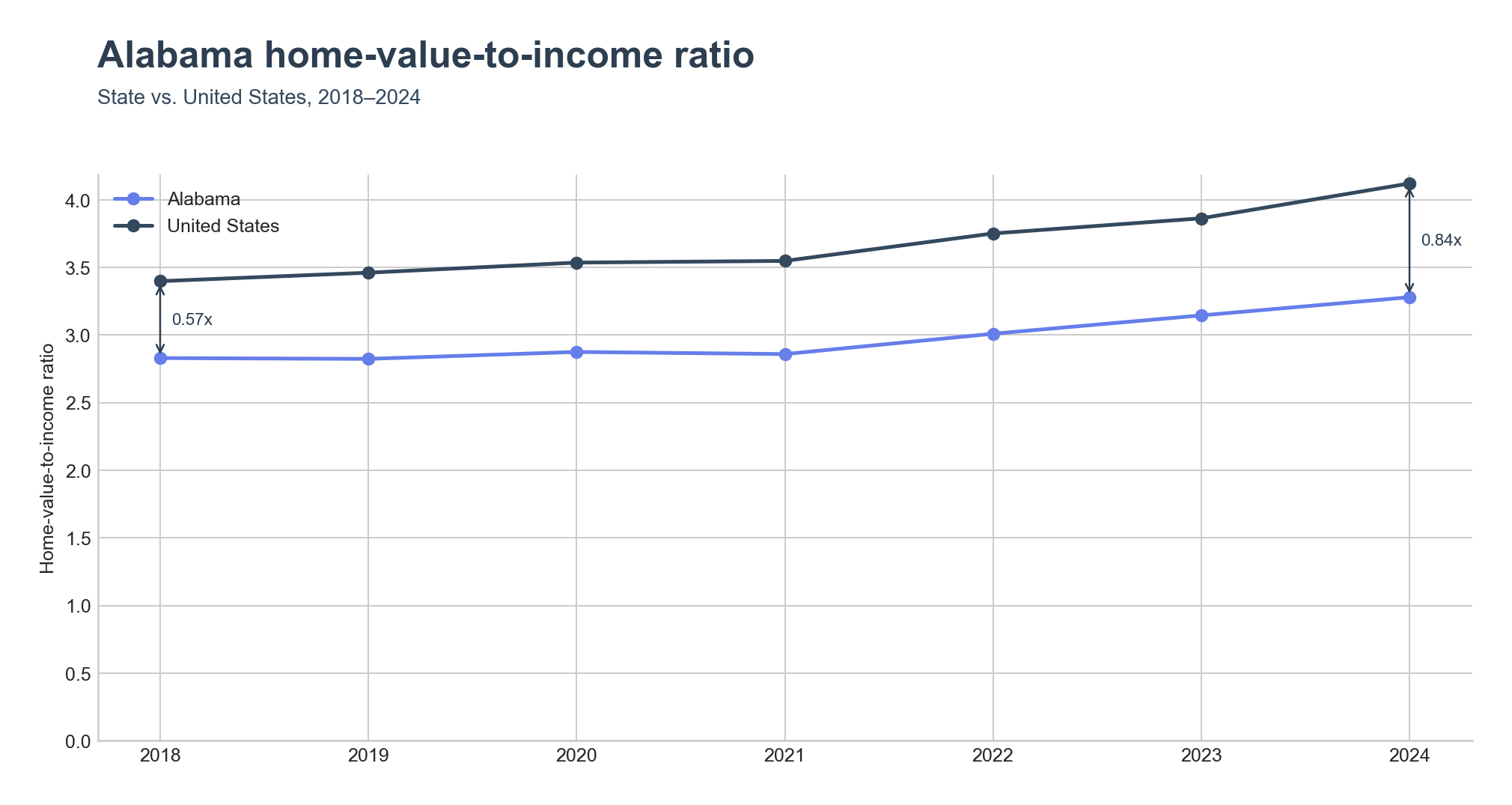
Alabama's home-value-to-income ratio stood at 3.28x in 2024, well below the United States figure of 4.12x. The separation has grown rather than held steady: back in 2018, Alabama's ratio of 2.83x stood against a national 3.40x, a closer pairing than today's.
Where affordability is tightest
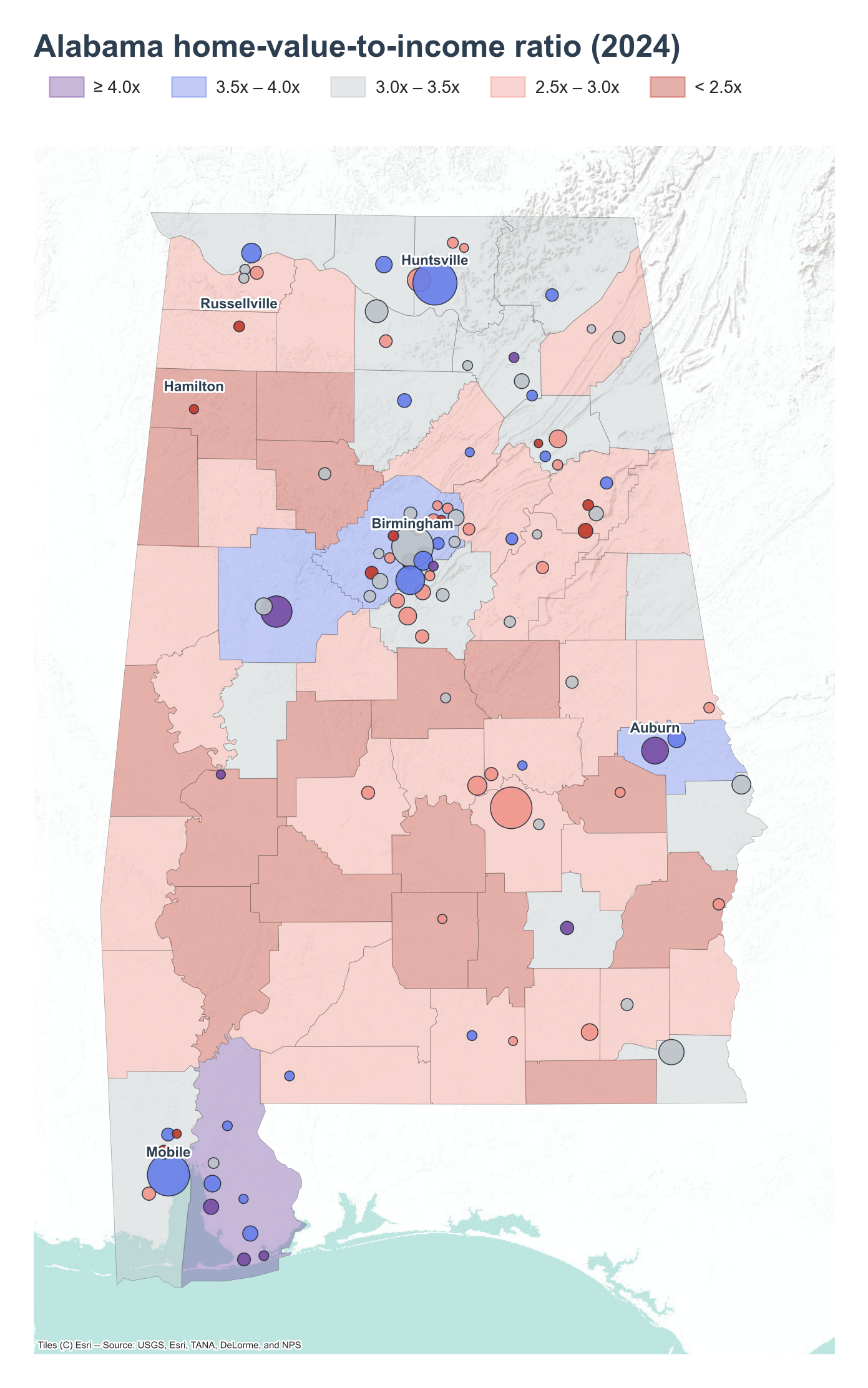
Homewood led the state at 5.91x, driven by a median home value of $558,500 against median household income of $94,485. Homewood is a Birmingham suburb just south of the city across Red Mountain, and its position on the map sits inside the cluster of elevated ratios ringing Birmingham itself.
Auburn followed at 5.73x, with a median home value of $364,800 against income of $63,668. Auburn is home to Auburn University , a factor consistent with the persistent demand for housing in a college town that pushes prices up relative to typical local wages.
Brook Highland, another Birmingham-area suburb visible on the map near the city, posted 5.35x on a home value of $427,400 and income of $79,904. Demopolis reached 5.28x on a home value of $183,600 against income of $34,802 — a case where the ratio is driven less by expensive housing than by comparatively low household income. Orange Beach rounded out the top tier at 5.14x, with a home value of $502,400 and income of $97,736. Orange Beach sits on the Gulf Coast in southern Baldwin County, part of a coastal stretch that shows the deepest purple shading on the map — Orange Beach and neighboring Gulf Shores draw Gulf Coast tourism and second-home demand that keeps prices elevated.
That coastal pattern extends to the county level: Baldwin County led all counties at 4.02x, with a home value of $316,900 against income of $78,775. Baldwin has been Alabama's fastest-growing county , a growth pattern that shows up on the map as the large purple band covering the county's southern reach. Lee County — home to Auburn — was the next-highest county at 3.98x on a home value of $262,200 and income of $65,824, followed by Tuscaloosa County at 3.76x ($248,700 home value, $66,231 income), Jefferson County — anchoring Birmingham — at 3.62x ($240,000 home value, $66,388 income), and Randolph County at 3.47x ($181,600 home value, $52,338 income).
Where affordability holds up
Hamilton, the county seat of Marion County, posted the lowest ratio in the state at 1.94x, on a home value of $106,300 against income of $54,871. Russellville followed at 2.13x ($123,800 home value, $58,231 income), and Attalla matched it at 2.13x ($126,100 home value, $59,215 income). Both sit in the northern part of the state, in the band of lighter-shaded counties visible on the map above Birmingham. Satsuma came in at 2.17x ($219,400 home value, $101,042 income) — notable because its income is well above the other low-ratio places, meaning affordability here comes from earning power rather than cheap housing. Grayson Valley, near Birmingham, rounded out the bottom five at 2.30x ($148,400 home value, $64,597 income).
At the county level, the lowest ratios cluster in the darker-red band running through central and western Alabama. Coosa County posted 2.01x ($115,500 home value, $57,355 income), Winston County 2.08x ($118,900 home value, $57,256 income), Marion County — home to Hamilton — 2.13x ($106,600 home value, $50,088 income), Butler County 2.23x ($99,800 home value, $44,755 income), and Lamar County 2.28x ($114,000 home value, $50,000 income).
A widening gap statewide
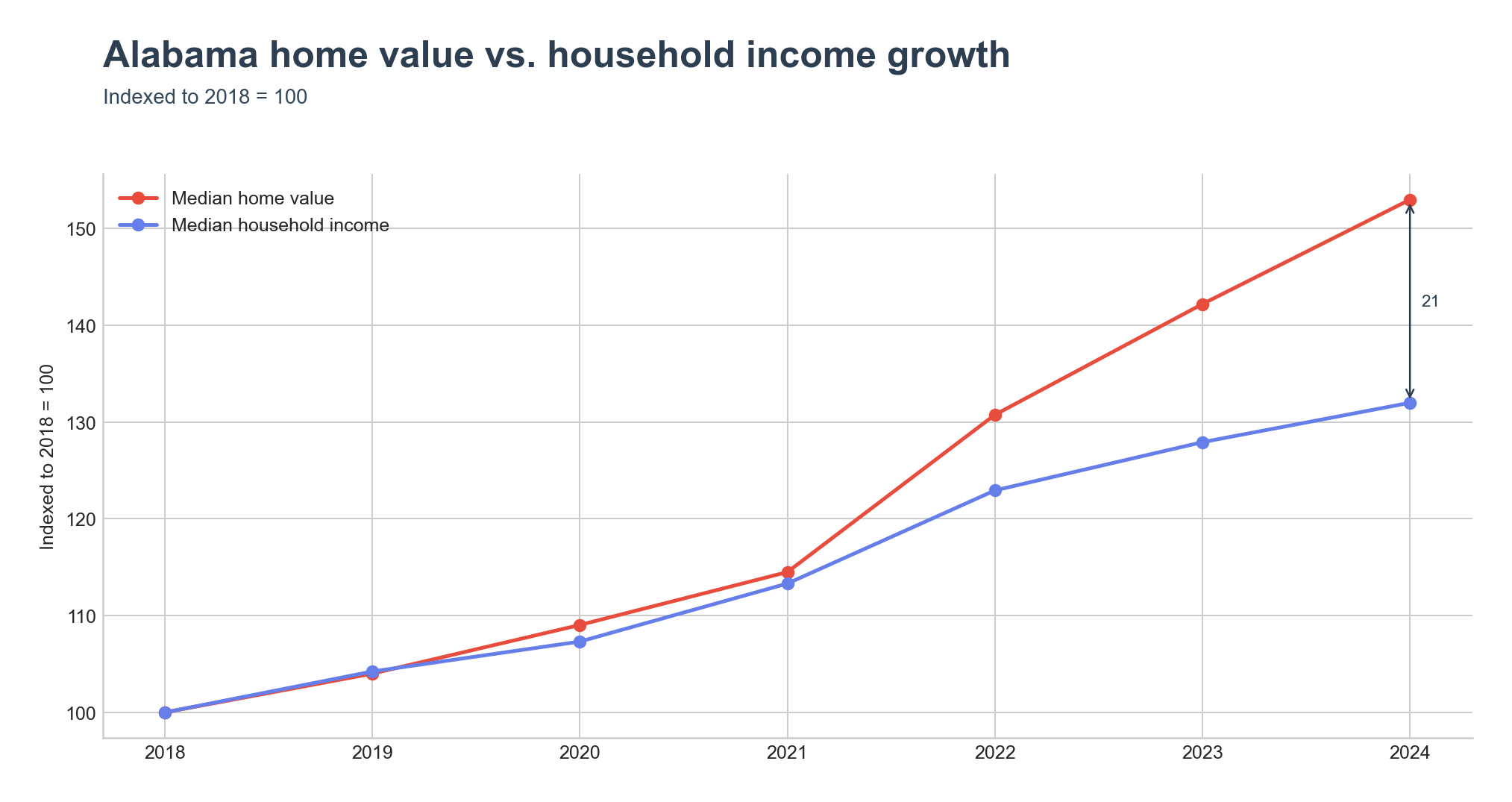
Since 2018, Alabama's median home value climbed from $137,200 to $209,900, while median household income rose from $48,486 to $63,999. Home values have consistently outpaced income growth across the period, which is the mechanical driver behind the ratio's steady climb from 2.83x to 3.28x.
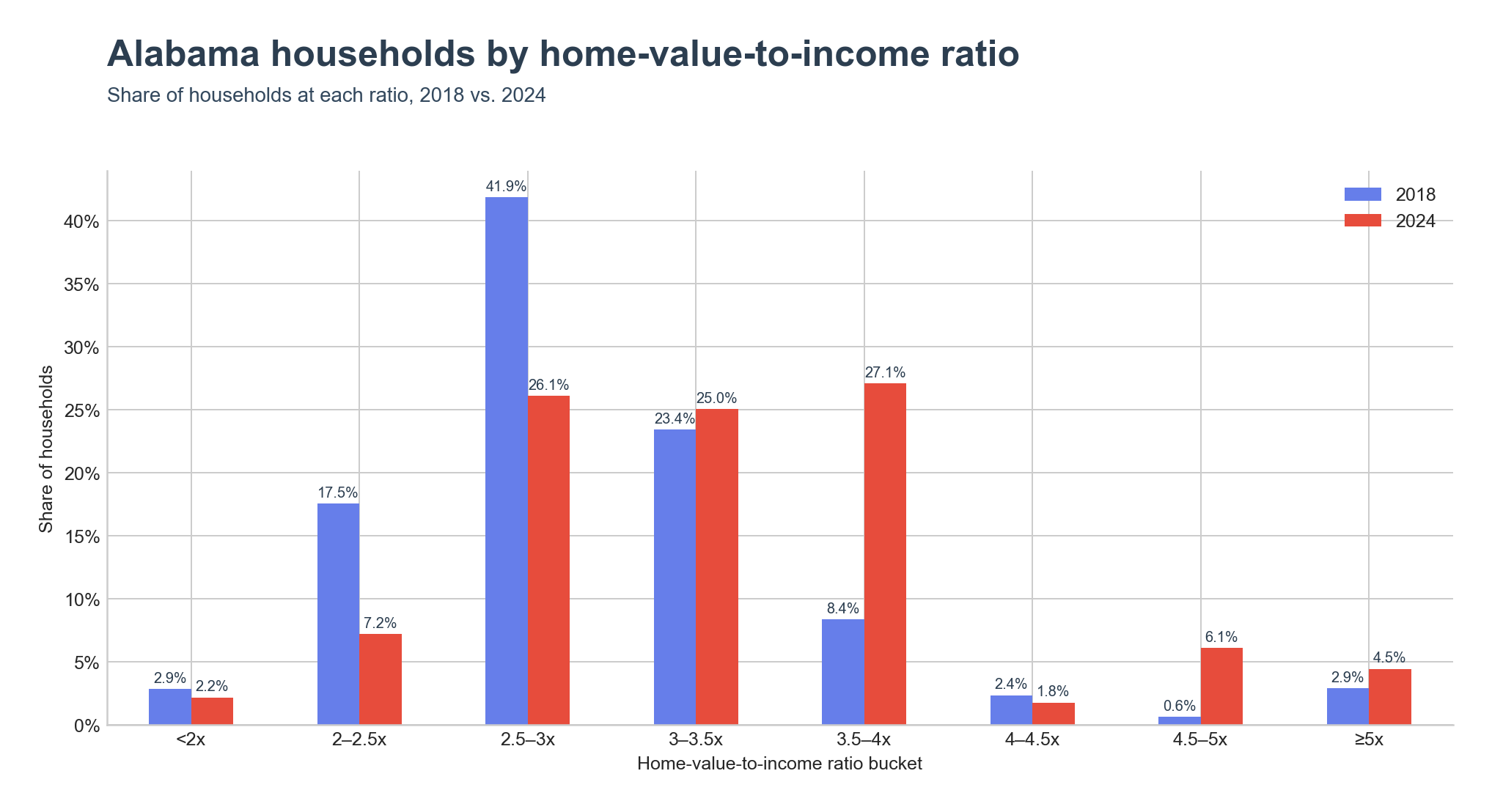
The distribution of households across ratio bands shifted higher between 2018 and 2024. The 2.5–3x band, which held 41.9% of households in 2018, fell to 26.1% by 2024. Over the same period, the 3.5–4x band grew from 8.4% to 27.1% of households, and the ≥5x band grew from 2.9% to 4.5%.
Key Takeaways
- Alabama's statewide home-value-to-income ratio was 3.28x in 2024, versus 4.12x for the United States.
- Homewood led all places at 5.91x, followed by Auburn at 5.73x, Brook Highland at 5.35x, Demopolis at 5.28x, and Orange Beach at 5.14x.
- Baldwin County led all counties at 4.02x, ahead of Lee County (3.98x), Tuscaloosa County (3.76x), Jefferson County (3.62x), and Randolph County (3.47x).
- Hamilton posted the lowest ratio among places at 1.94x; Coosa County posted the lowest among counties at 2.01x.
- The share of Alabama households in the 3.5–4x ratio band rose from 8.4% in 2018 to 27.1% in 2024.