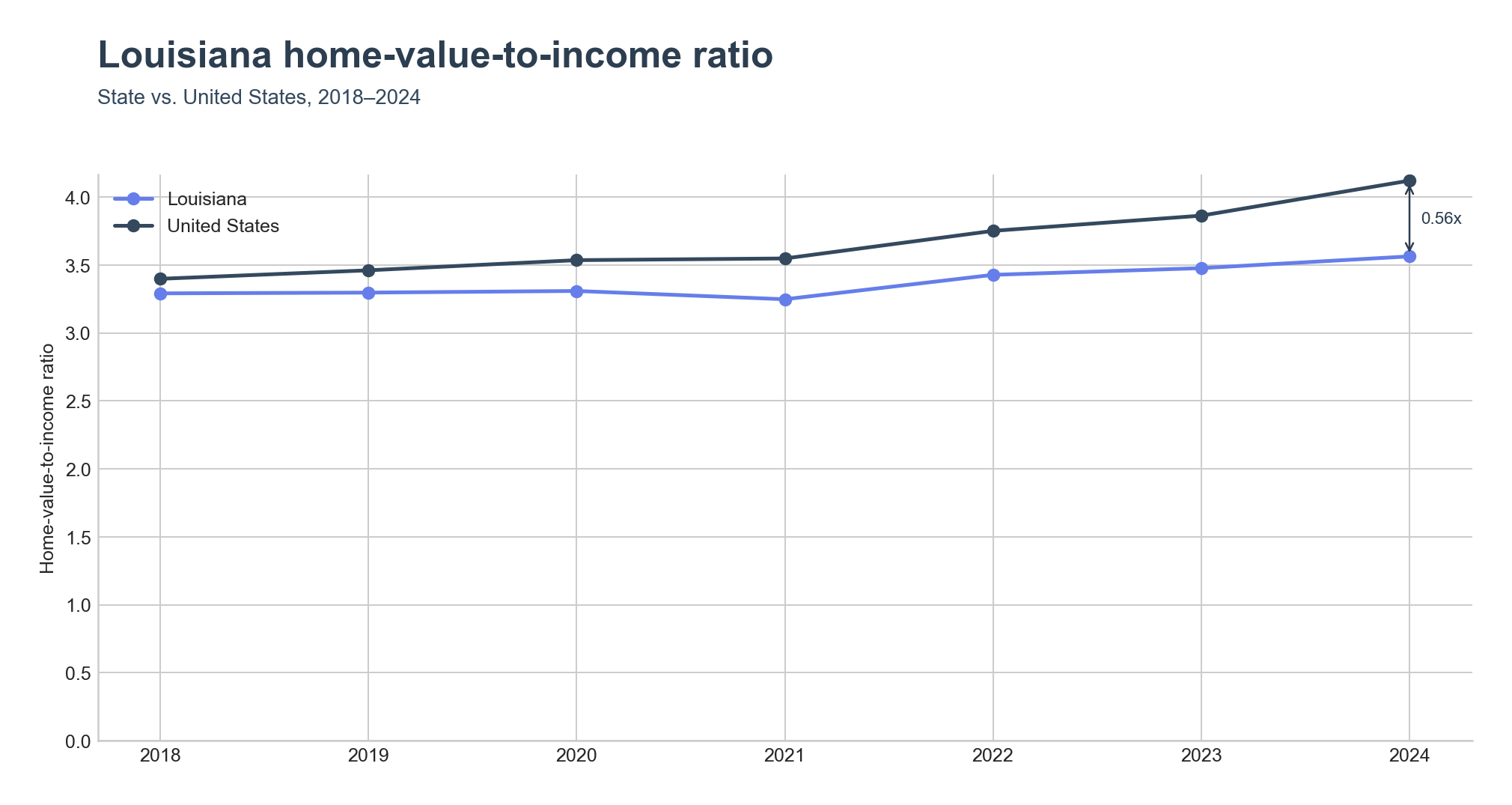
Louisiana's home-value-to-income ratio reached 3.56x in 2024, well below the United States ratio of 4.12x. The state has trailed the national ratio in every year since 2018, when Louisiana stood at 3.29x against a national 3.40x. Both lines rose over the period, but the national ratio pulled away faster, so the gap between Louisiana and the country is wider now than it was in 2018.
Where the ratio runs highest
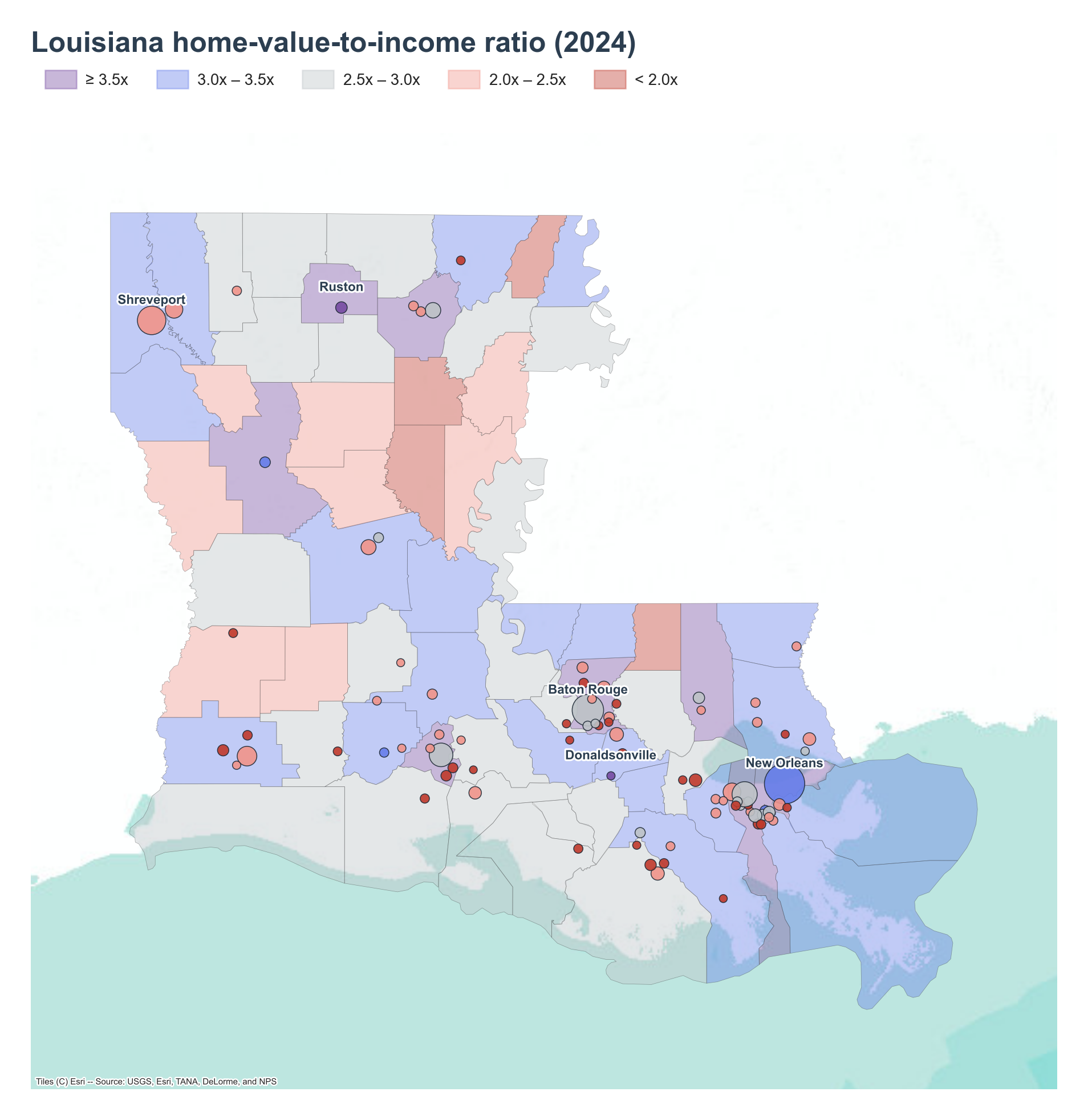
Donaldsonville, on the Mississippi River in Ascension Parish, posts the state's highest ratio at 7.87x, on a median home value of $185,900 against a median household income of just $23,618. The city's historic district holds one of the largest collections of antebellum-to-1933 buildings among Louisiana river towns, a legacy housing stock that keeps values elevated relative to local incomes.
Ruston, seat of Lincoln Parish and home to Louisiana Tech University , follows at 7.24x, with a median home value of $225,300 against a median household income of $31,120 — a pattern typical of college towns where enrolled students depress the measured household income baseline. Lincoln Parish itself ranks among the top parishes at 5.36x.
Gretna (5.97x) and New Orleans (5.57x) round out the top tier. New Orleans anchors Orleans Parish, which also posts the parish-level ratio of 5.57x on a median home value of $315,700. Natchitoches — the oldest permanent European settlement in Louisiana , founded by the French in 1714 — rounds out the top five places at 5.20x.
At the parish level, East Baton Rouge Parish (3.94x), Jefferson Parish (3.85x), and Tangipahoa Parish (3.75x) join Orleans and Lincoln among the highest ratios, all clustered around the state's largest metro areas visible on the parish map.
Where it runs lowest
The lowest ratios belong to a set of smaller places and rural parishes far below the state figure. Bridge City sits at 1.68x (home value $95,700, income $57,031), and Elmwood at 2.10x — both part of the dense cluster of place markers around New Orleans on the parish map. Addis (2.29x), Waggaman (2.49x), and Woodmere (2.52x) complete the bottom five places, each combining moderate home values with comparatively high household incomes.
Among parishes, LaSalle Parish has the lowest ratio in the state at 1.74x, followed by St. Helena Parish (1.84x), West Carroll Parish (1.92x), Caldwell Parish (1.98x), and Catahoula Parish (2.02x) — all shaded in the lowest bands on the 2024 parish map.
Value growth has outpaced income growth
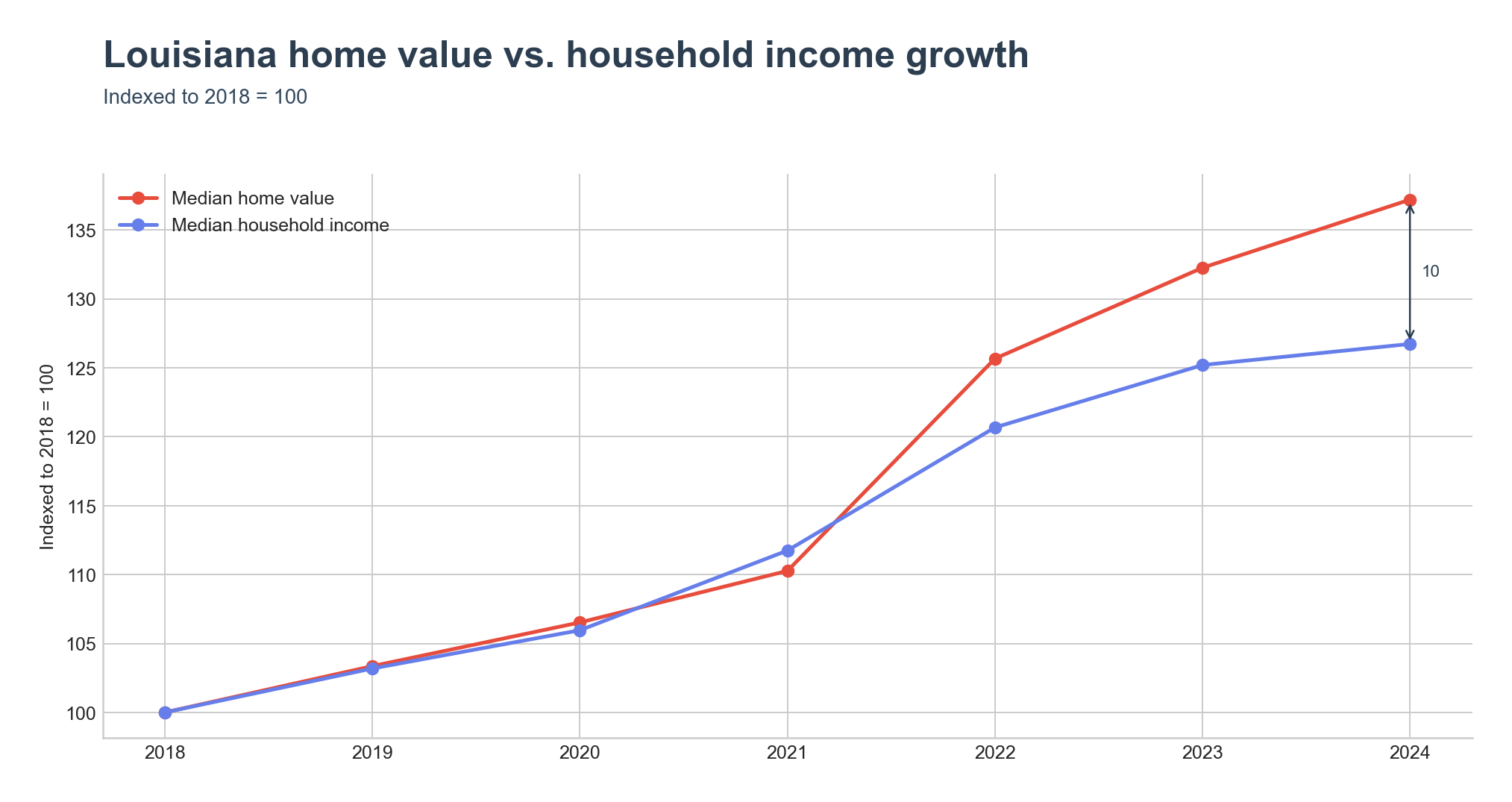
Since 2018, Louisiana's median home value rose from $157,800 to $216,500, while median household income rose from $47,942 to $60,756. Both climbed steadily, but home value growth accelerated faster starting in 2021, widening the gap between the two indexed lines through 2024.
Households are shifting into higher ratio bands
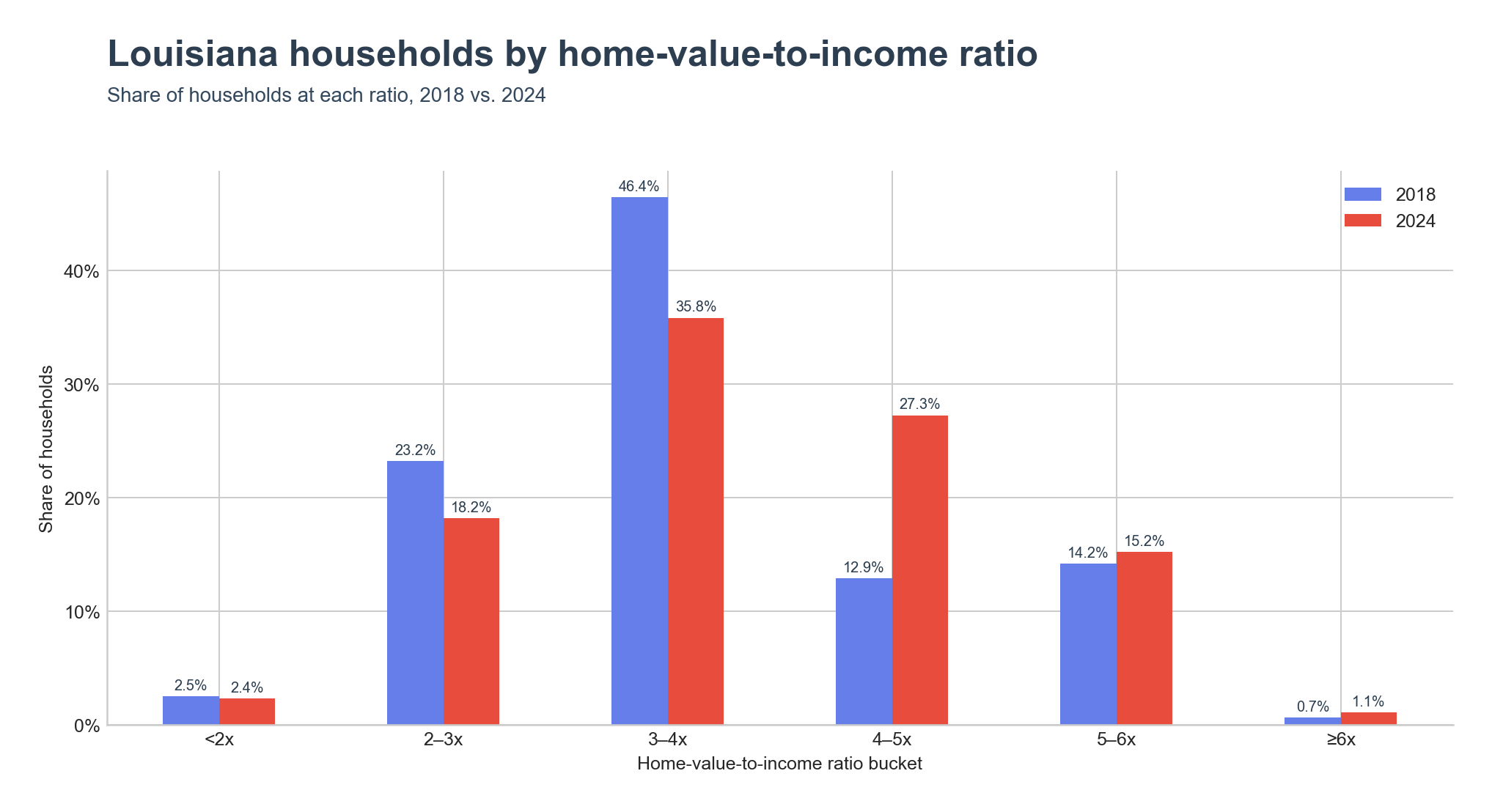
In 2018, 46.4% of Louisiana households lived in places with a ratio between 3x and 4x, the largest single band. By 2024, that band's share fell to 35.8%, while the 4–5x band grew from 12.9% to 27.3% and the 5–6x band grew from 14.2% to 15.2%. The share below 2x held roughly flat, from 2.5% to 2.4%.
Key Takeaways
- Louisiana's home-value-to-income ratio rose from 3.29x in 2018 to 3.56x in 2024, while the US ratio rose from 3.40x to 4.12x over the same period, widening the gap between the state and the nation.
- Donaldsonville (7.87x) and Ruston (7.24x) post the state's highest place-level ratios; Bridge City (1.68x) posts the lowest.
- Orleans Parish (5.57x) and Lincoln Parish (5.36x) lead all parishes; LaSalle Parish (1.74x) trails.
- Median home value grew from $157,800 to $216,500 since 2018, outpacing median household income growth from $47,942 to $60,756.
- The share of Louisiana households in the 4–5x ratio band more than doubled, from 12.9% in 2018 to 27.3% in 2024.