Maine sits just below the national line, but follows the same trajectory.
Maine's statewide home-value-to-income ratio reached 3.97x in 2024, up from 3.33x in 2018. The United States moved from 3.40x to 4.12x over the same window. Maine started 0.07x below the national ratio and ends the period 0.15x below — shadowing the U.S. curve, with a +0.64x climb against the national +0.72x.
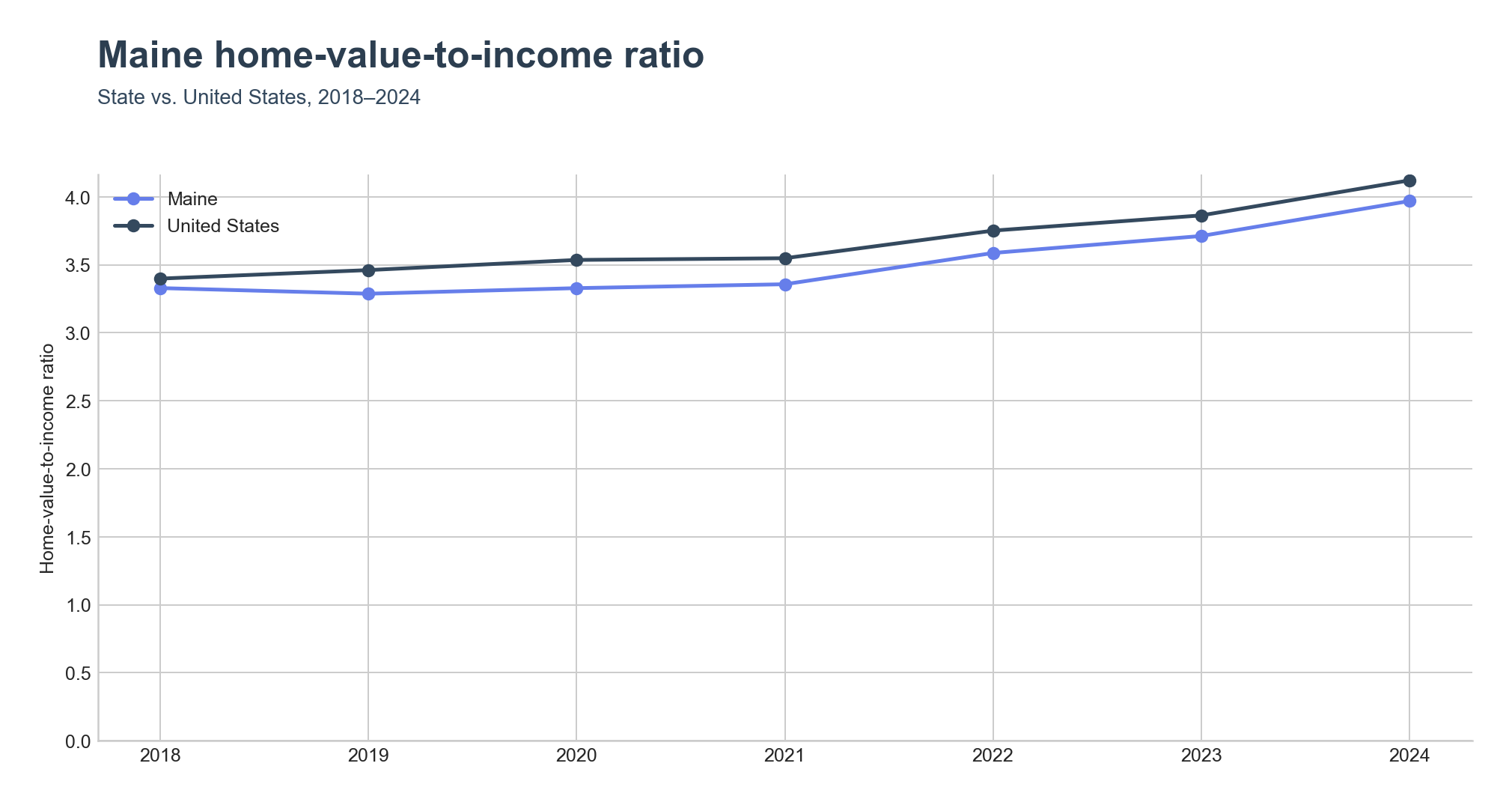
Home values pulled away from incomes after 2020.
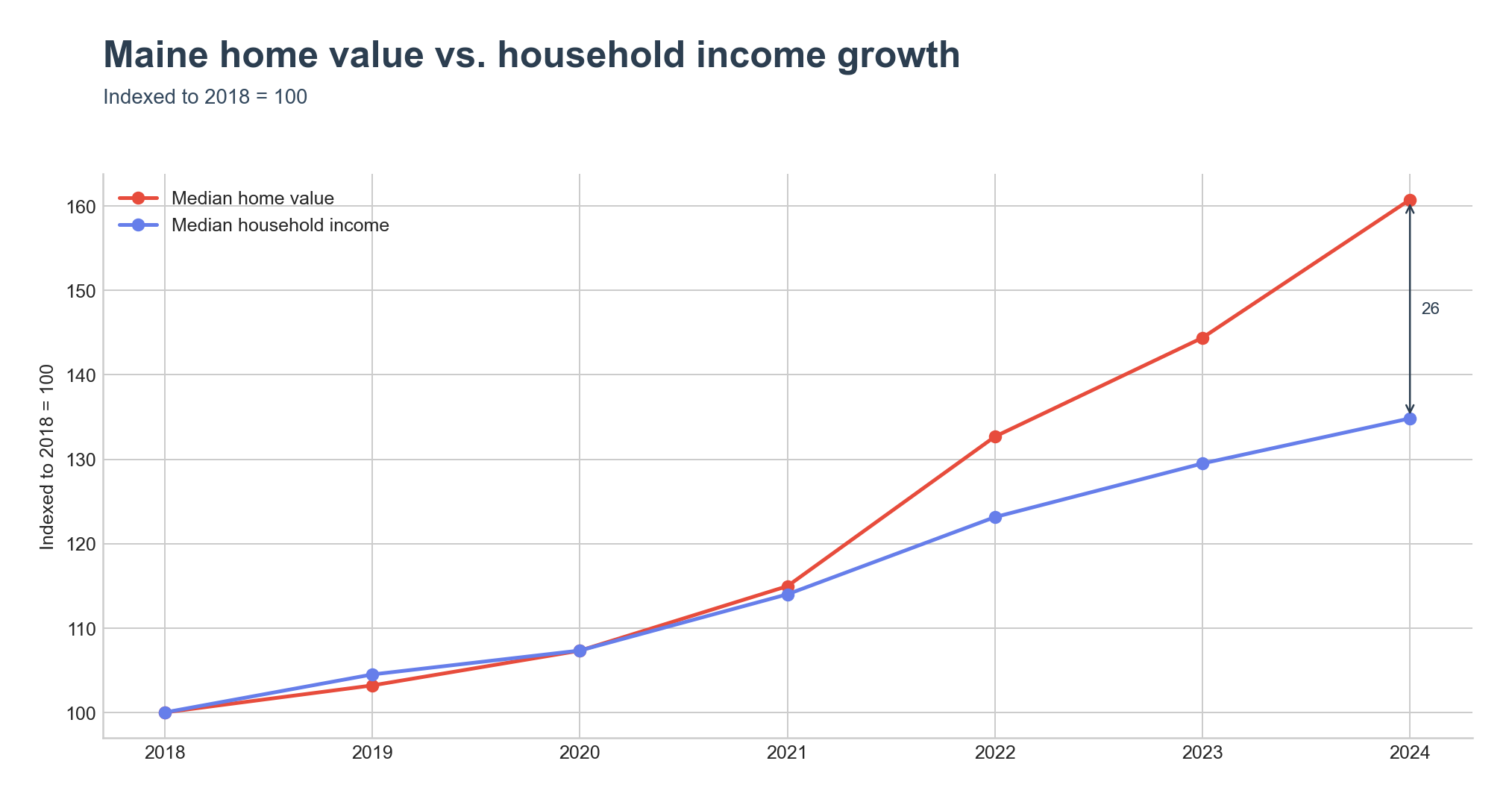
Indexed to 2018 = 100, Maine's median home value reached 161 by 2024 while median household income reached 135 — a 26-point gap. The typical Maine home went from $184,500 to $296,600 (a +61% move) while median household income rose from $55,425 to $74,733 (a +35% move). The two series tracked each other through 2020 and split in 2021.
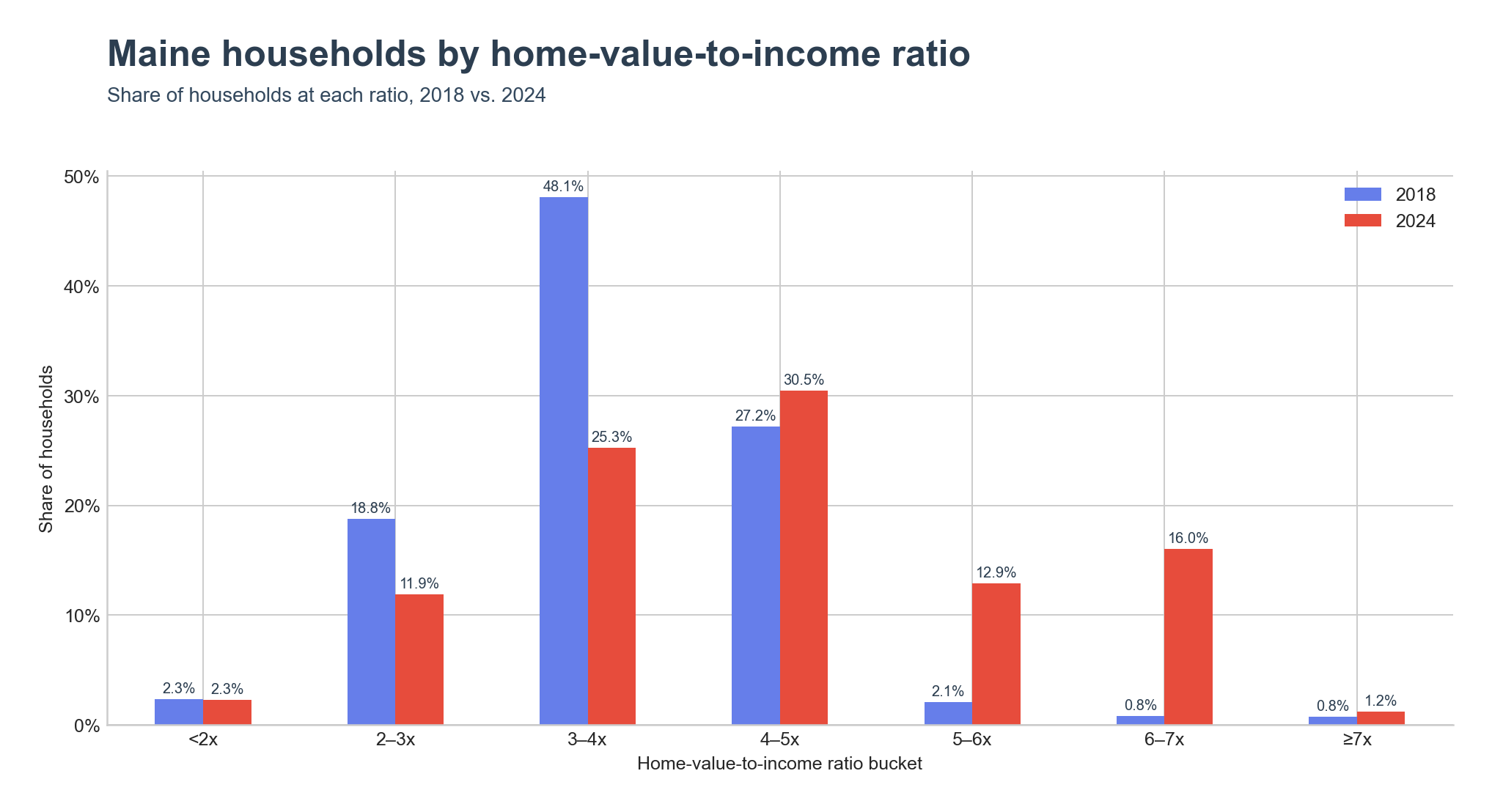
The Maine middle moved up a full ratio step, and a new top tier appeared.
In 2018, 48.1% of Maine households lived in places with a ratio between 3x and 4x — the modal Maine range — and the 2–3x band held another 18.8%. By 2024 the 3–4x share fell to 25.3%, the 2–3x share fell to 11.9%, and the 4–5x band rose from 27.2% to 30.5% to become the new mode. The most striking move is at the top: the 6–7x band, which held 0.8% of Maine households in 2018, holds 16.0% in 2024, and the 5–6x band grew from 2.1% to 12.9%.
High ratios hug the southern coast; low ratios sit in the rural north and Down East.
The county map sorts Maine cleanly. Cumberland County — the Portland area — tops the state at 4.72x, followed by York County at 4.48x along the southern coast. The next three are midcoast: Knox at 4.38x, Lincoln at 4.33x, and Hancock at 4.27x. All five sit on the coast.
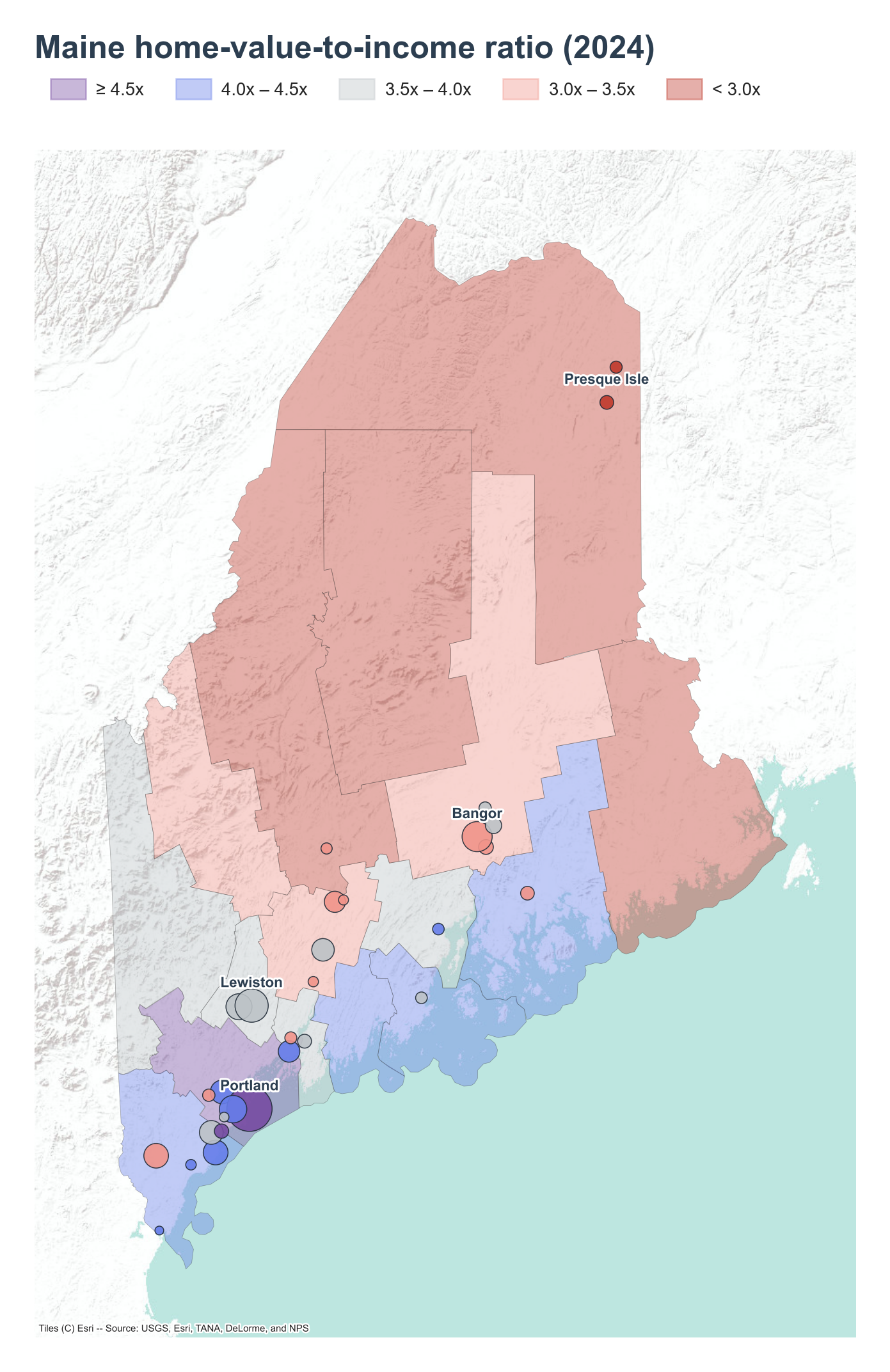
The bottom of the county distribution is everything inland and Down East. Aroostook County — Maine's northernmost county, which has lost population every decade since 1960 and absorbed the 1994 closure of Loring Air Force Base — sits at 2.64x. Piscataquis is at 2.77x, Somerset at 2.87x, and Washington County at 2.89x, with Penobscot (Bangor) at 3.23x as the lowest of the populated central-Maine counties.
Places: the southern coastal strip on top, older interior service centers on the bottom.
Every place in Maine's top five sits along the southern coast. Portland leads at 6.16x — the state's largest city, with a median home value of $489,600 against median household income of $79,540. Old Orchard Beach , a seaside resort town immediately south of Portland, is essentially tied at 6.10x on much lower $60,050 income — the resort economy detaches local wages from local prices. Biddeford at 5.48x is a former mill city whose downtown has been redeveloped over the past decade. Kittery at 5.45x sits directly across the river from the Portsmouth Naval Shipyard on the New Hampshire border. Brunswick at 5.14x is home to Bowdoin College .
The bottom-five places are interior service centers. Caribou sits lowest at 2.50x (home $134,100, income $53,709), with Presque Isle right behind at 2.64x — both inside Aroostook. Gardiner at 3.09x and Ellsworth at 3.13x round out the floor, with Waterville at 3.45x despite being home to Colby College .
Key Takeaways
- Maine's home-value-to-income ratio reached 3.97x in 2024, just 0.15x below the U.S. 4.12x.
- The state rose +0.64x since 2018, close to the national +0.72x.
- Home values grew 61% while household incomes grew 35%, opening a 26-index-point gap.
- The 6–7x band went from 0.8% of Maine households in 2018 to 16.0% in 2024.
- High ratios hug the southern coast from Kittery through Brunswick and on into midcoast; low ratios sit in Aroostook and the rural interior service centers.
- If you take away one thing: Maine's affordability problem is a southern-coastal problem layered onto a state that, on average, still prices below the nation.