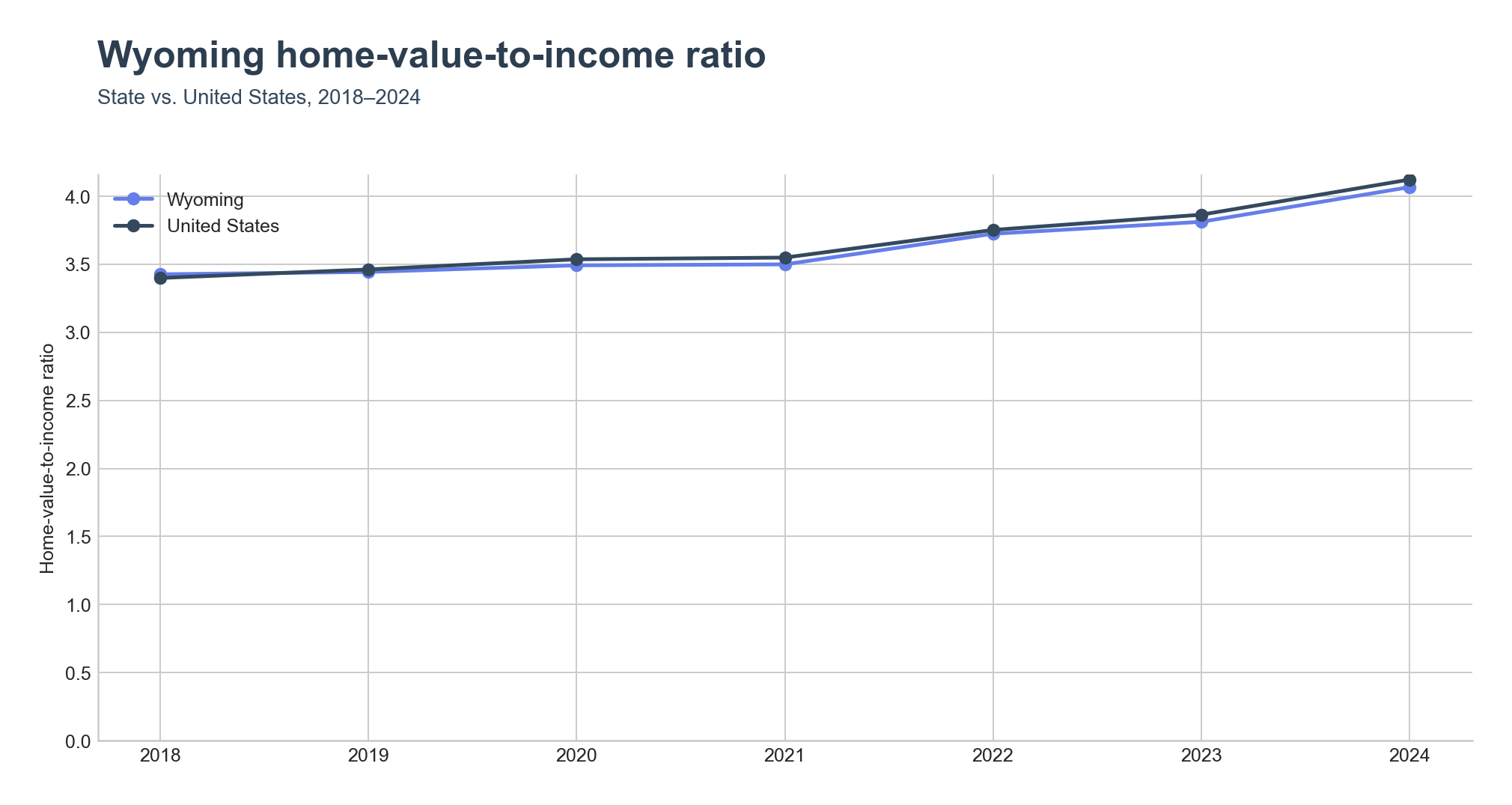
Wyoming started above the national line and ended just below it.
Wyoming's statewide home-value-to-income ratio reached 4.07x in 2024, up from 3.43x in 2018. The United States moved from 3.40x to 4.12x over the same window. Wyoming began the period 0.03x above the national ratio and ends it 0.05x below — the two curves crossed as the US climbed +0.72x against Wyoming's +0.64x.
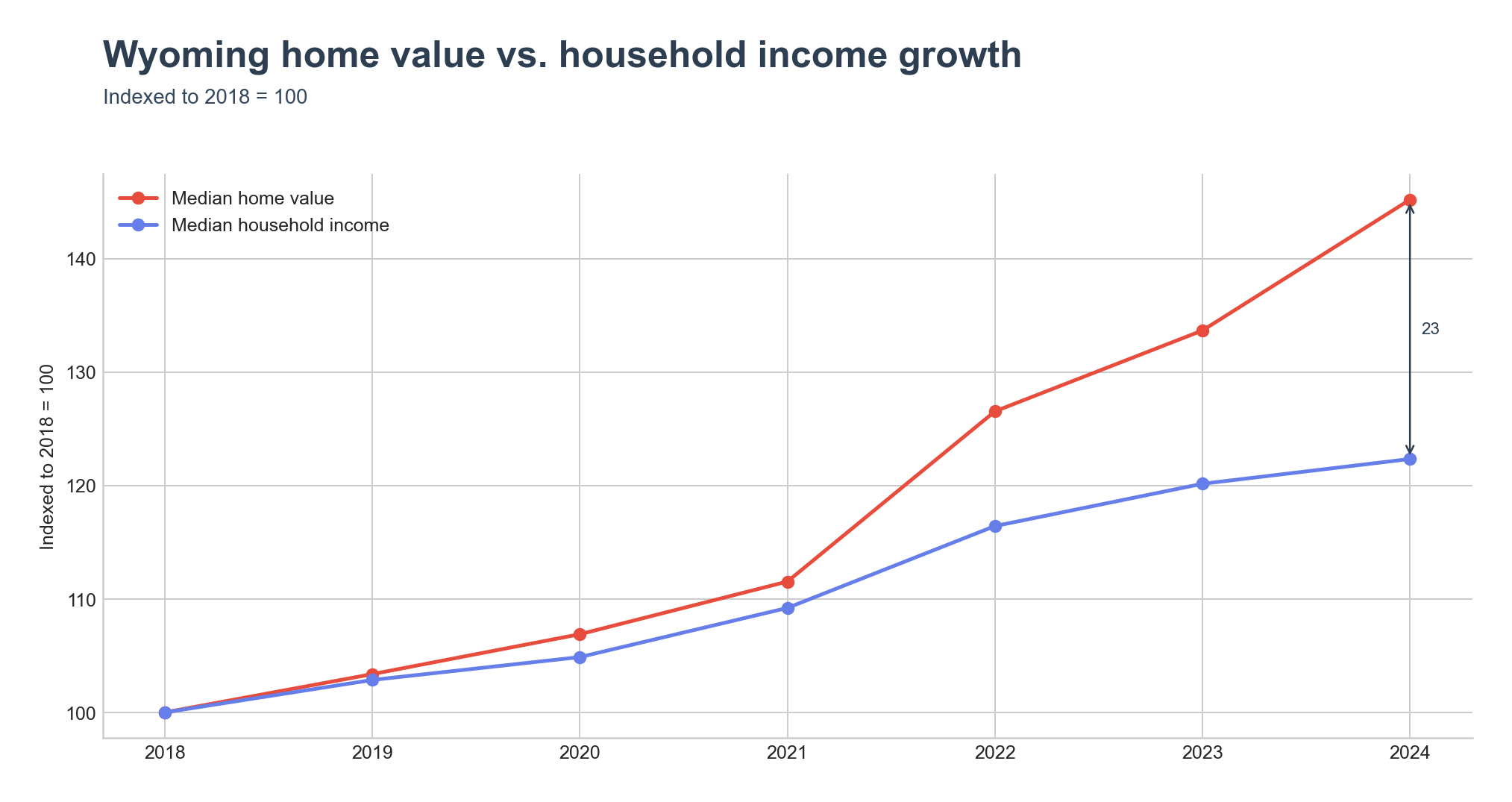
Home values pulled away from incomes after 2020.
Indexed to 2018 = 100, Wyoming's median home value reached 145 by 2024 while median household income reached 122 — a 23-point gap. The typical Wyoming home went from $213,300 to $309,700 (a +45% move) while median household income rose from $62,268 to $76,176 (a +22% move). The two series tracked each other through 2020 and split in 2021.
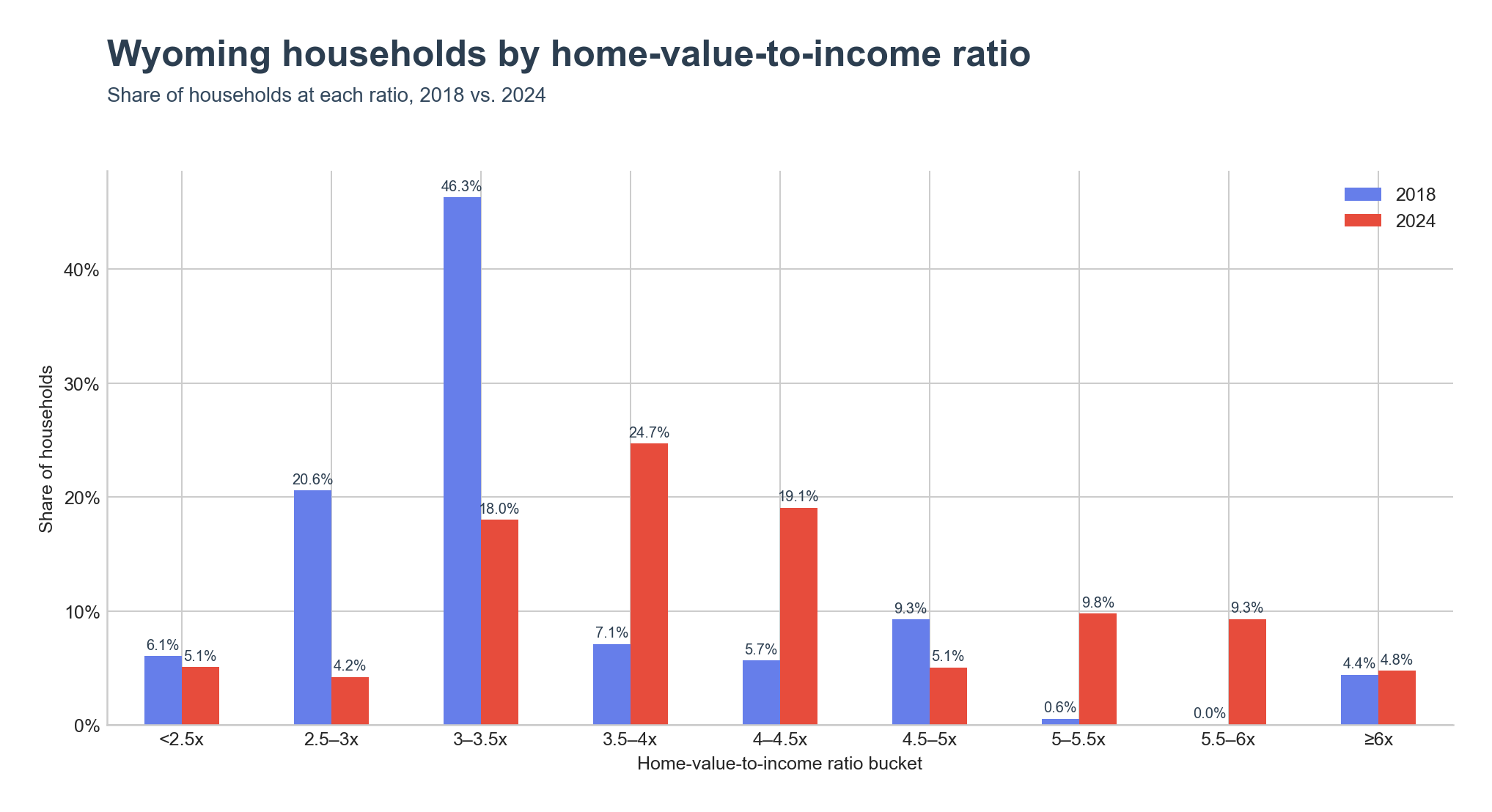
The Wyoming middle shifted up a full ratio step.
In 2018, 46.3% of Wyoming households lived in places with a ratio between 3x and 3.5x — the dominant Wyoming range — and the 2.5–3x band held another 20.6%. By 2024 the 3–3.5x share fell to 18.0% and the 2.5–3x share fell to 4.2%, while the 3.5–4x band rose to 24.7% to become the new mode and the 4–4.5x band rose from 5.7% to 19.1%. The 5–5.5x band grew from 0.6% to 9.8% and the 5.5–6x band from 0.0% to 9.3%, while the ≥6x band held roughly flat at 4.8%.
High ratios concentrate in the northwest and along a northern tier; low ratios sit in the energy-producing east and southwest.
The county map is dominated by one outlier. Teton County — the Jackson Hole area in the far northwest, holding Grand Teton National Park and part of Yellowstone — tops the state at 13.16x, on a median home value of $1,633,900 against median household income of $124,172. Teton has the highest per-capita income of any county in the United States, but home prices have far outrun even those incomes. To its east, Park County (Cody) sits at 5.48x. A northern tier follows: Sheridan County at 5.53x and Johnson County at 5.04x, with Albany County — home to the University of Wyoming in Laramie — at 5.38x in the south.
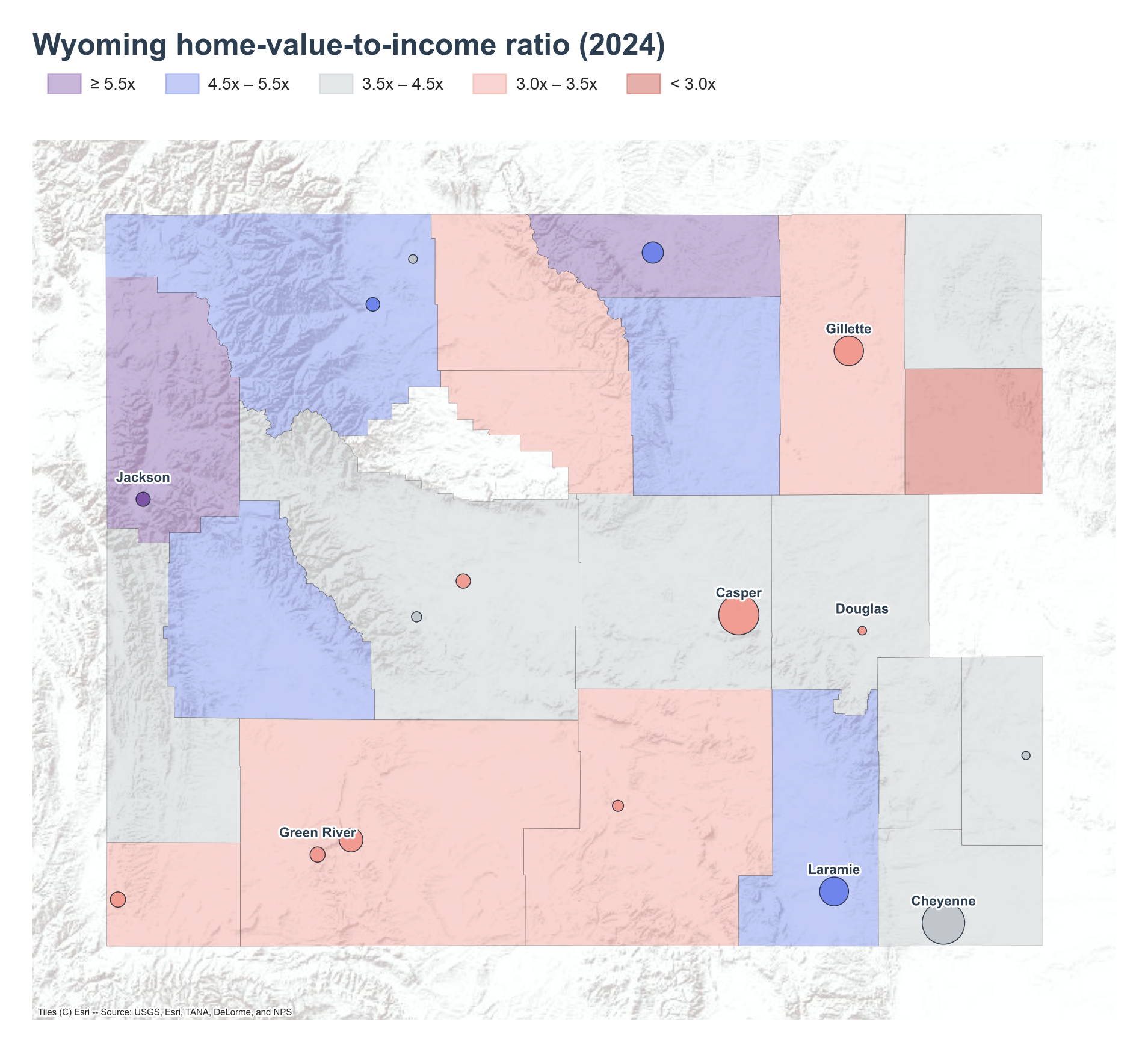
The bottom of the county distribution is the energy economy. Weston County in the northeast corner sits lowest at 2.48x, followed by Campbell County (Gillette), the coal-mining center, at 3.11x on a high median income of $89,869. Washakie sits at 3.13x, Carbon (Rawlins) at 3.16x, and Sweetwater County — the trona and energy belt around Green River — at 3.35x.
Places: Jackson stands alone on top; energy towns hold the floor.
Jackson leads every place in the state at 12.79x, with a median home value of $1,521,900 against median household income of $118,991 — the resort and second-home market in Jackson Hole detaches local prices from local wages. The next tier is far below: Laramie at 5.75x, the college town anchored by the University of Wyoming, then Sheridan at 5.42x and Cody at 5.22x, the east-gateway tourism town for Yellowstone. Powell rounds out the top five at 4.56x.
The bottom-five places are the energy and rail centers. Green River sits lowest at 3.11x (home $263,400, income $84,747), where trona mining sustains high local wages. Douglas follows at 3.22x, Gillette at 3.25x on income of $81,316, Rawlins at 3.35x, and Evanston at 3.67x.
Key Takeaways
- Wyoming's home-value-to-income ratio reached 4.07x in 2024, just 0.05x below the US 4.12x.
- The state rose +0.64x since 2018, a touch under the national +0.72x, and crossed from above to below the US line.
- Home values grew 45% while household incomes grew 22%, opening a 23-index-point gap.
- The 3.5–4x band became the new modal range at 24.7%, displacing the 3–3.5x band that held 46.3% of households in 2018.
- Teton County reaches 13.16x and Jackson 12.79x, both far above any other place in the state.
- High ratios concentrate in the northwest and a northern tier; the energy-producing east and southwest stay near 3x on strong mining wages.